

Introduction Risk Behaviour and Addiction in Adolescence
Defining Risk behaviour: Behaviours that pose a risk to a healthy and physical, cognitive,
psychosocial development of adolescents
The general developmental process of addiction
Contact with a substance –> Experimenting with a substance –> Integrated use -->
Excessive use –> Addicted use
For the definition of risk behaviour it can differ which depends on:
1. Characteristic of particular substance or behaviour: Smoking vs gaming
2. Cultural and Societal norms: alcohol use in wester countries vs islamic countries
3. Advances in scientific knowledge: knowledge on the risk of alcohol use for the
development of the adolescent brain
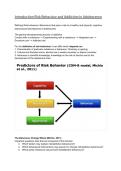
The Behaviour Change Wheel (Michie, 2011)
Important questions here that are answered of the lectures:
● Which factors may explain risk/addictive behaviours?)
● Which behavioural interventions may prevent or change risk/addictive behaviours?
● Which policy measures may prevent risk/addictive behaviours?
,Defining Adolescence (+10 - 24 years)
● Early adolescence | 10 - 14 years | physical growth, sexual maturation, psychosocial
development, social identity formation
● Mid adolescence | 15 - 17 years | experimenting with (risk) behaviours, personal
identity formation
● Late adolescence | 18 - 24 years| Practicing adult roles
Important neurological development in adolescence
1. Strong grow in brain volume -
● Decrease in grey matter (nerve cells)
● increase in white matter (connections)
● Pruning (if you don't use it you lose it)
2. High plasticity and flexibility of the brain
3. Increase in white matter: communication between brain regions strongly improves
● Long term memory increases
● Capacity for abstract (critical) thinking and metacognition increases
Peak in Risk Behaviour during adolescence follow an inverted U-shaped curve
Adolescents are known to engage in more frequent and greater risks—including substance
experimentation, criminal behavior, and dangerous driving—compared to other age groups.
This general pattern of risk-taking follows an inverted U-shape trajectory over development,
peaking during adolescence and young adulthood
The speed of the development of two brain regions differ (ARTIKEL GLADWIN)
● The affective-motivational system (emotional brain) develops fast (Bottom-up) | the
VTA produces dopamine and sends it to the nucleus accumbens, thereby creating
feelings of rewards
, ○ Overly active during early and mid adolescence
○ Adolescents experience stronger positive emotions than adults when they
receive or anticipate a rewards
■ Enhanced by testosterone
● The control system (rational brain) develops slowly (Top-Down)| the prefrontal cortex
○ Develops until about 25 years
○ Plays an important role in the development of executive functions
■ Risk estimation
■ Monitoring long-term goals
■ Inhibition of the tendency to respond to (short-term) possibilities for
reward (impulse control, behavioral inhibition, self control)
The difference in maturation rates results in a potential imbalance, where strong
motivational processes compete with relatively weak prefrontal control. This makes it difficult
for adolescents to inhibit immediate, reward-seeking responses, especially when
motivational processes are strongly triggered
Gladwin thinks that:
Repeated substance use leads to two types of neuro-adaptations:
1. Neural Sensitization: This results in strong impulsive reactions, such as attentional and
approach biases, toward drug cues. In later addiction stages, cues can automatically trigger
habitual approach responses that are outside voluntary control. Animal research suggests
this sensitization may occur more rapidly during adolescence
2. Impaired Control Functions: Heavy alcohol and drug use, particularly during
adolescence, is associated with impaired control functions. Studies show abnormalities in
white matter structure and impaired executive functions in adolescent binge drinkers and
heavy marijuana users. Longitudinal studies indicate a bidirectional relationship between
impulsive behaviors and binge drinking.
The Maturational Imbalance Model (casey et all, 2011)
, Increased risk-taking during adolescence is a result of an imbalance between rewards
sensitivity (the affective motivational system) and the impulsive control (control
system)
Defining drugs or psychoactive substances
● Psychoactive substances:
○ Are chemical substances that cross the blood-brain barrier and affect the
function of the central nervous system thereby changing mood, perceptions or
consciousness
○ Other characteristics of psychoactive substances
■ Induce craving after (regular) use
■ Evoke loss of control after they have been used (regularly)
○ They differ in strength of the psychoactive effect
○ They differ in the craving and loss of control
Types of drugs (based on their psychoactive effects)
1. Hallucinogens - LSD/Magic Mushrooms
2. Downers (depressants) - Alcohol/Heroin/GHB
3. Uppers (stimulants) - Cocaine/Speed/Nicotine
Defining Addiction
Sussman 2017 differentiates between intentional and extensional definitions of addiction
(Sussman 2017)
Intensional definition of addiction: these definitions aim to describe a casual addiction
process (see Sussmann, table 1.2)
● Pertains to a casual or process model type statements of addictions
● Five intensional models of addiction include those of (these are somewhat
overlapping)
○ Physiological and psychological dependence
■ Prolonged engagement in addictive behaviour that results in its
continued performance being necessary for physiologic and
psychological equilibrium - The engagement in the addictive behaviour
keeps going because otherwise the user will be out of balance
■ Its necessary for body and mind
■ Its not about enjoyment anymore, its about functioning
■ It became a pattern
○ Impulsive-obsessive/compulsive behaviour
■ Engaging in addictive behaviour due to a "building up of tension"
which is released, resulting in pleasure or reduction of anxiety, relief,
and perhaps later leading to self-reproach
■ Tension is building up because of the not using, which is then
released by using again. After this there is a self-reproach
(regret) about what the negative consequences are which are
causing tension again which makes the process start again.
○ Self-medication
■ Relief from disordered emotions and send of self-preservation through
engaging in addictive behaviour
Defining Risk behaviour: Behaviours that pose a risk to a healthy and physical, cognitive,
psychosocial development of adolescents
The general developmental process of addiction
Contact with a substance –> Experimenting with a substance –> Integrated use -->
Excessive use –> Addicted use
For the definition of risk behaviour it can differ which depends on:
1. Characteristic of particular substance or behaviour: Smoking vs gaming
2. Cultural and Societal norms: alcohol use in wester countries vs islamic countries
3. Advances in scientific knowledge: knowledge on the risk of alcohol use for the
development of the adolescent brain
The Behaviour Change Wheel (Michie, 2011)
Important questions here that are answered of the lectures:
● Which factors may explain risk/addictive behaviours?)
● Which behavioural interventions may prevent or change risk/addictive behaviours?
● Which policy measures may prevent risk/addictive behaviours?
,Defining Adolescence (+10 - 24 years)
● Early adolescence | 10 - 14 years | physical growth, sexual maturation, psychosocial
development, social identity formation
● Mid adolescence | 15 - 17 years | experimenting with (risk) behaviours, personal
identity formation
● Late adolescence | 18 - 24 years| Practicing adult roles
Important neurological development in adolescence
1. Strong grow in brain volume -
● Decrease in grey matter (nerve cells)
● increase in white matter (connections)
● Pruning (if you don't use it you lose it)
2. High plasticity and flexibility of the brain
3. Increase in white matter: communication between brain regions strongly improves
● Long term memory increases
● Capacity for abstract (critical) thinking and metacognition increases
Peak in Risk Behaviour during adolescence follow an inverted U-shaped curve
Adolescents are known to engage in more frequent and greater risks—including substance
experimentation, criminal behavior, and dangerous driving—compared to other age groups.
This general pattern of risk-taking follows an inverted U-shape trajectory over development,
peaking during adolescence and young adulthood
The speed of the development of two brain regions differ (ARTIKEL GLADWIN)
● The affective-motivational system (emotional brain) develops fast (Bottom-up) | the
VTA produces dopamine and sends it to the nucleus accumbens, thereby creating
feelings of rewards
, ○ Overly active during early and mid adolescence
○ Adolescents experience stronger positive emotions than adults when they
receive or anticipate a rewards
■ Enhanced by testosterone
● The control system (rational brain) develops slowly (Top-Down)| the prefrontal cortex
○ Develops until about 25 years
○ Plays an important role in the development of executive functions
■ Risk estimation
■ Monitoring long-term goals
■ Inhibition of the tendency to respond to (short-term) possibilities for
reward (impulse control, behavioral inhibition, self control)
The difference in maturation rates results in a potential imbalance, where strong
motivational processes compete with relatively weak prefrontal control. This makes it difficult
for adolescents to inhibit immediate, reward-seeking responses, especially when
motivational processes are strongly triggered
Gladwin thinks that:
Repeated substance use leads to two types of neuro-adaptations:
1. Neural Sensitization: This results in strong impulsive reactions, such as attentional and
approach biases, toward drug cues. In later addiction stages, cues can automatically trigger
habitual approach responses that are outside voluntary control. Animal research suggests
this sensitization may occur more rapidly during adolescence
2. Impaired Control Functions: Heavy alcohol and drug use, particularly during
adolescence, is associated with impaired control functions. Studies show abnormalities in
white matter structure and impaired executive functions in adolescent binge drinkers and
heavy marijuana users. Longitudinal studies indicate a bidirectional relationship between
impulsive behaviors and binge drinking.
The Maturational Imbalance Model (casey et all, 2011)
, Increased risk-taking during adolescence is a result of an imbalance between rewards
sensitivity (the affective motivational system) and the impulsive control (control
system)
Defining drugs or psychoactive substances
● Psychoactive substances:
○ Are chemical substances that cross the blood-brain barrier and affect the
function of the central nervous system thereby changing mood, perceptions or
consciousness
○ Other characteristics of psychoactive substances
■ Induce craving after (regular) use
■ Evoke loss of control after they have been used (regularly)
○ They differ in strength of the psychoactive effect
○ They differ in the craving and loss of control
Types of drugs (based on their psychoactive effects)
1. Hallucinogens - LSD/Magic Mushrooms
2. Downers (depressants) - Alcohol/Heroin/GHB
3. Uppers (stimulants) - Cocaine/Speed/Nicotine
Defining Addiction
Sussman 2017 differentiates between intentional and extensional definitions of addiction
(Sussman 2017)
Intensional definition of addiction: these definitions aim to describe a casual addiction
process (see Sussmann, table 1.2)
● Pertains to a casual or process model type statements of addictions
● Five intensional models of addiction include those of (these are somewhat
overlapping)
○ Physiological and psychological dependence
■ Prolonged engagement in addictive behaviour that results in its
continued performance being necessary for physiologic and
psychological equilibrium - The engagement in the addictive behaviour
keeps going because otherwise the user will be out of balance
■ Its necessary for body and mind
■ Its not about enjoyment anymore, its about functioning
■ It became a pattern
○ Impulsive-obsessive/compulsive behaviour
■ Engaging in addictive behaviour due to a "building up of tension"
which is released, resulting in pleasure or reduction of anxiety, relief,
and perhaps later leading to self-reproach
■ Tension is building up because of the not using, which is then
released by using again. After this there is a self-reproach
(regret) about what the negative consequences are which are
causing tension again which makes the process start again.
○ Self-medication
■ Relief from disordered emotions and send of self-preservation through
engaging in addictive behaviour


