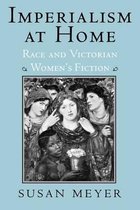
Susan Meyer, Imperialism at Home: Race and Victorian Women’s Fiction (Cornell University
Press, 1996)
Race relations used as a metaphor to explore relationships between men and women
in England.
Race as a Metaphor:
Linking of white women with people of non-white races.
A woman’s moral degeneracy was // racial degeneracy.
Domestic space of England // imperial spaces.
For Bronte- metaphor is used to illustrate ‘not shared inferiority but a shared
experience of frustration, limitation, and subordination’ (p.7.).
Meyer takes issue with Perera, Azim, Said- their claims are too broad.
o They have ‘obscured the fact that the social positioning of various writers of
the domestic novel in nineteenth-century Britain put them in different relations
to the project of empire’ (p.9.)
P.11- ‘since the gender positioning of British women writers required them to
negotiate an association with “inferior races”, their feminist impulses to question
gender hierarchies often provoked an interrogation of race hierarchies’.
White women ‘occupied an ambiguous position on the racial scales of nineteenth-
century science’ (p.19.)
The novel draws the comparisons itself- e.g. Jane describing herself as a “rebel
slave” or a “revolted slave”
‘a suppressed consciousness of the recent history of British slaveholding lies behind
the novel’s more tactful references to the Romans as slaveholders’ (p.21.)
Sometimes characters are paired i.e. ‘one the white female protagonist and the other
a male or female character associated with one or more nonwhite races’ (p.21.)
When they are using the metaphor, they are emptying the vehicle of its meaning. By
drawing a comparison, we are just looking at the similarities between e.g. the white
m/c woman and the black slave woman, without taking into account the other
qualities that both possess. Just remain on the margins of our consciousness.
Novels looked at- ‘engage with or repress the history of British imperialism to various
degrees, but once the door has been opened through metaphor, that history finds its
way into these fictions’ (p.23.)
o E.g. in JE- housekeeper talks of Rochesters- youngest was a slaveholder in
Jamaica- have been a violent race.
In Bronte’s writing- ‘race is both a major preoccupation and a central metaphor’
(p.25.)
Earlier writings- celebrate imperial conquests with little ambivalence BUT Bronte’s
later stories- ‘grow more and more preoccupied with rebellion both against the racial
hierarchies of empire and against the constraints of female social roles’ (p.25.)
JE- ‘echoes the language of accounts of slave uprisings’ (p.25.).
Ch2- “Indian Ink”- Colonialism and the Figurative Strategy of Jane Eyre.
Heroines of Shirley and Villette- ‘both compared to people of nonwhite races
experiencing the force of European imperialism’ (p.60.)
Louis Moore and M. Paul- both threaten to leave for colonies. ALSO ‘the man’s
dominating relationship with a colonial people is represented as a substitute for his
relationship with the rebellious heroine’ (p.60.)
The Professor- letter’s recipient has left for the colonies. Crimsworth compares
Belgian school girls to West Indians/ slaves. Presented as savage etc. Also- Frances
Henri- ‘shows a potential rebelliousness against male domination that the novel
figures using the imagery of race’ (p.61.) Look at page 255 TP.
The ‘figurative use of race relations in Bronte’s major fiction reveals a conflict
between sympathy for the oppressed and a hostile sense of racial supremacy’ (p.63.)
Jane Eyre:
Jane compared to a slave at Gateshead and Lowood- look up.
Metaphor of slavery- takes central status- imports character from the colonies.
Press, 1996)
Race relations used as a metaphor to explore relationships between men and women
in England.
Race as a Metaphor:
Linking of white women with people of non-white races.
A woman’s moral degeneracy was // racial degeneracy.
Domestic space of England // imperial spaces.
For Bronte- metaphor is used to illustrate ‘not shared inferiority but a shared
experience of frustration, limitation, and subordination’ (p.7.).
Meyer takes issue with Perera, Azim, Said- their claims are too broad.
o They have ‘obscured the fact that the social positioning of various writers of
the domestic novel in nineteenth-century Britain put them in different relations
to the project of empire’ (p.9.)
P.11- ‘since the gender positioning of British women writers required them to
negotiate an association with “inferior races”, their feminist impulses to question
gender hierarchies often provoked an interrogation of race hierarchies’.
White women ‘occupied an ambiguous position on the racial scales of nineteenth-
century science’ (p.19.)
The novel draws the comparisons itself- e.g. Jane describing herself as a “rebel
slave” or a “revolted slave”
‘a suppressed consciousness of the recent history of British slaveholding lies behind
the novel’s more tactful references to the Romans as slaveholders’ (p.21.)
Sometimes characters are paired i.e. ‘one the white female protagonist and the other
a male or female character associated with one or more nonwhite races’ (p.21.)
When they are using the metaphor, they are emptying the vehicle of its meaning. By
drawing a comparison, we are just looking at the similarities between e.g. the white
m/c woman and the black slave woman, without taking into account the other
qualities that both possess. Just remain on the margins of our consciousness.
Novels looked at- ‘engage with or repress the history of British imperialism to various
degrees, but once the door has been opened through metaphor, that history finds its
way into these fictions’ (p.23.)
o E.g. in JE- housekeeper talks of Rochesters- youngest was a slaveholder in
Jamaica- have been a violent race.
In Bronte’s writing- ‘race is both a major preoccupation and a central metaphor’
(p.25.)
Earlier writings- celebrate imperial conquests with little ambivalence BUT Bronte’s
later stories- ‘grow more and more preoccupied with rebellion both against the racial
hierarchies of empire and against the constraints of female social roles’ (p.25.)
JE- ‘echoes the language of accounts of slave uprisings’ (p.25.).
Ch2- “Indian Ink”- Colonialism and the Figurative Strategy of Jane Eyre.
Heroines of Shirley and Villette- ‘both compared to people of nonwhite races
experiencing the force of European imperialism’ (p.60.)
Louis Moore and M. Paul- both threaten to leave for colonies. ALSO ‘the man’s
dominating relationship with a colonial people is represented as a substitute for his
relationship with the rebellious heroine’ (p.60.)
The Professor- letter’s recipient has left for the colonies. Crimsworth compares
Belgian school girls to West Indians/ slaves. Presented as savage etc. Also- Frances
Henri- ‘shows a potential rebelliousness against male domination that the novel
figures using the imagery of race’ (p.61.) Look at page 255 TP.
The ‘figurative use of race relations in Bronte’s major fiction reveals a conflict
between sympathy for the oppressed and a hostile sense of racial supremacy’ (p.63.)
Jane Eyre:
Jane compared to a slave at Gateshead and Lowood- look up.
Metaphor of slavery- takes central status- imports character from the colonies.