ATI TEAS 6 - Science (Human Anatomy and Physiology)
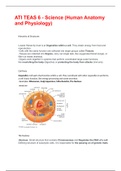
ATI TEAS 6 - Science (Human Anatomy and Physiology) Hierarchy of Structures Lowest Hierarchy level is at . They obtain energy from food and reproduction. -Cells with the same function are collected into larger groups called -Tissues are collected into s, carry out single task, like oxygenated blood (lungs), or filter out waste (kidneys). -Organs work together in systems that perform coordinated large-scale functions, like or ( Cell Parts : Cell parts that function within a cell. They coordinate with other organelles to performs a cell's basic function, like energy processing and waste excretion. ~Examples: . The Nucleus : Small structure that and Regulates the DNA of a cell. Defining structure of eukaryotic cells. It is responsible for the passing on of genetic traits between generations. -Contains: nuclear envelope, nucleoplasm, a nucleolus, nuclear pores, chromatin, and ribosomes. Highly condensed, threadlike rods of DNA. DNA is genetic material that stores information about the plant or animal. Consists of the DNA and Proteins that make up chromosomes. Structure contained within the nucleus, consists of proteins. Small, Round, and does not have a membrane. Involved in protein synthesis, and synthesizes and stores RNA. Nuclear Envelope Encloses the nucleus. Consists of inner and outer membranes made of lipids. Nuclear Pores Involved in exchange of material between nucleus and the cytoplasm. Liquid within the membrane and is similar to cytoplasm. "Plasma Membrane" -Made of Lipids and Proteins -Isolates the cell from its external environment while still enabling the cellar to communicate with the outside environment. -Consists: Phospholipid bilayer with the hydrophilic ends of the outer layer facing external environment. ~Cholesterol: Adds stiffness and flexibility ~Glycolipids: Help cell to recognize other cells of the organisms. ~Proteins: Help give cells shape ~Special Proteins: Helps cell communicate with external environment. ~Other Proteins: Transport molecules across membrane Selective Permeability With regard to size, charge, and solubility. -Size: Membrane allows small molecules to diffuse through it. Oxygen and Water molecules are small and can pass through the cells membrane. -Charge: Ions on a cells surface either attracts or repels ions. Ions with like charges are repelled, and ions with opposite charges are attracted to the surface. -Solubility: Molecules that are soluble in phospholipids can usually pass through the membrane. Many are not able to diffuse the membrane, and if anything they'll have to be moved through by active transport and vesicles .......................................CONTINUED.............................................
Written for
- Institution
-
South University
- Course
-
DBST 651 (DBST651)
Document information
- Uploaded on
- March 7, 2021
- Number of pages
- 74
- Written in
- 2020/2021
- Type
- Exam (elaborations)
- Contains
- Questions & answers
Subjects
-
organs work together in systems that perform coordinated large scale functions
-
like nourishing the body digestive or protecting the body from attacks immune
-
tissues are collected into organs
-
c

Also available in package deal