Growth factors and cellular responses
Plan of the lectures
13. Growth factor and cellular responses
14. Growth factor receptor signalling
15. Growth factor receptor endocytic trafficking
16. Interplay between growth factor receptor trafficking and signalling
- not found in text books
- new and emerging idea that signalling of GF receptors and trafficking inside the cell are linked
17. Actin, microtubules, cell-cell junctions and cell polarisation
18. Extracellular matrix and integrin’s
19. Integrin trafficking
20 cell migration and invasion
Learning objectives:
1. What is a growth factor?
2. Modes of communication?
3. Cell responses to growth factors
4. Growth factor receptors types
5. Receptor tyrosine kinase (RTK)
6. TGF beta receptor
Maintenance of tissue architecture small intestine
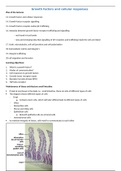
If look at any tissue in the body i.e. small intestine, there are lots of different types of cells
The diagram shows different types of cells
- Crypt
Contains stem cells, which will later differentiate to different types of cells
- Villus
- Absorptive cells
- Mucus secreting cells
- Epithelium cells
Beneath epithelia cells are stromal cells
- mesenchymal cells
to maintain integrity of tissue, cells need to communicate to each other
, LO1. WHAT IS A GROWTH FACTOR?
Growth factors
Extracellular protein that promotes growth, proliferation, differentiation or survival of cells
Typically act locally, unlike hormones
Present in low concentration in nanomolar to picomolar range
Cause changes in target cell biology via binding to specific receptors (GFR), which often lead to changes in gene
expression over a period of hours or may lead to rapid alterations in cell cytoskeleton.
LO2. MODES OF COMMUNICATION
1. Endocrine mode
Hormones and not growth factors
Travel in the bloodstream
2. Paracrine mode - most common for GF in normal cell
Used by GF
3. Neural mode
Synaptic signalling
4. Contact-dependent mode
Also called cell-cell contact or Juxtacrine
5. Autocrine signalling -most common for GF in cancer
A cell that secretes the ligand that binds to the receptor on the same cell surface, leading to changes in the cell.
Plan of the lectures
13. Growth factor and cellular responses
14. Growth factor receptor signalling
15. Growth factor receptor endocytic trafficking
16. Interplay between growth factor receptor trafficking and signalling
- not found in text books
- new and emerging idea that signalling of GF receptors and trafficking inside the cell are linked
17. Actin, microtubules, cell-cell junctions and cell polarisation
18. Extracellular matrix and integrin’s
19. Integrin trafficking
20 cell migration and invasion
Learning objectives:
1. What is a growth factor?
2. Modes of communication?
3. Cell responses to growth factors
4. Growth factor receptors types
5. Receptor tyrosine kinase (RTK)
6. TGF beta receptor
Maintenance of tissue architecture small intestine
If look at any tissue in the body i.e. small intestine, there are lots of different types of cells
The diagram shows different types of cells
- Crypt
Contains stem cells, which will later differentiate to different types of cells
- Villus
- Absorptive cells
- Mucus secreting cells
- Epithelium cells
Beneath epithelia cells are stromal cells
- mesenchymal cells
to maintain integrity of tissue, cells need to communicate to each other
, LO1. WHAT IS A GROWTH FACTOR?
Growth factors
Extracellular protein that promotes growth, proliferation, differentiation or survival of cells
Typically act locally, unlike hormones
Present in low concentration in nanomolar to picomolar range
Cause changes in target cell biology via binding to specific receptors (GFR), which often lead to changes in gene
expression over a period of hours or may lead to rapid alterations in cell cytoskeleton.
LO2. MODES OF COMMUNICATION
1. Endocrine mode
Hormones and not growth factors
Travel in the bloodstream
2. Paracrine mode - most common for GF in normal cell
Used by GF
3. Neural mode
Synaptic signalling
4. Contact-dependent mode
Also called cell-cell contact or Juxtacrine
5. Autocrine signalling -most common for GF in cancer
A cell that secretes the ligand that binds to the receptor on the same cell surface, leading to changes in the cell.