Growth factor receptor endocytic trafficking
Learning objectives:
At the level of receptor tyrosine kinase. All receptor tyrosine kinase are GF receptors. Will be looking at the trafficking
of the RTK in the cell
1. What is RTK trafficking
2. Endocytosis
3. Intracellular trafficking
4. Degradation of receptor
5. Ubiquitination endocytosis, degradation
6. Emerging concepts (link trafficking to neurological function)
a. Compartmental signalling
b. RTK nuclear localisation
1- Receptor tyrosine kinase trafficking
Receptor trafficking
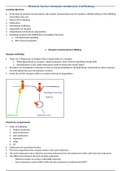
There are 2 things that can happen when a ligand binds to a receptor:
1. When ligand binds to receptor = ligand activation, which leads to signalling cascade (left)
2. Internalisation is also called endocytosis (need to know both words) (right)
Receptors are hydrophobic molecules as they are found embedded in the lipid bilayer and therefore when receptors
are internalised they are internalised in vesicles.
Inside the cell the receptor traffics in vesicles that lead to degradation
Membrane compartments
Order of trafficking:
1. Plasma membrane
2. Early endosomes
3. Late endosomes
4. lysosomes
5. Golgi
6. ER
Endosomes are specialised vesicles
The first compartment the receptor enters is the early endosome
The early endosome is also called the secretory endosome that will continue to traffic until reach late endosome
The differences between the early and late endosome:
- Different markers on surface called RAB molecules
- Early endosome contains RAB 5 while the late endosome is enriched with RAB 7
, The receptor in the late endosome then goes into the lysosome to be degraded as the lysosome is acidic and contains
many enzymes.
There is a secretion pathway, which is the opposite to the RTK trafficking pathway
The communication between the organelles is mediated by vesicles
Outside the cell
Membrane compartments communication: membrane vesicles
Cells are not static but rather dynamic
Cargo and receptor consistently traffic in the cell
Membrane compartments communicate between vesicles
7 Steps
1. Formation
- Formation/invagination of the membrane to form a bud
2. Budding
- Is the formation of a bud
3. Pinching off
- To form a vesicle
4. Transport
- Transported inside the cell along microtubules
5. Docking
- Doc to another endosome
6. Fusion
- With membrane of other (late) endosome
7. Unloading
- Deliver whatever is inside the vesicles. In this case, RTK
Endosome
Learning objectives:
At the level of receptor tyrosine kinase. All receptor tyrosine kinase are GF receptors. Will be looking at the trafficking
of the RTK in the cell
1. What is RTK trafficking
2. Endocytosis
3. Intracellular trafficking
4. Degradation of receptor
5. Ubiquitination endocytosis, degradation
6. Emerging concepts (link trafficking to neurological function)
a. Compartmental signalling
b. RTK nuclear localisation
1- Receptor tyrosine kinase trafficking
Receptor trafficking
There are 2 things that can happen when a ligand binds to a receptor:
1. When ligand binds to receptor = ligand activation, which leads to signalling cascade (left)
2. Internalisation is also called endocytosis (need to know both words) (right)
Receptors are hydrophobic molecules as they are found embedded in the lipid bilayer and therefore when receptors
are internalised they are internalised in vesicles.
Inside the cell the receptor traffics in vesicles that lead to degradation
Membrane compartments
Order of trafficking:
1. Plasma membrane
2. Early endosomes
3. Late endosomes
4. lysosomes
5. Golgi
6. ER
Endosomes are specialised vesicles
The first compartment the receptor enters is the early endosome
The early endosome is also called the secretory endosome that will continue to traffic until reach late endosome
The differences between the early and late endosome:
- Different markers on surface called RAB molecules
- Early endosome contains RAB 5 while the late endosome is enriched with RAB 7
, The receptor in the late endosome then goes into the lysosome to be degraded as the lysosome is acidic and contains
many enzymes.
There is a secretion pathway, which is the opposite to the RTK trafficking pathway
The communication between the organelles is mediated by vesicles
Outside the cell
Membrane compartments communication: membrane vesicles
Cells are not static but rather dynamic
Cargo and receptor consistently traffic in the cell
Membrane compartments communicate between vesicles
7 Steps
1. Formation
- Formation/invagination of the membrane to form a bud
2. Budding
- Is the formation of a bud
3. Pinching off
- To form a vesicle
4. Transport
- Transported inside the cell along microtubules
5. Docking
- Doc to another endosome
6. Fusion
- With membrane of other (late) endosome
7. Unloading
- Deliver whatever is inside the vesicles. In this case, RTK
Endosome