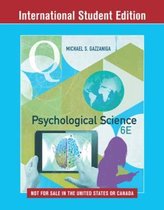
Psychological Science, 6th International Student Edition
Michael Gazzaniga
ISBN: 9780393644548
ENGLISH SUMMARY
This is a very extensive summary of the book Psychological Science By M. Gazzaniga. Every
chapter has a little “Need-to-know” section at the end. The summary is written in English.
All chapters are covered :
• Chapter 1. The science of psychology
• Chapter 2. Research methodology
• Chapter 3. Biology and behaviour
• Chapter 4. Consciousness
• Chapter 5. Sensation and perception
• Chapter 6. Learning
• Chapter 7. Memory
• Chapter 8. Thinking, language and intelligence
• Chapter 9. Human development
• Chapter 10. Emotion and motivation
• Chapter 11. Health and wellbeing
• Chapter 12. Social psychology
• Chapter 13. Personality
• Chapter 14. Psychological disorders
• Chapter 15. Treatment of psychological disorders
, Chapter 1. The science of psychology
Psychological science
Psychological science is the study of mind, brain and behaviour. Mind stands for mental activity,
such as thoughts, feelings and perceptions. Mental activity is the result of biological (chemical)
processes within the brain. Behaviour describes the totality of observable human (or animal)
actions.
One of the aims of this textbook is to learn to think more critically. A critical attitude is required
towards all kinds of information, especially information that seems logical. Scientists have to learn
to be sceptical. Critical thinking involves systematic questioning and evaluation of the information
at hand. It is important to ask critical questions and not to take information for granted. Critical
thinkers have to look for alternative explanations of behaviour. Critical thinking involves looking
for alternative explanations, detecting weak use of evidence and the use of logic. In addition, it is
important to be open to new information and to examine whether a study might be influenced by
personal or political interests. Also, think whether the used research designs are appropriate.
What are different types of inaccurate thinking?
Confirmation bias: people evaluate information that is similar to the beliefs they already had as
more positive. At the same time, they underestimate the value of information that is different from
their own ideas.
Seeing relationships that do not exist: it is often assumed that if two things happen at the same time,
they should be related to each other; which is not the case. Often it is just a coincidence.
After-the-fact explanations (hindsight bias): people often come up with explanations for why events
happen, also when they have incomplete information. Evidence is reinterpreted in a way that fits
better to the outcomes. As a result, existing evidence becomes biased.
Mental heuristics: heuristics are decision rules that are followed to decrease the effort that it takes
to make good decisions. However, using heuristics can also lead to more inaccurate decision
making.
Self-serving bias: People want to feel good about themselves, therefore, they think that they are
better than average on a variety of aspects. To support this positive view, people credit personal
strengths for successes whereas they blame outside forces for their failures. People also have
difficulty recognizing their own weaknesses.
What are the scientific foundations of psychology?
Psychology originated in philosophy, in which the great thinkers tried to understand the human
nature. In the 19th century, psychology became an independent discipline with different schools of
thought that dominated the field for a period of time.
The nature-nurture debate already started with Greek philosophers, such as Aristotle and Plato. The
question is whether psychological characteristics are biologically determined or caused by the
environment, for example by culture. Culture refers to the attitudes, norms and beliefs that are
important within a group of people who share their language. The result of the debate is that there is
always an interaction between genes and environment.
The mind-body problem involves the question whether the mind and the body exist separately from
each other or whether the mind is a subjective experience of the brain. Early philosophers thought
that the mind and body functioned separately from each other. Leonardo da Vinci was one of the
Michael Gazzaniga
ISBN: 9780393644548
ENGLISH SUMMARY
This is a very extensive summary of the book Psychological Science By M. Gazzaniga. Every
chapter has a little “Need-to-know” section at the end. The summary is written in English.
All chapters are covered :
• Chapter 1. The science of psychology
• Chapter 2. Research methodology
• Chapter 3. Biology and behaviour
• Chapter 4. Consciousness
• Chapter 5. Sensation and perception
• Chapter 6. Learning
• Chapter 7. Memory
• Chapter 8. Thinking, language and intelligence
• Chapter 9. Human development
• Chapter 10. Emotion and motivation
• Chapter 11. Health and wellbeing
• Chapter 12. Social psychology
• Chapter 13. Personality
• Chapter 14. Psychological disorders
• Chapter 15. Treatment of psychological disorders
, Chapter 1. The science of psychology
Psychological science
Psychological science is the study of mind, brain and behaviour. Mind stands for mental activity,
such as thoughts, feelings and perceptions. Mental activity is the result of biological (chemical)
processes within the brain. Behaviour describes the totality of observable human (or animal)
actions.
One of the aims of this textbook is to learn to think more critically. A critical attitude is required
towards all kinds of information, especially information that seems logical. Scientists have to learn
to be sceptical. Critical thinking involves systematic questioning and evaluation of the information
at hand. It is important to ask critical questions and not to take information for granted. Critical
thinkers have to look for alternative explanations of behaviour. Critical thinking involves looking
for alternative explanations, detecting weak use of evidence and the use of logic. In addition, it is
important to be open to new information and to examine whether a study might be influenced by
personal or political interests. Also, think whether the used research designs are appropriate.
What are different types of inaccurate thinking?
Confirmation bias: people evaluate information that is similar to the beliefs they already had as
more positive. At the same time, they underestimate the value of information that is different from
their own ideas.
Seeing relationships that do not exist: it is often assumed that if two things happen at the same time,
they should be related to each other; which is not the case. Often it is just a coincidence.
After-the-fact explanations (hindsight bias): people often come up with explanations for why events
happen, also when they have incomplete information. Evidence is reinterpreted in a way that fits
better to the outcomes. As a result, existing evidence becomes biased.
Mental heuristics: heuristics are decision rules that are followed to decrease the effort that it takes
to make good decisions. However, using heuristics can also lead to more inaccurate decision
making.
Self-serving bias: People want to feel good about themselves, therefore, they think that they are
better than average on a variety of aspects. To support this positive view, people credit personal
strengths for successes whereas they blame outside forces for their failures. People also have
difficulty recognizing their own weaknesses.
What are the scientific foundations of psychology?
Psychology originated in philosophy, in which the great thinkers tried to understand the human
nature. In the 19th century, psychology became an independent discipline with different schools of
thought that dominated the field for a period of time.
The nature-nurture debate already started with Greek philosophers, such as Aristotle and Plato. The
question is whether psychological characteristics are biologically determined or caused by the
environment, for example by culture. Culture refers to the attitudes, norms and beliefs that are
important within a group of people who share their language. The result of the debate is that there is
always an interaction between genes and environment.
The mind-body problem involves the question whether the mind and the body exist separately from
each other or whether the mind is a subjective experience of the brain. Early philosophers thought
that the mind and body functioned separately from each other. Leonardo da Vinci was one of the