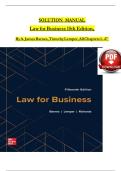
Solution Manual
Employment Law for Business, 10th Edition,
Dawn Bennett-Alexander, Chapters 1 - 16
,TABLE OF CONTENTS
Chapter 1 The Regulation of Employment
Chapter 2 The Employment Law Toolkit: Resources for Understanding the Law and Recurring
Legal Concepts
Chapter 3 Title VII of the Civil Rights Act of 1964
Chapter 4 Legal Construction of the Employment Environment Chapter 5
Affirmative Action
Chapter 6 Race and Color Discrimination
Chapter 7 National Origin Discrimination
Chapter 8 Gender Discrimination Chapter 9
Sexual Harassment
Chapter 10 Sexual Orientation and Gender Identity Discrimination Chapter 11
Religious Discrimination
Chapter 12 Age Discrimination Chapter 13
Disability Discrimination
Chapter 14 The Employee’s Right to Privacy and Management of Personal
Information
Chapter 15 Labor Law 857
Chapter 16 Selected Employment Benefits and Protections
Chapter 1
, The Regulation of Employment
Chapter Objective
The student is introduced to the regulatory environment of the employment relationship. The
chapter examines whether regulation is actually necessary or beneficial or if, perhaps, the
relationship would fare better with less governmental intervention. The concepts of ―freedom‖
to contract in the regulatory employment environment and non-compete agreements are
discussed. Since the regulations and case law discussed in this text rely on an individual‘s
classification as an employer or an employee, those definitions are delineated and explored.
Learning Objectives
(Click on the icon following the learning objective to be linked to the location in the outlinewhere
the chapter addresses that particular objective.)
At the conclusion of this chapter, the students should be able to:
1. Describe the balance between the freedom to contract and the current
regulatory environment for employment.
2. Identify who is subject to which employment laws and understand the implication of eachof
these laws for both the employer and employee.
3. Delineate the risks to the employer caused by employee misclassification.
4. Explain the difference between and employee and an independent contractor and the
tests that help us in that determination.
5. Articulate the various ways in which the concept ―employer‖ is defined by the
various employment-related regulations.
6. Describe the permissible parameters of non-compete agreements.
Detailed Chapter Outline
Scenarios—Points for Discussion
, Scenario One: This scenario offers an opportunity to review the distinctions between an
employee and an independent contractor discussed in the chapter (see ―The Definition of
Employee,‖ particularly Exhibits 1.3–1.5). Discuss the IRS 20-factor analysis, as it applies to
Dalia‘s position. In light of the low level of control that Dalia had over her fees and her work
process, and the limits upon her choice of clients, students should come to the conclusion that
Dalia is an employee (therefore, eligible to file an unemployment claim), rather than an
independent contractor.
Scenario Two: Soraya would not have a cause of action that would be recognized by the
EEOC. Review the section ―The Definition of ‗Employer‘‖ with students, and discuss the
rationale that determines the status of a supervisor vis-à-vis anti-discrimination legislation.
Because Soraya is Soraya‘s supervisor, not her employer, he cannot be the target of an EEOC
claim of sexual harassment.
CCC, Soraya‘s employer, would be vulnerable to an EEOC claim if the company lacked or
failedto follow a system for employee redress of discrimination grievances. However, in this case,
CCC appears to have a viable anti-discrimination policy that it adhered to diligently;
consequently, Soraya would be unlikely to win a decision in her favor. The court in Williams v.
Banning (1995) offered the following rationale for its decision in a similar case:
―She has an employer who was sensitive and responsive to her complaint. She can take
comfort in the knowledge that she continues to work for this company, while her harasser
does not and that the company's prompt action is likely to discourage other would be
harassers. This is precisely the result Title VII was meant to achieve.‖
Scenario Three: Students should discuss whether or not Mya non-compete agreement is likely tobe
found reasonable by a court, and elaborate the aspects of the agreement that Mya might contest
as unreasonable (see section below, ―Covenants Not to Compete‖). Does Mya have a persuasive
argument that the terms of her non-compete agreement are unreasonable in scope or duration?
Might she have grounds to claim that the agreement prohibits her from making a living?
Given the diversity of state laws regulating non-compete agreements, discuss the range of legal
restrictions that might apply to Mya‘s particular agreement with her employer. As an
employeewho works across several states, Mya‘s defense may depend upon the presence—and
specific language—of a forum selection clause in her non-compete agreement. Consider what
language would be more likely to provide Nan with a strong defense against the breach of
contract claim.
Mya might also argue that the company‘s client list is available through public means, and
therefore, her access to this list should not be prohibited.
General Lecture Note for Employment Law Course
In order to teach this course, instructors have found that students must be made to feel relatively
comfortable with their peers. Instructors will be asking the students to be honest and to stay in
their truth, even at times when they feel that their opinion on one of these matters will not be
Employment Law for Business, 10th Edition,
Dawn Bennett-Alexander, Chapters 1 - 16
,TABLE OF CONTENTS
Chapter 1 The Regulation of Employment
Chapter 2 The Employment Law Toolkit: Resources for Understanding the Law and Recurring
Legal Concepts
Chapter 3 Title VII of the Civil Rights Act of 1964
Chapter 4 Legal Construction of the Employment Environment Chapter 5
Affirmative Action
Chapter 6 Race and Color Discrimination
Chapter 7 National Origin Discrimination
Chapter 8 Gender Discrimination Chapter 9
Sexual Harassment
Chapter 10 Sexual Orientation and Gender Identity Discrimination Chapter 11
Religious Discrimination
Chapter 12 Age Discrimination Chapter 13
Disability Discrimination
Chapter 14 The Employee’s Right to Privacy and Management of Personal
Information
Chapter 15 Labor Law 857
Chapter 16 Selected Employment Benefits and Protections
Chapter 1
, The Regulation of Employment
Chapter Objective
The student is introduced to the regulatory environment of the employment relationship. The
chapter examines whether regulation is actually necessary or beneficial or if, perhaps, the
relationship would fare better with less governmental intervention. The concepts of ―freedom‖
to contract in the regulatory employment environment and non-compete agreements are
discussed. Since the regulations and case law discussed in this text rely on an individual‘s
classification as an employer or an employee, those definitions are delineated and explored.
Learning Objectives
(Click on the icon following the learning objective to be linked to the location in the outlinewhere
the chapter addresses that particular objective.)
At the conclusion of this chapter, the students should be able to:
1. Describe the balance between the freedom to contract and the current
regulatory environment for employment.
2. Identify who is subject to which employment laws and understand the implication of eachof
these laws for both the employer and employee.
3. Delineate the risks to the employer caused by employee misclassification.
4. Explain the difference between and employee and an independent contractor and the
tests that help us in that determination.
5. Articulate the various ways in which the concept ―employer‖ is defined by the
various employment-related regulations.
6. Describe the permissible parameters of non-compete agreements.
Detailed Chapter Outline
Scenarios—Points for Discussion
, Scenario One: This scenario offers an opportunity to review the distinctions between an
employee and an independent contractor discussed in the chapter (see ―The Definition of
Employee,‖ particularly Exhibits 1.3–1.5). Discuss the IRS 20-factor analysis, as it applies to
Dalia‘s position. In light of the low level of control that Dalia had over her fees and her work
process, and the limits upon her choice of clients, students should come to the conclusion that
Dalia is an employee (therefore, eligible to file an unemployment claim), rather than an
independent contractor.
Scenario Two: Soraya would not have a cause of action that would be recognized by the
EEOC. Review the section ―The Definition of ‗Employer‘‖ with students, and discuss the
rationale that determines the status of a supervisor vis-à-vis anti-discrimination legislation.
Because Soraya is Soraya‘s supervisor, not her employer, he cannot be the target of an EEOC
claim of sexual harassment.
CCC, Soraya‘s employer, would be vulnerable to an EEOC claim if the company lacked or
failedto follow a system for employee redress of discrimination grievances. However, in this case,
CCC appears to have a viable anti-discrimination policy that it adhered to diligently;
consequently, Soraya would be unlikely to win a decision in her favor. The court in Williams v.
Banning (1995) offered the following rationale for its decision in a similar case:
―She has an employer who was sensitive and responsive to her complaint. She can take
comfort in the knowledge that she continues to work for this company, while her harasser
does not and that the company's prompt action is likely to discourage other would be
harassers. This is precisely the result Title VII was meant to achieve.‖
Scenario Three: Students should discuss whether or not Mya non-compete agreement is likely tobe
found reasonable by a court, and elaborate the aspects of the agreement that Mya might contest
as unreasonable (see section below, ―Covenants Not to Compete‖). Does Mya have a persuasive
argument that the terms of her non-compete agreement are unreasonable in scope or duration?
Might she have grounds to claim that the agreement prohibits her from making a living?
Given the diversity of state laws regulating non-compete agreements, discuss the range of legal
restrictions that might apply to Mya‘s particular agreement with her employer. As an
employeewho works across several states, Mya‘s defense may depend upon the presence—and
specific language—of a forum selection clause in her non-compete agreement. Consider what
language would be more likely to provide Nan with a strong defense against the breach of
contract claim.
Mya might also argue that the company‘s client list is available through public means, and
therefore, her access to this list should not be prohibited.
General Lecture Note for Employment Law Course
In order to teach this course, instructors have found that students must be made to feel relatively
comfortable with their peers. Instructors will be asking the students to be honest and to stay in
their truth, even at times when they feel that their opinion on one of these matters will not be