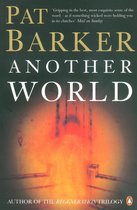
Pat Barker- ANOTHER WORLD
Life and family:
• Born May 1943, Thornaby-on-Tees
• Told that her father was an RAF pilot killed in WWII – a myth invented by mother, who did not
know real identity of father
• Brought up mainly by grandparents. Fascinated by grandfather’s bayonet wound from WWI.
Like Geordie in AW, died of cancer, but blamed illness on wound. ‘In each case the man
needs to believe that the war is what's killing him’.
• Attended grammar school, 1955-1962; read International History at London School of
Economics, 1962-1965.
• Returned to North East to teach
• First novel: Union Street (1982); breakthrough: Regeneration (1991); Another World (1998)
Another World:
• Set in post-industrial north-east- Newcastle-upon-Tyne.
• Texts deal with harsh realities of working class life.
• A fascination with things UNSAID about the war- particularly WWI.
• Is starting a second WWI trilogy- started in 2007- about painters during the war.
• Barker’s texts are concerned about the persistence of the past in the present.
• A focus on violence- what drives people to commit violent acts?
• This is apparent from beg of AW- The Bigg Market.
• ‘an age of monstrosities’
• Gareth’s addiction to violent games.
• Sense of a history of violence- place is saturated with violent events. E.g. Peter
Sutcliffe, James Bulger abduction- all come to his mind.
• A sense of violence and loss pervades the text.
*Focus on Geordie*
Initial breakdown- 1919- immediately after the war. Mother was interested in spiritualism-
photograph- confirmed past cannot be laid till rest.
-When we got [the photographs] there was this, I don’t know, thing in the background. You couldn’t
make out the features, but you could just about see it was a face. And me mam says, ‘Oh, that’s our
Harry’, and she burst out crying and, I don’t know why, but it absolutely knocked my end in, did that. I
was no good at all after. (p. 154)
-The reader can grasp, where perhaps Geordie cannot, that the spiritualist photograph led directly to
his collapse because it confirmed that the past cannot easily, or straightforwardly, be laid to rest. The
spectral presence in the photograph both reflects and fashions within him the impossible burden of his
own survival.
Anne Whitehead, ‘The Past as Revenant: Trauma and Haunting in Pat Barker’s Another World’,
Critique: Studies in Contemporary Fiction 45.2 (2004), 129-46 (p. 133).
Geordie won’t discuss how he received his wound.
o Traumatic memories return as his wound becomes more painful.
‘For years he’s been free of nightmares, flashbacks, hallucinations, all the dreadful baggage he
brought back with him from France, yet in the last few months they’ve returned. His nights, recently,
have been terrible to endure. Terrible to witness. Worse than that, he’s actually become quite
dangerous. Auntie Frieda’s been mistaken for a German soldier more than once.’ (p. 63)
Trauma is a wound- perhaps more powerful wound:
‘His belief that he’s dying of this ancient wound may be strange, but it isn’t meaningless. The bleeding
bayonet wound’s the physical equivalent of the eruption of memory that makes his nights dreadful.’ (p.
227)
Life and family:
• Born May 1943, Thornaby-on-Tees
• Told that her father was an RAF pilot killed in WWII – a myth invented by mother, who did not
know real identity of father
• Brought up mainly by grandparents. Fascinated by grandfather’s bayonet wound from WWI.
Like Geordie in AW, died of cancer, but blamed illness on wound. ‘In each case the man
needs to believe that the war is what's killing him’.
• Attended grammar school, 1955-1962; read International History at London School of
Economics, 1962-1965.
• Returned to North East to teach
• First novel: Union Street (1982); breakthrough: Regeneration (1991); Another World (1998)
Another World:
• Set in post-industrial north-east- Newcastle-upon-Tyne.
• Texts deal with harsh realities of working class life.
• A fascination with things UNSAID about the war- particularly WWI.
• Is starting a second WWI trilogy- started in 2007- about painters during the war.
• Barker’s texts are concerned about the persistence of the past in the present.
• A focus on violence- what drives people to commit violent acts?
• This is apparent from beg of AW- The Bigg Market.
• ‘an age of monstrosities’
• Gareth’s addiction to violent games.
• Sense of a history of violence- place is saturated with violent events. E.g. Peter
Sutcliffe, James Bulger abduction- all come to his mind.
• A sense of violence and loss pervades the text.
*Focus on Geordie*
Initial breakdown- 1919- immediately after the war. Mother was interested in spiritualism-
photograph- confirmed past cannot be laid till rest.
-When we got [the photographs] there was this, I don’t know, thing in the background. You couldn’t
make out the features, but you could just about see it was a face. And me mam says, ‘Oh, that’s our
Harry’, and she burst out crying and, I don’t know why, but it absolutely knocked my end in, did that. I
was no good at all after. (p. 154)
-The reader can grasp, where perhaps Geordie cannot, that the spiritualist photograph led directly to
his collapse because it confirmed that the past cannot easily, or straightforwardly, be laid to rest. The
spectral presence in the photograph both reflects and fashions within him the impossible burden of his
own survival.
Anne Whitehead, ‘The Past as Revenant: Trauma and Haunting in Pat Barker’s Another World’,
Critique: Studies in Contemporary Fiction 45.2 (2004), 129-46 (p. 133).
Geordie won’t discuss how he received his wound.
o Traumatic memories return as his wound becomes more painful.
‘For years he’s been free of nightmares, flashbacks, hallucinations, all the dreadful baggage he
brought back with him from France, yet in the last few months they’ve returned. His nights, recently,
have been terrible to endure. Terrible to witness. Worse than that, he’s actually become quite
dangerous. Auntie Frieda’s been mistaken for a German soldier more than once.’ (p. 63)
Trauma is a wound- perhaps more powerful wound:
‘His belief that he’s dying of this ancient wound may be strange, but it isn’t meaningless. The bleeding
bayonet wound’s the physical equivalent of the eruption of memory that makes his nights dreadful.’ (p.
227)