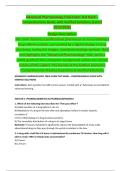
Advanced Pharmacology Final Exam Test Bank –
Comprehensive Guide with Verified Solutions (Latest
2025/2026)
Design Description:
The cover features a professional pharmacist or nurse holding a
drug reference book, surrounded by a digital display of drug
structures, molecular images, and pharmacology symbols. Bold
text highlights the "Advanced Pharmacology" title, while a
subtle gradient blue and green background evokes the clinical
nature of the subject. The banner at the bottom promotes
"Comprehensive Practice Questions & Verified Solutions.
ADVANCED PHARMACOLOGY FINAL EXAM TEST BANK – COMPREHENSIVE GUIDE WITH
VERIFIED SOLUTIONS
Instructions: Each question has ONE correct answer, marked with ✓. Rationales are provided for
enhanced learning.
SECTION 1: PHARMACOKINETICS & PHARMACODYNAMICS
1. Which of the following best describes the "first-pass effect"?
A) Rapid excretion of a drug before it can act
B) Metabolism of a drug in the liver after oral absorption, before it reaches systemic
circulation ✓
C) The initial binding of a drug to plasma proteins
D) The immediate distribution of a drug to its target tissue
Rationale: First-pass metabolism significantly reduces the bioavailability of many orally
administered drugs as they pass through the portal circulation to the liver.
2. A drug with a half-life of 6 hours is administered by continuous IV infusion. How long will it
take to reach >90% of steady-state concentration?
A) 6 hours
B) 12 hours
,C) 24 hours ✓
D) 36 hours
Rationale: It takes approximately 4-5 half-lives to reach steady-state. 5 x 6 hours = 30 hours
(closest answer is 24 hours, representing ~4 half-lives reaching ~94%).
3. The therapeutic index of a drug is calculated as:
A) ED50 / LD50
B) LD50 / ED50 ✓
C) TD50 / ED50
D) EC50 / IC50
Rationale: Therapeutic Index (TI) = LD50/ED50, where LD50 is the lethal dose for 50% of the
population and ED50 is the effective dose for 50%. A higher TI indicates a safer drug.
4. Which term describes a drug that binds to a receptor and produces a submaximal
response?
A) Competitive antagonist
B) Inverse agonist
C) Partial agonist ✓
D) Chemical antagonist
Rationale: A partial agonist has affinity and efficacy but cannot produce the maximum response
even with full receptor occupancy, acting as an agonist in some contexts and an antagonist in
others.
5. Phenytoin demonstrates dose-dependent (nonlinear) pharmacokinetics because:
A) It is highly protein-bound
B) Its metabolic enzymes become saturated at therapeutic doses ✓
C) It has a very narrow volume of distribution
D) It is primarily renally excreted unchanged
Rationale: Phenytoin metabolism via hepatic CYP2C9/CYP2C19 becomes saturated within the
therapeutic range, meaning small dose increases can lead to disproportionately large increases
in plasma concentration.
SECTION 2: AUTONOMIC & CARDIOVASCULAR PHARMACOLOGY
6. A patient experiencing anaphylactic shock would benefit MOST immediately from:
A) Propranolol
B) Epinephrine ✓
C) Atropine
,D) Albuterol
Rationale: Epinephrine (alpha-1, beta-1, beta-2 agonist) is first-line for anaphylaxis: alpha-1
effects reverse vasodilation/edema, beta-1 supports cardiac output, beta-2 causes
bronchodilation.
7. Which drug is a competitive antagonist at angiotensin II type 1 (AT1) receptors?
A) Lisinopril
B) Spironolactone
C) Losartan ✓
D) Hydralazine
Rationale: Losartan is an ARB (Angiotensin II Receptor Blocker), selectively competing for AT1
receptors, blocking the effects of angiotensin II (vasoconstriction, aldosterone release).
8. The antiarrhythmic drug Amiodarone is classified as a Class III agent because its primary
mechanism is:
A) Sodium channel blockade (phase 0)
B) Beta-adrenergic receptor blockade
C) Potassium channel blockade, prolonging action potential duration ✓
D) Calcium channel blockade (phase 2)
Rationale: Vaughan Williams Class III antiarrhythmics block potassium channels (especially IKr),
prolonging repolarization and the effective refractory period (ERP).
9. Digoxin toxicity is exacerbated by:
A) Hyperkalemia
B) Hypokalemia ✓
C) Hypermagnesemia
D) Hypercalcemia
Rationale: Hypokalemia reduces competition for digoxin binding to the Na+/K+ ATPase pump,
potentiating its inhibitory effects and increasing the risk of severe arrhythmias.
10. The desired effect of administering Dobutamine in acute heart failure is primarily due to
its action on:
A) Alpha-1 receptors, increasing peripheral resistance
B) Beta-1 receptors, increasing cardiac contractility ✓
C) Beta-2 receptors, causing bronchodilation
D) Dopamine receptors, increasing renal perfusion
Rationale: Dobutamine is a relatively selective beta-1 adrenergic agonist, increasing myocardial
contractility (positive inotropy) and cardiac output with minimal effect on heart rate or
peripheral resistance.
, SECTION 3: CNS PHARMACOLOGY
11. Which mechanism underlies the therapeutic effect of SSRI antidepressants?
A) Blockade of dopamine reuptake
B) Inhibition of monoamine oxidase
C) Increased synaptic concentration of serotonin ✓
D) Antagonism at NMDA glutamate receptors
Rationale: SSRIs (e.g., fluoxetine) selectively inhibit the serotonin transporter (SERT), blocking
presynaptic reuptake of serotonin, leading to increased extracellular serotonin.
12. Benzodiazepines exert their effects by:
A) Directly opening chloride channels
B) Binding to a site on GABA-A receptors, increasing the frequency of channel opening ✓
C) Inhibiting GABA transaminase
D) Antagonizing glutamate receptors
Rationale: BZDs bind to a specific site on the GABA-A receptor complex, allosterically increasing
the receptor's affinity for GABA, which increases the frequency of chloride channel opening,
leading to hyperpolarization.
13. The drug of choice for absence seizures is:
A) Phenytoin
B) Carbamazepine
C) Valproic Acid or Ethosuximide ✓
D) Lorazepam
Rationale: Ethosuximide is first-line for absence seizures as it selectively inhibits T-type calcium
channels in thalamic neurons. Valproic acid is a broad-spectrum alternative.
14. Levodopa is used in Parkinson's disease instead of dopamine because:
A) Dopamine is too expensive
B) Levodopa has direct dopamine receptor agonist activity
C) Dopamine does not cross the blood-brain barrier ✓
D) Dopamine is rapidly excreted by the kidneys
Rationale: Dopamine cannot cross the BBB. Levodopa, its precursor, is transported via L-amino
acid transporters and then decarboxylated to dopamine in the brain.
15. Which analgesic has NO anti-inflammatory activity?
A) Ibuprofen
B) Celecoxib
Comprehensive Guide with Verified Solutions (Latest
2025/2026)
Design Description:
The cover features a professional pharmacist or nurse holding a
drug reference book, surrounded by a digital display of drug
structures, molecular images, and pharmacology symbols. Bold
text highlights the "Advanced Pharmacology" title, while a
subtle gradient blue and green background evokes the clinical
nature of the subject. The banner at the bottom promotes
"Comprehensive Practice Questions & Verified Solutions.
ADVANCED PHARMACOLOGY FINAL EXAM TEST BANK – COMPREHENSIVE GUIDE WITH
VERIFIED SOLUTIONS
Instructions: Each question has ONE correct answer, marked with ✓. Rationales are provided for
enhanced learning.
SECTION 1: PHARMACOKINETICS & PHARMACODYNAMICS
1. Which of the following best describes the "first-pass effect"?
A) Rapid excretion of a drug before it can act
B) Metabolism of a drug in the liver after oral absorption, before it reaches systemic
circulation ✓
C) The initial binding of a drug to plasma proteins
D) The immediate distribution of a drug to its target tissue
Rationale: First-pass metabolism significantly reduces the bioavailability of many orally
administered drugs as they pass through the portal circulation to the liver.
2. A drug with a half-life of 6 hours is administered by continuous IV infusion. How long will it
take to reach >90% of steady-state concentration?
A) 6 hours
B) 12 hours
,C) 24 hours ✓
D) 36 hours
Rationale: It takes approximately 4-5 half-lives to reach steady-state. 5 x 6 hours = 30 hours
(closest answer is 24 hours, representing ~4 half-lives reaching ~94%).
3. The therapeutic index of a drug is calculated as:
A) ED50 / LD50
B) LD50 / ED50 ✓
C) TD50 / ED50
D) EC50 / IC50
Rationale: Therapeutic Index (TI) = LD50/ED50, where LD50 is the lethal dose for 50% of the
population and ED50 is the effective dose for 50%. A higher TI indicates a safer drug.
4. Which term describes a drug that binds to a receptor and produces a submaximal
response?
A) Competitive antagonist
B) Inverse agonist
C) Partial agonist ✓
D) Chemical antagonist
Rationale: A partial agonist has affinity and efficacy but cannot produce the maximum response
even with full receptor occupancy, acting as an agonist in some contexts and an antagonist in
others.
5. Phenytoin demonstrates dose-dependent (nonlinear) pharmacokinetics because:
A) It is highly protein-bound
B) Its metabolic enzymes become saturated at therapeutic doses ✓
C) It has a very narrow volume of distribution
D) It is primarily renally excreted unchanged
Rationale: Phenytoin metabolism via hepatic CYP2C9/CYP2C19 becomes saturated within the
therapeutic range, meaning small dose increases can lead to disproportionately large increases
in plasma concentration.
SECTION 2: AUTONOMIC & CARDIOVASCULAR PHARMACOLOGY
6. A patient experiencing anaphylactic shock would benefit MOST immediately from:
A) Propranolol
B) Epinephrine ✓
C) Atropine
,D) Albuterol
Rationale: Epinephrine (alpha-1, beta-1, beta-2 agonist) is first-line for anaphylaxis: alpha-1
effects reverse vasodilation/edema, beta-1 supports cardiac output, beta-2 causes
bronchodilation.
7. Which drug is a competitive antagonist at angiotensin II type 1 (AT1) receptors?
A) Lisinopril
B) Spironolactone
C) Losartan ✓
D) Hydralazine
Rationale: Losartan is an ARB (Angiotensin II Receptor Blocker), selectively competing for AT1
receptors, blocking the effects of angiotensin II (vasoconstriction, aldosterone release).
8. The antiarrhythmic drug Amiodarone is classified as a Class III agent because its primary
mechanism is:
A) Sodium channel blockade (phase 0)
B) Beta-adrenergic receptor blockade
C) Potassium channel blockade, prolonging action potential duration ✓
D) Calcium channel blockade (phase 2)
Rationale: Vaughan Williams Class III antiarrhythmics block potassium channels (especially IKr),
prolonging repolarization and the effective refractory period (ERP).
9. Digoxin toxicity is exacerbated by:
A) Hyperkalemia
B) Hypokalemia ✓
C) Hypermagnesemia
D) Hypercalcemia
Rationale: Hypokalemia reduces competition for digoxin binding to the Na+/K+ ATPase pump,
potentiating its inhibitory effects and increasing the risk of severe arrhythmias.
10. The desired effect of administering Dobutamine in acute heart failure is primarily due to
its action on:
A) Alpha-1 receptors, increasing peripheral resistance
B) Beta-1 receptors, increasing cardiac contractility ✓
C) Beta-2 receptors, causing bronchodilation
D) Dopamine receptors, increasing renal perfusion
Rationale: Dobutamine is a relatively selective beta-1 adrenergic agonist, increasing myocardial
contractility (positive inotropy) and cardiac output with minimal effect on heart rate or
peripheral resistance.
, SECTION 3: CNS PHARMACOLOGY
11. Which mechanism underlies the therapeutic effect of SSRI antidepressants?
A) Blockade of dopamine reuptake
B) Inhibition of monoamine oxidase
C) Increased synaptic concentration of serotonin ✓
D) Antagonism at NMDA glutamate receptors
Rationale: SSRIs (e.g., fluoxetine) selectively inhibit the serotonin transporter (SERT), blocking
presynaptic reuptake of serotonin, leading to increased extracellular serotonin.
12. Benzodiazepines exert their effects by:
A) Directly opening chloride channels
B) Binding to a site on GABA-A receptors, increasing the frequency of channel opening ✓
C) Inhibiting GABA transaminase
D) Antagonizing glutamate receptors
Rationale: BZDs bind to a specific site on the GABA-A receptor complex, allosterically increasing
the receptor's affinity for GABA, which increases the frequency of chloride channel opening,
leading to hyperpolarization.
13. The drug of choice for absence seizures is:
A) Phenytoin
B) Carbamazepine
C) Valproic Acid or Ethosuximide ✓
D) Lorazepam
Rationale: Ethosuximide is first-line for absence seizures as it selectively inhibits T-type calcium
channels in thalamic neurons. Valproic acid is a broad-spectrum alternative.
14. Levodopa is used in Parkinson's disease instead of dopamine because:
A) Dopamine is too expensive
B) Levodopa has direct dopamine receptor agonist activity
C) Dopamine does not cross the blood-brain barrier ✓
D) Dopamine is rapidly excreted by the kidneys
Rationale: Dopamine cannot cross the BBB. Levodopa, its precursor, is transported via L-amino
acid transporters and then decarboxylated to dopamine in the brain.
15. Which analgesic has NO anti-inflammatory activity?
A) Ibuprofen
B) Celecoxib