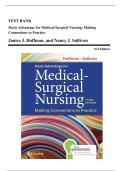
TEST BANK
Davis Advantage for Medical-Surgical Nursing: Making
Connections to Practice
Janice J. Hoffman, and Nancy J. Sullivan
3rd Edition
,Table of Contents
Chapter 01 Foundations for Medical-Surgical Nursing 1
Chapter 02 Interprofessional Collaboration and Care Coordination 25
Chapter 03 Cultural Considerations 47
Chapter 04 Ethical Concepts 68
Chapter 05 Palliative Care and End-of-Life Issues 92
Chapter 06 Geriatric Implications for Medical-Surgical Nursing 115
Chapter 07 Oxygen Therapy Management 141
Chapter 08 Fluid and Electrolyte Management 170
Chapter 09 Acid–Base Balance 196
Chapter 10 Overview of Infusion Therapies 219
Chapter 11 Pain Management 243
Chapter 12 Complementary and Alternative Care Initiatives 268
Chapter 13 Overview of Cancer Care 288
Chapter 14 Overview of Shock and Sepsis 311
Chapter 15 Priorities for the Preoperative Patient 334
Chapter 16 Priorities for the Intraoperative Patient 357
Chapter 17 Priorities for the Postoperative Patient 381
Chapter 18 Assessment of Immune Function 406
Chapter 19 Coordinating Care for Patients With Immune Disorders 428
Chapter 20 Coordinating Care for Patients With Connective Tissue Disorders 451
Chapter 21 Coordinating Care for Patients With Multidrug-Resistant Organism Infectious
Disorders 474
Chapter 22 Coordinating Care for Patients With HIV 503
Chapter 23 Assessment of Respiratory Function 527
Chapter 24 Coordinating Care for Patients With Infectious Respiratory Disorders 550
Chapter 25 Coordinating Care for Patients With Upper Airway Disorders 577
Chapter 26 Coordinating Care for Patients With Lower Airway Disorders 600
Chapter 27 Coordinating Care for Critically Ill Patients With Respiratory Dysfunction 622
Chapter 28 Assessment of Cardiovascular Function 647
Chapter 29 Coordinating Care for Patients With Cardiac Dysrhythmia 670
Chapter 30 Coordinating Care for Patients With Cardiac Disorders 691
Chapter 31 Coordinating Care for Patients With Vascular Disorders 714
Chapter 32 Coordinating Care for Critically Ill Patients With Cardiovascular Dysfunction 739
Chapter 33 Assessment of Hematological Function 763
Chapter 34 Coordinating Care for Patients With Hematological Disorders 785
Chapter 35 Assessment of Neurological Function 810
Chapter 36 Coordinating Care for Patients With Brain Disorders 833
Chapter 37 Coordinating Care for Patients With Spinal Cord Disorders 857
Chapter 38 Coordinating Care for Patients With Peripheral Nervous System Disorders 880
Chapter 39 Coordinating Care for Critically Ill Patients With Neurological Dysfunction 905
Chapter 40 Assessment of Endocrine Function 931
,Chapter 41 Coordinating Care for Patients With Pituitary Disorders 954
Chapter 42 Coordinating Care for Patients With Adrenal Disorders 978
Chapter 43 Coordinating Care for Patients With Thyroid and Parathyroid Disorders 1002
Chapter 44 Coordinating Care for Patients With Diabetes Mellitus 1024
Chapter 45 Assessment of Visual Function 1049
Chapter 46 Coordinating Care for Patients With Visual Disorders 1073
Chapter 47 Assessment of Auditory Function 1097
Chapter 48 Coordinating Care for Patients With Hearing Disorders 1119
Chapter 49 Assessment of Integumentary Function 1142
Chapter 50 Coordinating Care for Patients With Skin Disorders 1164
Chapter 51 Coordinating Care for Patients With Burns 1188
Chapter 52 Assessment of Musculoskeletal Function 1213
Chapter 53 Coordinating Care for Patients With Musculoskeletal Disorders 1235
Chapter 54 Coordinating Care for Patients With Musculoskeletal Trauma 1260
Chapter 55 Assessment of Gastrointestinal Function 1283
Chapter 56 Coordinating Care for Patients With Oral and Esophageal Disorders 1307
Chapter 57 Coordinating Care for Patients With Stomach Disorders 1331
Chapter 58 Coordinating Care for Patients With Intestinal Disorders 1355
Chapter 59 Coordinating Care for Patients With Hepatic Disorders 1381
Chapter 60 Coordinating Care for Patients With Biliary and Pancreatic Disorders 1405
Chapter 61 Assessment of Renal and Urinary Function 1429
Chapter 62 Coordinating Care for Patients With Renal Disorders 1452
Chapter 63 Coordinating Care for Patients With Urinary Disorders 1476
Chapter 64 Assessment of Reproductive Function 1501
Chapter 65 Coordinating Care for Female Patients With Reproductive and Breast
Disorders 1525
Chapter 66 Coordinating Care for Male Patients With Reproductive and Breast Disorders 1551
Chapter 67 Coordinating Care for Patients With Sexually Transmitted Infection 1576
Chapter 68 Managing Care for the Adult Patient With Obesity 1602
Chapter 69 Emergency, Trauma, and Environmental Injuries 1626
Chapter 70 Substance Use Disorders in the Adult Population 1651
Chapter 71 Disasters, Mass Casualty Incidents, and Complex Emergencies 1677
,______________________________________________________________________________________________
Test Bank - Medical-Surgical Nursing: Making Connections to Practice, 3rd Edition (Hoffman, 2024)
Chapter 1: Foundations for Medical-Surgical Nursing
MULTIPLE RESPONSE
1. Which professional nursing organizations provide certification in medical-surgical nursing?
Select all that apply.
A. Academy of Medical-Surgical Nursing
B. American Nurse Credentialing Center
C. Beryl Institute
D. Medical-Surgical Nursing Certification Board
E. Nursing Executive Center
ANS: B, D
Chapter number and title: 1, Foundations for Medical-Surgical Nursing
Chapter learning objective: 1. Describing the role and competencies of medical-surgical
nursing
Chapter page reference: p. 5
Heading: Introduction
Integrated Processes: N/A
Client Need: N/A
Cognitive Level: Knowledge [Remembering]
Concept: Professionalism
Difficulty: Easy
Feedback
A This is incorrect. The Academy of Medical-Surgical Nurses is the only
professional nursing organization dedicated to medical-surgical nursing but
does not offer certification.
B This is correct. Certification in medical-surgical nursing is available through the
American Nurses Credentialing Center (ANCC); registered nurses with this
certification are entitled to the credential of registered nurse–board certified
(RN-BC).
C This is incorrect. The Beryl Institute is an organization that fosters
patient-centered care through the “patient experience” that is influenced by all
the interactions and experiences encountered. They are not a certification
organization.
D This is correct. Nurses earn the credential certified medical-surgical registered
nurse (CMSRN) through the Medical-Surgical Nursing Certification Board
E This is incorrect. The Nursing Executive Center serves nursing administrators
through data collection around best practices, strategic initiatives, and
operational issues. They are not a certification body.
PTS: 1 CON: Professionalism
2. The staff nurse is teaching a group of student nurses the situations that necessitate hand-off
communication. Which student responses indicate understanding? Select all that apply.
A. “A hand-off is required before administering a medication.”
B. “A hand-off is required during change of shift.”
______________________________________________________________________________________________
1|Page
,______________________________________________________________________________________________
Test Bank - Medical-Surgical Nursing: Making Connections to Practice, 3rd Edition (Hoffman, 2024)
C. “A hand-off is required for a patient who is transferred to the surgical suite.”
D. “A hand-off is required whenever the nurse receives a new patient assignment.”
E. “A hand-off is required before family visitation.”
ANS: B, C, D
Chapter number and title: 1, Foundations for Medical-Surgical Nursing
Chapter learning objective: 6. Describing the role of interprofessional collaboration and
teamwork in the provision of safe, quality patient care
Chapter page reference: p. 6
Heading: Patient Safety Outcomes
Integrated Processes: Communication and Documentation
Client Need: Safe and Effective Care Environment/Management of Care
Cognitive Level: Analysis [Analyzing]
Concept: Communication
Difficulty: Difficult
Feedback
A This is incorrect. This response indicates the need for further education related
to this procedure. Hand-off communication is not required before the
administration of medication. The nurse would, however, verify the patient’s
identity using two sources.
B This is correct. This response does not indicate the need for further education
related to this procedure. Hand-off communication is required when patient care
is transferred from one provider to another, such as during the change of shift.
C This is correct. This response does not indicate the need for further education
related to this procedure. Hand-off communication is required when patient care
is transferred from one provider to another, such as when a patient is transferred
to the surgical suite.
D This is correct. This response does not indicate the need for further education
related to this procedure. Hand-off communication is required when patient care
is transferred from one provider to another, such as anytime the nurse receives a
new patient assignment.
E This is incorrect. This response indicates the need for further education related
to this procedure. Hand-off communication is not required before family
visitation.
PTS: 1 CON: Communication
3. In preparing an educational program on Quality and Safety Education for Nursing (QSEN),
the nurse incorporates which competencies? Select all that apply.
A. Patient-centered care
B. Legal implications of nursing care
C. Evidence-based practice
D. Informatics
E. Cost containment measures
ANS: A, C, D
Chapter number and title: 1, Foundations for Medical-Surgical Nursing
______________________________________________________________________________________________
2|Page
,______________________________________________________________________________________________
Test Bank - Medical-Surgical Nursing: Making Connections to Practice, 3rd Edition (Hoffman, 2024)
Chapter learning objective: 5. Discussing the implications of the Quality and Safety
Education for Nurses (QSEN) competencies for medical-surgical nurses
Chapter page reference: p. 7
Heading: Patient Safety Outcomes/Box 1.9 QSEN Competencies
Integrated Processes: Nursing Process: Planning
Client Need: Safe and Effective Care Environment/Management of Care
Cognitive Level: Knowledge [Remembering]
Concept: Professionalism
Difficulty: Easy
Feedback
A This is correct. Patient-centered care is a Quality and Safety Education for
Nursing (QSEN) competency. Other QSEN competencies include teamwork
and collaboration, evidence-based practice, quality improvement, safety, and
informatics.
B This is correct. Evidence-based practice is a QSEN Competency.
C This is incorrect. Legal considerations are not a specific QSEN competency.
D This is correct. Informatics is a QSEN competency.
E This is incorrect. Cost containment is not a specific QSEN competency.
PTS: 1 CON: Professionalism
4. Which actions by the nurse enhance patient safety during medication administration? Select
all that apply.
A. Answering the call bell while transporting medications for a different patient
B. Identifying the patient using two sources before administering the medication
C. Holding a medication if the patient’s diagnosis does not support its use
D. Holding a medication because it arrived from the pharmacy 2 hours after the
scheduled administration time
E. Having another nurse verify the prescribed dose of insulin the patient is to receive
ANS: B, C, E
Chapter number and title: 1, Foundations for Medical-Surgical Nursing
Chapter learning objective: 5. Discussing the implications of the Quality and Safety
Education for Nurses (QSEN) competencies for medical-surgical nurses
Chapter page reference: pp. 6-7
Heading: Patient Safety Outcomes
Integrated Processes: Nursing Process: Implementation
Client Need: Safe and Effective Care Environment/Safety and Infection Control
Cognitive Level: Application [Applying]
Concept: Safety
Difficulty: Difficult
Feedback
A This is incorrect. Interruptions should be minimized during the medication
administration process; therefore, the nurse should not answer the call bell for
another patient while transporting medications for administration.
B This is correct. Verification of the right patient is one of the rights of medication
administration; therefore, the nurse would identify the patient using two sources
______________________________________________________________________________________________
3|Page
,______________________________________________________________________________________________
Test Bank - Medical-Surgical Nursing: Making Connections to Practice, 3rd Edition (Hoffman, 2024)
before the administration of medication.
C This is correct. The nurse should ensure that the rationale for all medications is
associated with the patient’s condition; therefore, this action enhances patient
safety during medication administration.
D This is incorrect. Medications should be administered as prescribed, and if a
medication is not available to be administered at the prescribed time, the
provider needs to be contacted about when to administer the next dose and
whether any other time adjustments need to be made.
E This is correct. Verifying the dose of a high-risk medication, such as insulin,
enhances patient safety during medication administration.
PTS: 1 CON: Safety
5. The nurse provides care to patients in the medical-surgical unit. Which nursing actions
support the Joint Commission’s National Patient Safety Goals when providing patient care?
Select all that apply.
A. Silencing a patient’s cardiorespiratory monitor while the family visits
B. Asking the unlicensed assistive personnel to remove clutter from the patient’s
room
C. Using the SBAR method to provide patient information to radiology before
transfer
D. Encouraging the patient’s healthcare provider to wash the hands before assessing a
surgical wound
E. Identifying the patient before administering medication by asking, “What is your
date of birth?”
ANS: B, C, D, E
Chapter number and title: 1, Foundations for Medical-Surgical Nursing
Chapter learning objective: 5. Discussing the implications of the Quality and Safety
Education for Nurses (QSEN) competencies for medical-surgical nurses
Chapter page reference: pp. 6-7
Heading: Patient Safety Outcomes
Integrated Processes: Communication and Documentation
Client Need: Safe and Effective Care Environment
Cognitive Level: Analysis [Analyzing]
Concept: Professionalism
Difficulty: Difficult
Feedback
A This is incorrect. Cardiorespiratory alarms are set specifically for the patient
who is being monitored with this equipment. Silencing the monitor during
family visits increases the likelihood that changes in the patient’s status will be
missed because the alarm will not sound when changes occur.
B This is correct. Removing clutter from the patient’s room decreases the risk of
accidental falls and enhances patient safety.
C This is correct. The SBAR method of documentation enhances communication
between the patient’s healthcare providers.
D This is correct. Encouraging hand hygiene decreases the risk of patient
infection.
______________________________________________________________________________________________
4|Page
,______________________________________________________________________________________________
Test Bank - Medical-Surgical Nursing: Making Connections to Practice, 3rd Edition (Hoffman, 2024)
E This is correct. Two sources of data are required when identifying the patient.
Asking the patient for their date of birth is an appropriate nursing action that
enhances safety when providing care.
PTS: 1 CON: Professionalism
6. The medical-surgical nurse assumes care for a patient who is receiving continuous cardiac
monitoring. Which actions by the nurse enhance safety for this patient? Select all that apply.
A. Silencing the alarm during family visitation
B. Assessing the alarm parameters at the start of the shift
C. Responding to the alarm in a timely fashion
D. Decreasing the alarm volume to enhance restful sleep
E. Adjusting alarm parameters based on specified practitioner prescription
ANS: B, C, E
Chapter number and title: 1, Foundations for Medical-Surgical Nursing
Chapter learning objective: 5. Discussing the implications of the Quality and Safety
Education for Nurses (QSEN) competencies for medical-surgical nurses
Chapter page reference: pp. 6-7
Heading: Patient Safety Outcomes
Integrated Processes: Nursing Process: Implementation
Client Need: Safe and Effective Care Environment/Safety and Infection Control
Cognitive Level: Application [Applying]
Concept: Safety
Difficulty: Difficult
Feedback
A This is incorrect. Monitor alarms should be audible even during family
visitation. Inaudible alarms may impede patient safety.
B This is correct. The nurse should assess the alarm parameters, comparing them
with the prescribed settings, at the start of each shift. This action enhances
patient safety.
C This is correct. The nurse should respond to all alarms in a timely fashion,
which enhances patient safety.
D This is incorrect. Monitor alarms should be audible at all times, even when the
patient is asleep, to enhance patient safety.
E This is correct. The nurse should adjust alarm parameters based on specific
practitioner prescriptions. This action enhances safety.
PTS: 1 CON: Safety
7. The nurse is planning an interprofessional care conference for a patient who is approaching
discharge from the hospital. Which members of the interprofessional team should the nurse
invite to attend? Select all that apply.
A. Physician
B. Pharmacist
C. Unit secretary
D. Social worker
E. Home care aide
______________________________________________________________________________________________
5|Page
,______________________________________________________________________________________________
Test Bank - Medical-Surgical Nursing: Making Connections to Practice, 3rd Edition (Hoffman, 2024)
ANS: A, B, D
Chapter number and title: 1, Foundations for Medical-Surgical Nursing
Chapter learning objective: 6. Describing the role of interprofessional collaboration and
teamwork in the provision of safe, quality patient care
Chapter page reference: p. 8
Heading: Interprofessional Collaboration and Communication
Integrated Processes: Nursing Process: Planning
Client Need: Safe and Effective Care Environment/Management of Care
Cognitive Level: Comprehension [Understanding]
Concept: Collaboration
Difficulty: Easy
Feedback
A This is correct. The physician is a member of the interprofessional team and
should be invited to participate in the care conference.
B This is correct. The pharmacist is a member of the interprofessional team and
should be invited to participate in the care conference.
C This is incorrect. The unit secretary is not a member of the interprofessional
team and therefore would not require an invitation to attend the care conference.
D This is correct. The social worker is a member of the interprofessional team and
therefore should be invited to participate in the care conference.
E This is incorrect. The home care aide, although a member of the
interprofessional team, would not benefit from attending a care conference
while the patient is hospitalized.
PTS: 1 CON: Collaboration
8. The nurse manager wants to designate a member of the nursing team as the care coordinator
for a patient who will require significant care during the hospitalization. Which skills should
this nurse possess to assume this role? Select all that apply.
A. Clinical reasoning
B. Communication skills
C. Advanced life support training
D. Leadership experience
E. Intravenous therapy skills
ANS: A, B
Chapter number and title: 1, Foundation of Medical-Surgical Nursing Practice
Chapter learning objective: 6. Describing the role of interprofessional collaboration and
teamwork in the provision of safe, quality patient care
Chapter page reference: p. 8
Heading: Interprofessional Collaboration and Communication
Integrated Processes: Nursing Process: Planning
Client Need: Safe and Effective Care Environment/Management of Care
Cognitive Level: Analysis [Analyzing]
Concept: Collaboration
Difficulty: Difficult
______________________________________________________________________________________________
6|Page
, ______________________________________________________________________________________________
Test Bank - Medical-Surgical Nursing: Making Connections to Practice, 3rd Edition (Hoffman, 2024)
Feedback
A This is correct. Effective clinical reasoning is a skill required for the nurse to
assume the role of care coordinator.
B This is correct. Effective communication is a skill required for the nurse to
assume the role of care coordinator.
C This is incorrect. Although advanced life support training is important, these
competencies are not required for the nurse to assume the role of care
coordinator.
D This is incorrect. Leadership experience is not needed for the nurse to assume
the role of care coordinator.
E This is incorrect. Effective intravenous skills are not required for the nurse to
assume the role of care coordinator.
PTS: 1 CON: Collaboration
9. A recent nursing graduate prepares for the National Council Licensure Examination for
Registered Nurses. What will be measured in the Next Generation item types? Select all that
apply.
A. Recognize cues
B. Analyze hypotheses
C. Generate solutions
D. Prioritize actions
E. Take action
ANS: A, C, E
Chapter number and title: 1, Foundation of Medical-Surgical Nursing Practice
Chapter learning objective: 2. Explaining how clinical judgment supports the
medical-surgical nurse in ensuring safe patient care and positive outcomes.
Chapter page reference: p. 3
Heading: Clinical Judgment
Integrated Processes: Clinical Judgment
Client Need: Safe and Effective Care Environment/Management of Care
Cognitive Level: Knowledge [Remembering]
Concept: Caring
Difficulty: Moderate
Feedback
A Recognize cues is the first step of the NCSBN Clinical Judgment Measurement
Model.
B Analyze hypotheses is not a part of the NCSBN Clinical Judgment
Measurement Model, but analyze cues and prioritize hypotheses are.
C Generate solutions is a part of the NCSBN Clinical Judgment Measurement
Model.
D Prioritize actions is not a part of the NCSBN Clinical Judgment Measurement
Model, but prioritize hypotheses and take actions are.
E Take action is a part of the NCSBN Clinical Judgment Measurement Model.
PTS: 1 CON: Caring
______________________________________________________________________________________________
7|Page
Davis Advantage for Medical-Surgical Nursing: Making
Connections to Practice
Janice J. Hoffman, and Nancy J. Sullivan
3rd Edition
,Table of Contents
Chapter 01 Foundations for Medical-Surgical Nursing 1
Chapter 02 Interprofessional Collaboration and Care Coordination 25
Chapter 03 Cultural Considerations 47
Chapter 04 Ethical Concepts 68
Chapter 05 Palliative Care and End-of-Life Issues 92
Chapter 06 Geriatric Implications for Medical-Surgical Nursing 115
Chapter 07 Oxygen Therapy Management 141
Chapter 08 Fluid and Electrolyte Management 170
Chapter 09 Acid–Base Balance 196
Chapter 10 Overview of Infusion Therapies 219
Chapter 11 Pain Management 243
Chapter 12 Complementary and Alternative Care Initiatives 268
Chapter 13 Overview of Cancer Care 288
Chapter 14 Overview of Shock and Sepsis 311
Chapter 15 Priorities for the Preoperative Patient 334
Chapter 16 Priorities for the Intraoperative Patient 357
Chapter 17 Priorities for the Postoperative Patient 381
Chapter 18 Assessment of Immune Function 406
Chapter 19 Coordinating Care for Patients With Immune Disorders 428
Chapter 20 Coordinating Care for Patients With Connective Tissue Disorders 451
Chapter 21 Coordinating Care for Patients With Multidrug-Resistant Organism Infectious
Disorders 474
Chapter 22 Coordinating Care for Patients With HIV 503
Chapter 23 Assessment of Respiratory Function 527
Chapter 24 Coordinating Care for Patients With Infectious Respiratory Disorders 550
Chapter 25 Coordinating Care for Patients With Upper Airway Disorders 577
Chapter 26 Coordinating Care for Patients With Lower Airway Disorders 600
Chapter 27 Coordinating Care for Critically Ill Patients With Respiratory Dysfunction 622
Chapter 28 Assessment of Cardiovascular Function 647
Chapter 29 Coordinating Care for Patients With Cardiac Dysrhythmia 670
Chapter 30 Coordinating Care for Patients With Cardiac Disorders 691
Chapter 31 Coordinating Care for Patients With Vascular Disorders 714
Chapter 32 Coordinating Care for Critically Ill Patients With Cardiovascular Dysfunction 739
Chapter 33 Assessment of Hematological Function 763
Chapter 34 Coordinating Care for Patients With Hematological Disorders 785
Chapter 35 Assessment of Neurological Function 810
Chapter 36 Coordinating Care for Patients With Brain Disorders 833
Chapter 37 Coordinating Care for Patients With Spinal Cord Disorders 857
Chapter 38 Coordinating Care for Patients With Peripheral Nervous System Disorders 880
Chapter 39 Coordinating Care for Critically Ill Patients With Neurological Dysfunction 905
Chapter 40 Assessment of Endocrine Function 931
,Chapter 41 Coordinating Care for Patients With Pituitary Disorders 954
Chapter 42 Coordinating Care for Patients With Adrenal Disorders 978
Chapter 43 Coordinating Care for Patients With Thyroid and Parathyroid Disorders 1002
Chapter 44 Coordinating Care for Patients With Diabetes Mellitus 1024
Chapter 45 Assessment of Visual Function 1049
Chapter 46 Coordinating Care for Patients With Visual Disorders 1073
Chapter 47 Assessment of Auditory Function 1097
Chapter 48 Coordinating Care for Patients With Hearing Disorders 1119
Chapter 49 Assessment of Integumentary Function 1142
Chapter 50 Coordinating Care for Patients With Skin Disorders 1164
Chapter 51 Coordinating Care for Patients With Burns 1188
Chapter 52 Assessment of Musculoskeletal Function 1213
Chapter 53 Coordinating Care for Patients With Musculoskeletal Disorders 1235
Chapter 54 Coordinating Care for Patients With Musculoskeletal Trauma 1260
Chapter 55 Assessment of Gastrointestinal Function 1283
Chapter 56 Coordinating Care for Patients With Oral and Esophageal Disorders 1307
Chapter 57 Coordinating Care for Patients With Stomach Disorders 1331
Chapter 58 Coordinating Care for Patients With Intestinal Disorders 1355
Chapter 59 Coordinating Care for Patients With Hepatic Disorders 1381
Chapter 60 Coordinating Care for Patients With Biliary and Pancreatic Disorders 1405
Chapter 61 Assessment of Renal and Urinary Function 1429
Chapter 62 Coordinating Care for Patients With Renal Disorders 1452
Chapter 63 Coordinating Care for Patients With Urinary Disorders 1476
Chapter 64 Assessment of Reproductive Function 1501
Chapter 65 Coordinating Care for Female Patients With Reproductive and Breast
Disorders 1525
Chapter 66 Coordinating Care for Male Patients With Reproductive and Breast Disorders 1551
Chapter 67 Coordinating Care for Patients With Sexually Transmitted Infection 1576
Chapter 68 Managing Care for the Adult Patient With Obesity 1602
Chapter 69 Emergency, Trauma, and Environmental Injuries 1626
Chapter 70 Substance Use Disorders in the Adult Population 1651
Chapter 71 Disasters, Mass Casualty Incidents, and Complex Emergencies 1677
,______________________________________________________________________________________________
Test Bank - Medical-Surgical Nursing: Making Connections to Practice, 3rd Edition (Hoffman, 2024)
Chapter 1: Foundations for Medical-Surgical Nursing
MULTIPLE RESPONSE
1. Which professional nursing organizations provide certification in medical-surgical nursing?
Select all that apply.
A. Academy of Medical-Surgical Nursing
B. American Nurse Credentialing Center
C. Beryl Institute
D. Medical-Surgical Nursing Certification Board
E. Nursing Executive Center
ANS: B, D
Chapter number and title: 1, Foundations for Medical-Surgical Nursing
Chapter learning objective: 1. Describing the role and competencies of medical-surgical
nursing
Chapter page reference: p. 5
Heading: Introduction
Integrated Processes: N/A
Client Need: N/A
Cognitive Level: Knowledge [Remembering]
Concept: Professionalism
Difficulty: Easy
Feedback
A This is incorrect. The Academy of Medical-Surgical Nurses is the only
professional nursing organization dedicated to medical-surgical nursing but
does not offer certification.
B This is correct. Certification in medical-surgical nursing is available through the
American Nurses Credentialing Center (ANCC); registered nurses with this
certification are entitled to the credential of registered nurse–board certified
(RN-BC).
C This is incorrect. The Beryl Institute is an organization that fosters
patient-centered care through the “patient experience” that is influenced by all
the interactions and experiences encountered. They are not a certification
organization.
D This is correct. Nurses earn the credential certified medical-surgical registered
nurse (CMSRN) through the Medical-Surgical Nursing Certification Board
E This is incorrect. The Nursing Executive Center serves nursing administrators
through data collection around best practices, strategic initiatives, and
operational issues. They are not a certification body.
PTS: 1 CON: Professionalism
2. The staff nurse is teaching a group of student nurses the situations that necessitate hand-off
communication. Which student responses indicate understanding? Select all that apply.
A. “A hand-off is required before administering a medication.”
B. “A hand-off is required during change of shift.”
______________________________________________________________________________________________
1|Page
,______________________________________________________________________________________________
Test Bank - Medical-Surgical Nursing: Making Connections to Practice, 3rd Edition (Hoffman, 2024)
C. “A hand-off is required for a patient who is transferred to the surgical suite.”
D. “A hand-off is required whenever the nurse receives a new patient assignment.”
E. “A hand-off is required before family visitation.”
ANS: B, C, D
Chapter number and title: 1, Foundations for Medical-Surgical Nursing
Chapter learning objective: 6. Describing the role of interprofessional collaboration and
teamwork in the provision of safe, quality patient care
Chapter page reference: p. 6
Heading: Patient Safety Outcomes
Integrated Processes: Communication and Documentation
Client Need: Safe and Effective Care Environment/Management of Care
Cognitive Level: Analysis [Analyzing]
Concept: Communication
Difficulty: Difficult
Feedback
A This is incorrect. This response indicates the need for further education related
to this procedure. Hand-off communication is not required before the
administration of medication. The nurse would, however, verify the patient’s
identity using two sources.
B This is correct. This response does not indicate the need for further education
related to this procedure. Hand-off communication is required when patient care
is transferred from one provider to another, such as during the change of shift.
C This is correct. This response does not indicate the need for further education
related to this procedure. Hand-off communication is required when patient care
is transferred from one provider to another, such as when a patient is transferred
to the surgical suite.
D This is correct. This response does not indicate the need for further education
related to this procedure. Hand-off communication is required when patient care
is transferred from one provider to another, such as anytime the nurse receives a
new patient assignment.
E This is incorrect. This response indicates the need for further education related
to this procedure. Hand-off communication is not required before family
visitation.
PTS: 1 CON: Communication
3. In preparing an educational program on Quality and Safety Education for Nursing (QSEN),
the nurse incorporates which competencies? Select all that apply.
A. Patient-centered care
B. Legal implications of nursing care
C. Evidence-based practice
D. Informatics
E. Cost containment measures
ANS: A, C, D
Chapter number and title: 1, Foundations for Medical-Surgical Nursing
______________________________________________________________________________________________
2|Page
,______________________________________________________________________________________________
Test Bank - Medical-Surgical Nursing: Making Connections to Practice, 3rd Edition (Hoffman, 2024)
Chapter learning objective: 5. Discussing the implications of the Quality and Safety
Education for Nurses (QSEN) competencies for medical-surgical nurses
Chapter page reference: p. 7
Heading: Patient Safety Outcomes/Box 1.9 QSEN Competencies
Integrated Processes: Nursing Process: Planning
Client Need: Safe and Effective Care Environment/Management of Care
Cognitive Level: Knowledge [Remembering]
Concept: Professionalism
Difficulty: Easy
Feedback
A This is correct. Patient-centered care is a Quality and Safety Education for
Nursing (QSEN) competency. Other QSEN competencies include teamwork
and collaboration, evidence-based practice, quality improvement, safety, and
informatics.
B This is correct. Evidence-based practice is a QSEN Competency.
C This is incorrect. Legal considerations are not a specific QSEN competency.
D This is correct. Informatics is a QSEN competency.
E This is incorrect. Cost containment is not a specific QSEN competency.
PTS: 1 CON: Professionalism
4. Which actions by the nurse enhance patient safety during medication administration? Select
all that apply.
A. Answering the call bell while transporting medications for a different patient
B. Identifying the patient using two sources before administering the medication
C. Holding a medication if the patient’s diagnosis does not support its use
D. Holding a medication because it arrived from the pharmacy 2 hours after the
scheduled administration time
E. Having another nurse verify the prescribed dose of insulin the patient is to receive
ANS: B, C, E
Chapter number and title: 1, Foundations for Medical-Surgical Nursing
Chapter learning objective: 5. Discussing the implications of the Quality and Safety
Education for Nurses (QSEN) competencies for medical-surgical nurses
Chapter page reference: pp. 6-7
Heading: Patient Safety Outcomes
Integrated Processes: Nursing Process: Implementation
Client Need: Safe and Effective Care Environment/Safety and Infection Control
Cognitive Level: Application [Applying]
Concept: Safety
Difficulty: Difficult
Feedback
A This is incorrect. Interruptions should be minimized during the medication
administration process; therefore, the nurse should not answer the call bell for
another patient while transporting medications for administration.
B This is correct. Verification of the right patient is one of the rights of medication
administration; therefore, the nurse would identify the patient using two sources
______________________________________________________________________________________________
3|Page
,______________________________________________________________________________________________
Test Bank - Medical-Surgical Nursing: Making Connections to Practice, 3rd Edition (Hoffman, 2024)
before the administration of medication.
C This is correct. The nurse should ensure that the rationale for all medications is
associated with the patient’s condition; therefore, this action enhances patient
safety during medication administration.
D This is incorrect. Medications should be administered as prescribed, and if a
medication is not available to be administered at the prescribed time, the
provider needs to be contacted about when to administer the next dose and
whether any other time adjustments need to be made.
E This is correct. Verifying the dose of a high-risk medication, such as insulin,
enhances patient safety during medication administration.
PTS: 1 CON: Safety
5. The nurse provides care to patients in the medical-surgical unit. Which nursing actions
support the Joint Commission’s National Patient Safety Goals when providing patient care?
Select all that apply.
A. Silencing a patient’s cardiorespiratory monitor while the family visits
B. Asking the unlicensed assistive personnel to remove clutter from the patient’s
room
C. Using the SBAR method to provide patient information to radiology before
transfer
D. Encouraging the patient’s healthcare provider to wash the hands before assessing a
surgical wound
E. Identifying the patient before administering medication by asking, “What is your
date of birth?”
ANS: B, C, D, E
Chapter number and title: 1, Foundations for Medical-Surgical Nursing
Chapter learning objective: 5. Discussing the implications of the Quality and Safety
Education for Nurses (QSEN) competencies for medical-surgical nurses
Chapter page reference: pp. 6-7
Heading: Patient Safety Outcomes
Integrated Processes: Communication and Documentation
Client Need: Safe and Effective Care Environment
Cognitive Level: Analysis [Analyzing]
Concept: Professionalism
Difficulty: Difficult
Feedback
A This is incorrect. Cardiorespiratory alarms are set specifically for the patient
who is being monitored with this equipment. Silencing the monitor during
family visits increases the likelihood that changes in the patient’s status will be
missed because the alarm will not sound when changes occur.
B This is correct. Removing clutter from the patient’s room decreases the risk of
accidental falls and enhances patient safety.
C This is correct. The SBAR method of documentation enhances communication
between the patient’s healthcare providers.
D This is correct. Encouraging hand hygiene decreases the risk of patient
infection.
______________________________________________________________________________________________
4|Page
,______________________________________________________________________________________________
Test Bank - Medical-Surgical Nursing: Making Connections to Practice, 3rd Edition (Hoffman, 2024)
E This is correct. Two sources of data are required when identifying the patient.
Asking the patient for their date of birth is an appropriate nursing action that
enhances safety when providing care.
PTS: 1 CON: Professionalism
6. The medical-surgical nurse assumes care for a patient who is receiving continuous cardiac
monitoring. Which actions by the nurse enhance safety for this patient? Select all that apply.
A. Silencing the alarm during family visitation
B. Assessing the alarm parameters at the start of the shift
C. Responding to the alarm in a timely fashion
D. Decreasing the alarm volume to enhance restful sleep
E. Adjusting alarm parameters based on specified practitioner prescription
ANS: B, C, E
Chapter number and title: 1, Foundations for Medical-Surgical Nursing
Chapter learning objective: 5. Discussing the implications of the Quality and Safety
Education for Nurses (QSEN) competencies for medical-surgical nurses
Chapter page reference: pp. 6-7
Heading: Patient Safety Outcomes
Integrated Processes: Nursing Process: Implementation
Client Need: Safe and Effective Care Environment/Safety and Infection Control
Cognitive Level: Application [Applying]
Concept: Safety
Difficulty: Difficult
Feedback
A This is incorrect. Monitor alarms should be audible even during family
visitation. Inaudible alarms may impede patient safety.
B This is correct. The nurse should assess the alarm parameters, comparing them
with the prescribed settings, at the start of each shift. This action enhances
patient safety.
C This is correct. The nurse should respond to all alarms in a timely fashion,
which enhances patient safety.
D This is incorrect. Monitor alarms should be audible at all times, even when the
patient is asleep, to enhance patient safety.
E This is correct. The nurse should adjust alarm parameters based on specific
practitioner prescriptions. This action enhances safety.
PTS: 1 CON: Safety
7. The nurse is planning an interprofessional care conference for a patient who is approaching
discharge from the hospital. Which members of the interprofessional team should the nurse
invite to attend? Select all that apply.
A. Physician
B. Pharmacist
C. Unit secretary
D. Social worker
E. Home care aide
______________________________________________________________________________________________
5|Page
,______________________________________________________________________________________________
Test Bank - Medical-Surgical Nursing: Making Connections to Practice, 3rd Edition (Hoffman, 2024)
ANS: A, B, D
Chapter number and title: 1, Foundations for Medical-Surgical Nursing
Chapter learning objective: 6. Describing the role of interprofessional collaboration and
teamwork in the provision of safe, quality patient care
Chapter page reference: p. 8
Heading: Interprofessional Collaboration and Communication
Integrated Processes: Nursing Process: Planning
Client Need: Safe and Effective Care Environment/Management of Care
Cognitive Level: Comprehension [Understanding]
Concept: Collaboration
Difficulty: Easy
Feedback
A This is correct. The physician is a member of the interprofessional team and
should be invited to participate in the care conference.
B This is correct. The pharmacist is a member of the interprofessional team and
should be invited to participate in the care conference.
C This is incorrect. The unit secretary is not a member of the interprofessional
team and therefore would not require an invitation to attend the care conference.
D This is correct. The social worker is a member of the interprofessional team and
therefore should be invited to participate in the care conference.
E This is incorrect. The home care aide, although a member of the
interprofessional team, would not benefit from attending a care conference
while the patient is hospitalized.
PTS: 1 CON: Collaboration
8. The nurse manager wants to designate a member of the nursing team as the care coordinator
for a patient who will require significant care during the hospitalization. Which skills should
this nurse possess to assume this role? Select all that apply.
A. Clinical reasoning
B. Communication skills
C. Advanced life support training
D. Leadership experience
E. Intravenous therapy skills
ANS: A, B
Chapter number and title: 1, Foundation of Medical-Surgical Nursing Practice
Chapter learning objective: 6. Describing the role of interprofessional collaboration and
teamwork in the provision of safe, quality patient care
Chapter page reference: p. 8
Heading: Interprofessional Collaboration and Communication
Integrated Processes: Nursing Process: Planning
Client Need: Safe and Effective Care Environment/Management of Care
Cognitive Level: Analysis [Analyzing]
Concept: Collaboration
Difficulty: Difficult
______________________________________________________________________________________________
6|Page
, ______________________________________________________________________________________________
Test Bank - Medical-Surgical Nursing: Making Connections to Practice, 3rd Edition (Hoffman, 2024)
Feedback
A This is correct. Effective clinical reasoning is a skill required for the nurse to
assume the role of care coordinator.
B This is correct. Effective communication is a skill required for the nurse to
assume the role of care coordinator.
C This is incorrect. Although advanced life support training is important, these
competencies are not required for the nurse to assume the role of care
coordinator.
D This is incorrect. Leadership experience is not needed for the nurse to assume
the role of care coordinator.
E This is incorrect. Effective intravenous skills are not required for the nurse to
assume the role of care coordinator.
PTS: 1 CON: Collaboration
9. A recent nursing graduate prepares for the National Council Licensure Examination for
Registered Nurses. What will be measured in the Next Generation item types? Select all that
apply.
A. Recognize cues
B. Analyze hypotheses
C. Generate solutions
D. Prioritize actions
E. Take action
ANS: A, C, E
Chapter number and title: 1, Foundation of Medical-Surgical Nursing Practice
Chapter learning objective: 2. Explaining how clinical judgment supports the
medical-surgical nurse in ensuring safe patient care and positive outcomes.
Chapter page reference: p. 3
Heading: Clinical Judgment
Integrated Processes: Clinical Judgment
Client Need: Safe and Effective Care Environment/Management of Care
Cognitive Level: Knowledge [Remembering]
Concept: Caring
Difficulty: Moderate
Feedback
A Recognize cues is the first step of the NCSBN Clinical Judgment Measurement
Model.
B Analyze hypotheses is not a part of the NCSBN Clinical Judgment
Measurement Model, but analyze cues and prioritize hypotheses are.
C Generate solutions is a part of the NCSBN Clinical Judgment Measurement
Model.
D Prioritize actions is not a part of the NCSBN Clinical Judgment Measurement
Model, but prioritize hypotheses and take actions are.
E Take action is a part of the NCSBN Clinical Judgment Measurement Model.
PTS: 1 CON: Caring
______________________________________________________________________________________________
7|Page