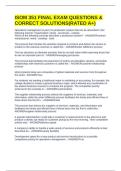
ISOM 351 FINAL EXAM QUESTIONS &
CORRECT SOLUTIONS(RATED A+)
Operations management is part of a production system that can be described in the
following manner: Organization: inputs - processes - outputs.
Which of the following correctly describes a production system? - ANSWERFurniture
manufacturer: wood - sanding - chair
The process that includes the activities required to produce and deliver the service or
product to the external customer is called the: - ANSWERorder fulfillment process
The key decisions to eliminate activities that do not add value while improving those that
do are an important part of: - ANSWERmanaging processes
The process that facilitates the placement of orders and identifies, attracts, and builds
relationships with external customers is called the: - ANSWERcustomer relationship
process
Most products today are composites of global materials and services from throughout
the world - ANSWERTrue
For students not wanting a traditional major in marketing or accounting, for example, the
college decided to create a general business major, which allowed any combination of
the easiest business courses to comprise the program. The competitive priority
achieved in this example is: - ANSWERcustomization
The supplier relationship process selects the suppliers of services, materials, and
information, while the order fulfillment process facilitates the timely and efficient flow of
these items into the firm. - ANSWERFalse
The process that selects the suppliers of services, materials, and information and
facilitates the timely and efficient flow of these items into the firm is called the: -
ANSWERsupplier relationship process
A popular haberdashery could take a customer's measurements in the afternoon and
produce a dandy suit ready for customer pickup by the next morning. Their competitive
priority was: - ANSWERdelivery speed
A company's ability to handle a wide variety of services and products efficiently is best
described as: - ANSWERvariety flexibility
Development speed for a new product and service introductions is a possible
competitive priority for operations management. - ANSWERTrue
, Operations management refers to the direction and control of inputs that transform
processes into products and service. - ANSWERTrue
While other suppliers bidding for the contract brought bids with lower per unit costs,
Orchard wanted to take delivery based on the fact that the components they were using
were machined to their exacting specifications 99.999999% of the time. Orchard's
competitive priority was: - ANSWERconsistent quality
Use the information provided in Table 1.1 An example of an internal customer is:
Lumber company - ABC Toy Manufacturing company - Toy Store at the mall -
ANSWERThe shipping department at ABC
At the level of the firm, service providers offer just services and manufacturers offer just
products. - ANSWERFalse
Budgeting, recruiting, and scheduling are examples of a: - ANSWERsupport process
Regardless of how departments like accounting, engineering, finance, and marketing
function in an organization, they are all linked together through: - ANSWERprocesses
Which of these statements about processes is not true? - ANSWERA process can exist
without customers.
The three main line functions of any business include operations, finance, and
marketing. - ANSWERTrue
A make-to-order strategy produces products to customer specifications in large
volumes. - ANSWERFalse
Suppose that competitive priorities call for offering a wide variety of customized
services. Which of the following process decisions would be more likely? -
ANSWERmore resource flexibility
An effective tool for showing steps of a service process with a high level of customer
contact is a: - ANSWERservice blueprint
A flowchart traces the flow of all except the following: - ANSWERsafety regulations
through a process.
Brainstorming sessions must have - ANSWERa way for all participants to communicate.
Active customer contact and personalized attention can lower cost to the customer by: -
ANSWERsubstituting customer efforts for those of the service provider.
Work sampling is most often used in situations in which: - ANSWERan estimate of the
proportion of the time spent on a particular activity is needed.
CORRECT SOLUTIONS(RATED A+)
Operations management is part of a production system that can be described in the
following manner: Organization: inputs - processes - outputs.
Which of the following correctly describes a production system? - ANSWERFurniture
manufacturer: wood - sanding - chair
The process that includes the activities required to produce and deliver the service or
product to the external customer is called the: - ANSWERorder fulfillment process
The key decisions to eliminate activities that do not add value while improving those that
do are an important part of: - ANSWERmanaging processes
The process that facilitates the placement of orders and identifies, attracts, and builds
relationships with external customers is called the: - ANSWERcustomer relationship
process
Most products today are composites of global materials and services from throughout
the world - ANSWERTrue
For students not wanting a traditional major in marketing or accounting, for example, the
college decided to create a general business major, which allowed any combination of
the easiest business courses to comprise the program. The competitive priority
achieved in this example is: - ANSWERcustomization
The supplier relationship process selects the suppliers of services, materials, and
information, while the order fulfillment process facilitates the timely and efficient flow of
these items into the firm. - ANSWERFalse
The process that selects the suppliers of services, materials, and information and
facilitates the timely and efficient flow of these items into the firm is called the: -
ANSWERsupplier relationship process
A popular haberdashery could take a customer's measurements in the afternoon and
produce a dandy suit ready for customer pickup by the next morning. Their competitive
priority was: - ANSWERdelivery speed
A company's ability to handle a wide variety of services and products efficiently is best
described as: - ANSWERvariety flexibility
Development speed for a new product and service introductions is a possible
competitive priority for operations management. - ANSWERTrue
, Operations management refers to the direction and control of inputs that transform
processes into products and service. - ANSWERTrue
While other suppliers bidding for the contract brought bids with lower per unit costs,
Orchard wanted to take delivery based on the fact that the components they were using
were machined to their exacting specifications 99.999999% of the time. Orchard's
competitive priority was: - ANSWERconsistent quality
Use the information provided in Table 1.1 An example of an internal customer is:
Lumber company - ABC Toy Manufacturing company - Toy Store at the mall -
ANSWERThe shipping department at ABC
At the level of the firm, service providers offer just services and manufacturers offer just
products. - ANSWERFalse
Budgeting, recruiting, and scheduling are examples of a: - ANSWERsupport process
Regardless of how departments like accounting, engineering, finance, and marketing
function in an organization, they are all linked together through: - ANSWERprocesses
Which of these statements about processes is not true? - ANSWERA process can exist
without customers.
The three main line functions of any business include operations, finance, and
marketing. - ANSWERTrue
A make-to-order strategy produces products to customer specifications in large
volumes. - ANSWERFalse
Suppose that competitive priorities call for offering a wide variety of customized
services. Which of the following process decisions would be more likely? -
ANSWERmore resource flexibility
An effective tool for showing steps of a service process with a high level of customer
contact is a: - ANSWERservice blueprint
A flowchart traces the flow of all except the following: - ANSWERsafety regulations
through a process.
Brainstorming sessions must have - ANSWERa way for all participants to communicate.
Active customer contact and personalized attention can lower cost to the customer by: -
ANSWERsubstituting customer efforts for those of the service provider.
Work sampling is most often used in situations in which: - ANSWERan estimate of the
proportion of the time spent on a particular activity is needed.