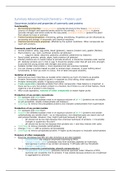
Summary Advanced Food Chemistry
Lipids
Classification of lipids ester group:
• Major group of lipids: triacylglycerols
• Saponifiable lipids: contain an ester group so can be hydrolysed by a reaction with a base
• Unsaponifiable lipids: no ester group: free fatty acids, sterols, hydrocarbons, vitamins
Fatty acids
• Aliphatic carboxylic acids with 4 or more carbon atoms → so structure WITH carbon but
WIHOUT an aromatic ring structure
• Saturated: no double bonds. Shorthand notation: for instance C16:0
• Unsaturated: one or more double bonds.
o Geometrical isomers: occur normally in cis-isomer. Processing can lead to trans-
isomer.
o Shorthand notation 1: Cx:y Δz = C18:2 Δ3 or C18:2, 3c, 6c (count form carboxylic
group)
o Shorthand notation 2: w-(Cx:y wm) = C18:2 w6 (count from methyl-end)
o Pentadiene structure: double bonds are three carbons apart, so methylene interrupted:
double – single – single – double
o Drawing structure: at double bonds it is flat, keep repeating double-single-single-
double. Below: 2 pentadiene systems.
o
o Drawing cis structure: every double bond is change of 45°
o You can go from C20:4 w6 to C18:2 w6 by desaturation and elongation because the
first double bond is at the same place.
Major lipid components: triacylglycerols (triglycerides)
• Simple TAG: three identical fatty acids. Mixed TAG: different fatty acids.
• Palmitic acid on sn-1, oleic acid on sn-2 and stearic acid on sn-3 = 1-palmitoyl, 2-oleoyl, 3-
stearoyl-sn-glycerol , or POS
• 5 different fatty acids = 53 = 125 different triglycerides
Minor lipid components
• Mono- and diacylglycerols: indicate uncompleted triglyceride synthesis or post-harvest lipolysis
(enzymes), emulsifying properties
• Phospholipids: most important minor compound!
o Glycerol backbone with 1 phosphate group and 2 fatty acids
o Hydrophilic head (phosphate group + substituent) and hydrophobic tails (fatty acids)
o Lecithin: natural emulsifier that is a mixture of different phospholipids
o Different substituents (base alcohols) attached to the phosphate group.
▪ No substituent
▪ Ethanolamine
▪ Inositol
▪ Choline → most hydratable
• Sterols: for instance cholesterol, increases risk of heart disease
• Wax esters: fatty acid + long-chain alcohol → haziness, remove by cooling and filtration
• Hydrocarbons: for instance carotenoids → long conjugated system = colour
• Fat-soluble vitamins: vitamin A, D and K. Vitamin E = tocopherol
• Tocopherols: natural antioxidant. Less substituted with methyl = better AO activity
Analysis of lipid composition
Fatty acid composition – GC-FID
• Also for geometrical (cis/trans) or positional isomers (different position double bonds)
• Step 1: release from glycerol backbone by strong base or acid
• Step 2: transform to FAMEs (Fatty Acid Methyl Esters) by methanol → more volatile
• Step 3: dissolve in organic solvent and inject to GC-FID
• Ions are formed by hydrogen flame and detected → retention time can be compared with
standard compounds. Peak area: relative amount of this fatty acid compared to others.
• Long retention time for: long fatty acids (less volatile), more double bonds, first double bond
close to methyl end
, Triacylglycerol composition – GC-FID or (U)HPLC
• No methyl esterification step needed
• Positional isomers (different position of the FA at the glycerol backbone) can be identified but
then you need partial hydrolysis
• With RP-HPLC and ELSD or MS detection: Retention time depends on ECN. Bigger ECN = longer
retention time
o ECN = CN – 2.60n0 – 2.35nl – 2.17nln
o CN = carbon number, total carbons of all fatty acids together
o 2.60n0 = 2.60 x number of double bonds in oleic acid
Degree of unsaturation – Iodine Value
• Grams of iodine that reacted with 100 grams of oil
• Iodine reacts with double bonds. Excess of iodine is transformed to free iodine (I 2) and titrated
to see how much iodine did not, and thus how much did react with double bonds.
• Calculate IV of oil: fraction of fatty acid x IV of fatty acid
Oil quality – lipid oxidation
• Degradation of unsaturated fatty acids → decreased nutritional value, off flavour (aldehydes,
ketones etc.)
• Colorimetric measurements: measure amount of conjugated dienes (double-single-double)
because this happens upon first step of oxidation, measure aldehydes by p-anisidine + TBARs
Oil quality – hydrolysis
• Degradation of TAG into free fatty acids and glycerol
• Happens during processing or storage (high temperature, change in pH, lipase)
• Measure free fatty acid content by titration with NaOH.
Sources of oils and fats
• Seed oil → from endosperm that is on the inside of the kernel / seed
o Low water content
o Small oil bodies
o Oil surrounded by phospholipids and proteins → prevents coalescence of oil
o Seeds have longer shelf life than extracted oil
• Pulp oil → from mesocarp (= fruity flesh surrounding the seed)
o High water content → lower oil stability (more lipid oxidation, hydrolysis, enzymatic
activity, spoilage by bacteria) = so needs fast extraction after harvesting
o Large oil bodies
Extraction of seed oils
• Harvest and storage: seeds can be stored longer if their moisture content is low
• Cleaning: remove impurities by sieving, air separation, magnets
• Dehulling (decortication): remove the hull. Can for instance contain waxes → oil turbidity. Less
material = easier to handle.
• Conditioning: bring to certain moisture content and temperature. Heating leads to:
o Disrupted cell membranes → more yield
o Denaturing proteins → breaking up emulsions
o Lowering oil viscosity
o Inactivate enzymes
o Sterilize seeds
o Detoxification
• Size reduction (breaking or flaking): disrupt the cell wall and oil bodies, increase surface to
volume ratio → so oil is easier extracted (more and with less power) and uniform cooking
• Pressing (mechanical extraction): volume becomes less and pressure increases
o Direct pressing: high pressure and high temperature (= lot of energy) leads to a cake
with only 4-7% residual oil. Organic method. Cooling is needed afterwards.
o Pre-pressing: low pressure leads to a cake with 15-25% residual oil so should be
combined with solvent extraction.
o Cold pressing: no heat is applied, high quality oil (virgin olive oil)
• Leaching (solvent-extraction): used to further extract oil from flakes or press cake. Yield of
99% = highest yield!
o Organic solvent is used: highly soluble in oil, not soluble in water, easy removable
from the meal, low cost, non-hazardous, environmental friendly → hexane
Lipids
Classification of lipids ester group:
• Major group of lipids: triacylglycerols
• Saponifiable lipids: contain an ester group so can be hydrolysed by a reaction with a base
• Unsaponifiable lipids: no ester group: free fatty acids, sterols, hydrocarbons, vitamins
Fatty acids
• Aliphatic carboxylic acids with 4 or more carbon atoms → so structure WITH carbon but
WIHOUT an aromatic ring structure
• Saturated: no double bonds. Shorthand notation: for instance C16:0
• Unsaturated: one or more double bonds.
o Geometrical isomers: occur normally in cis-isomer. Processing can lead to trans-
isomer.
o Shorthand notation 1: Cx:y Δz = C18:2 Δ3 or C18:2, 3c, 6c (count form carboxylic
group)
o Shorthand notation 2: w-(Cx:y wm) = C18:2 w6 (count from methyl-end)
o Pentadiene structure: double bonds are three carbons apart, so methylene interrupted:
double – single – single – double
o Drawing structure: at double bonds it is flat, keep repeating double-single-single-
double. Below: 2 pentadiene systems.
o
o Drawing cis structure: every double bond is change of 45°
o You can go from C20:4 w6 to C18:2 w6 by desaturation and elongation because the
first double bond is at the same place.
Major lipid components: triacylglycerols (triglycerides)
• Simple TAG: three identical fatty acids. Mixed TAG: different fatty acids.
• Palmitic acid on sn-1, oleic acid on sn-2 and stearic acid on sn-3 = 1-palmitoyl, 2-oleoyl, 3-
stearoyl-sn-glycerol , or POS
• 5 different fatty acids = 53 = 125 different triglycerides
Minor lipid components
• Mono- and diacylglycerols: indicate uncompleted triglyceride synthesis or post-harvest lipolysis
(enzymes), emulsifying properties
• Phospholipids: most important minor compound!
o Glycerol backbone with 1 phosphate group and 2 fatty acids
o Hydrophilic head (phosphate group + substituent) and hydrophobic tails (fatty acids)
o Lecithin: natural emulsifier that is a mixture of different phospholipids
o Different substituents (base alcohols) attached to the phosphate group.
▪ No substituent
▪ Ethanolamine
▪ Inositol
▪ Choline → most hydratable
• Sterols: for instance cholesterol, increases risk of heart disease
• Wax esters: fatty acid + long-chain alcohol → haziness, remove by cooling and filtration
• Hydrocarbons: for instance carotenoids → long conjugated system = colour
• Fat-soluble vitamins: vitamin A, D and K. Vitamin E = tocopherol
• Tocopherols: natural antioxidant. Less substituted with methyl = better AO activity
Analysis of lipid composition
Fatty acid composition – GC-FID
• Also for geometrical (cis/trans) or positional isomers (different position double bonds)
• Step 1: release from glycerol backbone by strong base or acid
• Step 2: transform to FAMEs (Fatty Acid Methyl Esters) by methanol → more volatile
• Step 3: dissolve in organic solvent and inject to GC-FID
• Ions are formed by hydrogen flame and detected → retention time can be compared with
standard compounds. Peak area: relative amount of this fatty acid compared to others.
• Long retention time for: long fatty acids (less volatile), more double bonds, first double bond
close to methyl end
, Triacylglycerol composition – GC-FID or (U)HPLC
• No methyl esterification step needed
• Positional isomers (different position of the FA at the glycerol backbone) can be identified but
then you need partial hydrolysis
• With RP-HPLC and ELSD or MS detection: Retention time depends on ECN. Bigger ECN = longer
retention time
o ECN = CN – 2.60n0 – 2.35nl – 2.17nln
o CN = carbon number, total carbons of all fatty acids together
o 2.60n0 = 2.60 x number of double bonds in oleic acid
Degree of unsaturation – Iodine Value
• Grams of iodine that reacted with 100 grams of oil
• Iodine reacts with double bonds. Excess of iodine is transformed to free iodine (I 2) and titrated
to see how much iodine did not, and thus how much did react with double bonds.
• Calculate IV of oil: fraction of fatty acid x IV of fatty acid
Oil quality – lipid oxidation
• Degradation of unsaturated fatty acids → decreased nutritional value, off flavour (aldehydes,
ketones etc.)
• Colorimetric measurements: measure amount of conjugated dienes (double-single-double)
because this happens upon first step of oxidation, measure aldehydes by p-anisidine + TBARs
Oil quality – hydrolysis
• Degradation of TAG into free fatty acids and glycerol
• Happens during processing or storage (high temperature, change in pH, lipase)
• Measure free fatty acid content by titration with NaOH.
Sources of oils and fats
• Seed oil → from endosperm that is on the inside of the kernel / seed
o Low water content
o Small oil bodies
o Oil surrounded by phospholipids and proteins → prevents coalescence of oil
o Seeds have longer shelf life than extracted oil
• Pulp oil → from mesocarp (= fruity flesh surrounding the seed)
o High water content → lower oil stability (more lipid oxidation, hydrolysis, enzymatic
activity, spoilage by bacteria) = so needs fast extraction after harvesting
o Large oil bodies
Extraction of seed oils
• Harvest and storage: seeds can be stored longer if their moisture content is low
• Cleaning: remove impurities by sieving, air separation, magnets
• Dehulling (decortication): remove the hull. Can for instance contain waxes → oil turbidity. Less
material = easier to handle.
• Conditioning: bring to certain moisture content and temperature. Heating leads to:
o Disrupted cell membranes → more yield
o Denaturing proteins → breaking up emulsions
o Lowering oil viscosity
o Inactivate enzymes
o Sterilize seeds
o Detoxification
• Size reduction (breaking or flaking): disrupt the cell wall and oil bodies, increase surface to
volume ratio → so oil is easier extracted (more and with less power) and uniform cooking
• Pressing (mechanical extraction): volume becomes less and pressure increases
o Direct pressing: high pressure and high temperature (= lot of energy) leads to a cake
with only 4-7% residual oil. Organic method. Cooling is needed afterwards.
o Pre-pressing: low pressure leads to a cake with 15-25% residual oil so should be
combined with solvent extraction.
o Cold pressing: no heat is applied, high quality oil (virgin olive oil)
• Leaching (solvent-extraction): used to further extract oil from flakes or press cake. Yield of
99% = highest yield!
o Organic solvent is used: highly soluble in oil, not soluble in water, easy removable
from the meal, low cost, non-hazardous, environmental friendly → hexane