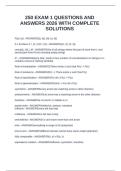
250 EXAM 1 QUESTIONS AND
ANSWERS 2026 WITH COMPLETE
SOLUTIONS
P({a, b}) - ANSWERS{{}, {a}, {b}, {a, b}}
A x B where A = {1, 2} B = {3} - ANSWERS{(1, 3), (2, 3)}
concat(L, M), LM - ANSWERSSet of all strings where first part of word from L and
second part from M (no choosing empty string)
A* - ANSWERSKleene Star: result of any number of concatenations on strings in A,
contains concat of nothing (lambda)
Rule of instantiation - ANSWERSThere exists x such that P(x) -> P(c)
Rule of existence - ANSWERSP(c) -> There exists x such that P(x)
Rule of specification - ANSWERSFor all x P(x) -> P(c)
Rule of generalization - ANSWERSP(arb) -> For all x P(x)
symmetric - ANSWERSevery arrow has matching arrow in other direction
antisymmetric - ANSWERSno arrow has a matching arrow in the other direction
transitive - ANSWERSa->b and b->c implies a->c
partial order - ANSWERSreflexive, antisym, transitive
reflexive - ANSWERSevery dot has loop
irreflexive - ANSWERSno dot has a loop
well-defined - ANSWERSx's can't have more than one arrow
onto - ANSWERSeverything in range is hit (surjection)
one-to-one - ANSWERSdifferent domain cannot have same output (injection)
fully comparable - ANSWERSR(x, y) v R(y, x)
equivalence relation - ANSWERSreflexive, symmetric, transitive
ANSWERS 2026 WITH COMPLETE
SOLUTIONS
P({a, b}) - ANSWERS{{}, {a}, {b}, {a, b}}
A x B where A = {1, 2} B = {3} - ANSWERS{(1, 3), (2, 3)}
concat(L, M), LM - ANSWERSSet of all strings where first part of word from L and
second part from M (no choosing empty string)
A* - ANSWERSKleene Star: result of any number of concatenations on strings in A,
contains concat of nothing (lambda)
Rule of instantiation - ANSWERSThere exists x such that P(x) -> P(c)
Rule of existence - ANSWERSP(c) -> There exists x such that P(x)
Rule of specification - ANSWERSFor all x P(x) -> P(c)
Rule of generalization - ANSWERSP(arb) -> For all x P(x)
symmetric - ANSWERSevery arrow has matching arrow in other direction
antisymmetric - ANSWERSno arrow has a matching arrow in the other direction
transitive - ANSWERSa->b and b->c implies a->c
partial order - ANSWERSreflexive, antisym, transitive
reflexive - ANSWERSevery dot has loop
irreflexive - ANSWERSno dot has a loop
well-defined - ANSWERSx's can't have more than one arrow
onto - ANSWERSeverything in range is hit (surjection)
one-to-one - ANSWERSdifferent domain cannot have same output (injection)
fully comparable - ANSWERSR(x, y) v R(y, x)
equivalence relation - ANSWERSreflexive, symmetric, transitive