

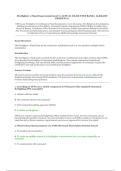
Firefighter 1 Final Exam (2026/2027) | ACTUAL EXAM TEST BANK | ALREADY
GRADED A+
NFPA 1001 Firefighter I Certification Final Examination | Core Domains: Fire Behavior & Combustion,
Building Construction & Fire Effects, Personal Protective Equipment (PPE) & SCBA, Forcible Entry,
Search & Rescue, Ventilation, Hose Streams & Fire Streams, Ladder Operations, Salvage & Overhaul,
Fire Prevention & Public Education, and Incident Command System (ICS) Fundamentals | Fire Service
Certification Focus | Comprehensive Skills & Knowledge Assessment Format
Exam Structure
The Firefighter 1 Final Exam for the 2026/2027 certification cycle is a 100-question, multiple-choice
examination.
Introduction
This Firefighter 1 Final Exam test bank for the 2026/2027 certification cycle aligns with the latest NFPA
1001 Standard for Firefighter Professional Qualifications. The content emphasizes foundational
firefighting knowledge, safe operational skills, and the practical application of techniques required for
certification and safe performance as a probationary firefighter.
Answer Format
All correct answers and fire service procedures must be presented in bold and green, followed by
detailed rationales referencing NFPA standards, ICS protocols, tactical safety considerations, and
evidence-based fireground practices.
1. According to NFPA 1971, which component is NOT part of the standard structural
firefighting PPE ensemble?
A. Helmet with face shield
B. Fire-resistant turnout coat and pants
C. Self-contained breathing apparatus (SCBA)
D. Leather work gloves
NFPA 1971 requires structural firefighting PPE to include helmet, hood, turnout coat/pants, gloves
(specifically thermal/fire-resistant, not general leather), boots, and SCBA. Leather work gloves do not
meet thermal or flame resistance requirements and are not approved for interior fire attack.
2. What is the primary purpose of a PASS (Personal Alert Safety System) device?
A. To monitor air consumption
B. To emit an audible alarm if a firefighter is motionless for a set time (typically 30
seconds)
C. To communicate with command
,D. To measure heat exposure
Per NFPA 1982, the PASS device activates automatically when motionless for 15–30 seconds, alerting
others to a downed firefighter. It is integrated into SCBA and is critical for rapid intervention during
mayday situations.
3. In fire behavior, what does the term “flashover” describe?
A. Spontaneous ignition of unburned gases
B. The near-simultaneous ignition of all combustible contents in a compartment due to
radiant heat
C. Explosion from flammable vapors
D. Backdraft explosion
Flashover occurs when room temperatures reach 500–600°C (932–1112°F), causing all exposed
surfaces to ignite. It marks the transition from a contents fire to a fully developed room fire and is a
critical hazard for interior crews (NFPA 921).
4. Which type of building construction is MOST prone to early collapse during a fire?
A. Type I (Fire-resistive)
B. Type II (Non-combustible)
C. Type V (Wood-frame)
D. Type III (Ordinary)
Type V construction uses lightweight wood framing with minimal fire resistance. Modern Type V
(especially with engineered I-joists or trusses) can fail in as little as 5–10 minutes under fire conditions
(NFPA 220). This makes it the most collapse-prone for interior operations.
5. What is the correct way to test the seal of an SCBA facepiece before donning?
A. Inhale deeply with the air turned off
B. Block the exhalation valve and gently inhale—if the facepiece collapses slightly and
holds, the seal is good
C. Blow into the mask
D. Submerge in water
The negative pressure seal check (blocking the exhalation valve and inhaling) verifies no air leaks
around the facepiece. A positive pressure check (exhaling with inhalation valve blocked) is also used.
Both are required per OSHA and NFPA 1500 before entry.
, 6. Which forcible entry tool is BEST suited for prying open a jammed inward-swinging
door?
A. Flathead axe
B. Halligan bar
C. Sledgehammer
D. Rabbit tool
The Halligan bar’s adz end can be inserted between the door and jamb to force inward-swinging doors.
Its fork can also defeat locks. It is often used with a flathead axe (the “irons”) for maximum leverage
(IFSTA Essentials).
7. In primary search operations, what is the standard search pattern used in zero-visibility
conditions?
A. Grid search
B. Oriented search (team remains connected to a hoseline or search rope)
C. Free search
D. Thermal imaging only
NFPA 1403 and fire service best practices require that search teams maintain contact with a hoseline or
search rope to ensure egress in zero visibility. This “oriented search” prevents disorientation and
enables rapid evacuation if conditions deteriorate.
8. What is the primary purpose of vertical ventilation during interior fire attack?
A. To cool the structure
B. To remove heat, smoke, and toxic gases from the fire compartment, improving visibility
and tenability for interior crews
C. To provide fresh air for overhaul
D. To dry out salvage covers
Vertical ventilation (e.g., cutting a hole in the roof) creates a path for hot gases to escape, reducing heat
buildup and smoke logging. It must be coordinated with fire attack to avoid feeding the fire (IFSTA,
NFPA 1500).
9. Which fire stream is MOST effective for interior structural firefighting?
A. Solid stream
B. Fog stream (adjustable nozzle set to narrow fog for penetration)
GRADED A+
NFPA 1001 Firefighter I Certification Final Examination | Core Domains: Fire Behavior & Combustion,
Building Construction & Fire Effects, Personal Protective Equipment (PPE) & SCBA, Forcible Entry,
Search & Rescue, Ventilation, Hose Streams & Fire Streams, Ladder Operations, Salvage & Overhaul,
Fire Prevention & Public Education, and Incident Command System (ICS) Fundamentals | Fire Service
Certification Focus | Comprehensive Skills & Knowledge Assessment Format
Exam Structure
The Firefighter 1 Final Exam for the 2026/2027 certification cycle is a 100-question, multiple-choice
examination.
Introduction
This Firefighter 1 Final Exam test bank for the 2026/2027 certification cycle aligns with the latest NFPA
1001 Standard for Firefighter Professional Qualifications. The content emphasizes foundational
firefighting knowledge, safe operational skills, and the practical application of techniques required for
certification and safe performance as a probationary firefighter.
Answer Format
All correct answers and fire service procedures must be presented in bold and green, followed by
detailed rationales referencing NFPA standards, ICS protocols, tactical safety considerations, and
evidence-based fireground practices.
1. According to NFPA 1971, which component is NOT part of the standard structural
firefighting PPE ensemble?
A. Helmet with face shield
B. Fire-resistant turnout coat and pants
C. Self-contained breathing apparatus (SCBA)
D. Leather work gloves
NFPA 1971 requires structural firefighting PPE to include helmet, hood, turnout coat/pants, gloves
(specifically thermal/fire-resistant, not general leather), boots, and SCBA. Leather work gloves do not
meet thermal or flame resistance requirements and are not approved for interior fire attack.
2. What is the primary purpose of a PASS (Personal Alert Safety System) device?
A. To monitor air consumption
B. To emit an audible alarm if a firefighter is motionless for a set time (typically 30
seconds)
C. To communicate with command
,D. To measure heat exposure
Per NFPA 1982, the PASS device activates automatically when motionless for 15–30 seconds, alerting
others to a downed firefighter. It is integrated into SCBA and is critical for rapid intervention during
mayday situations.
3. In fire behavior, what does the term “flashover” describe?
A. Spontaneous ignition of unburned gases
B. The near-simultaneous ignition of all combustible contents in a compartment due to
radiant heat
C. Explosion from flammable vapors
D. Backdraft explosion
Flashover occurs when room temperatures reach 500–600°C (932–1112°F), causing all exposed
surfaces to ignite. It marks the transition from a contents fire to a fully developed room fire and is a
critical hazard for interior crews (NFPA 921).
4. Which type of building construction is MOST prone to early collapse during a fire?
A. Type I (Fire-resistive)
B. Type II (Non-combustible)
C. Type V (Wood-frame)
D. Type III (Ordinary)
Type V construction uses lightweight wood framing with minimal fire resistance. Modern Type V
(especially with engineered I-joists or trusses) can fail in as little as 5–10 minutes under fire conditions
(NFPA 220). This makes it the most collapse-prone for interior operations.
5. What is the correct way to test the seal of an SCBA facepiece before donning?
A. Inhale deeply with the air turned off
B. Block the exhalation valve and gently inhale—if the facepiece collapses slightly and
holds, the seal is good
C. Blow into the mask
D. Submerge in water
The negative pressure seal check (blocking the exhalation valve and inhaling) verifies no air leaks
around the facepiece. A positive pressure check (exhaling with inhalation valve blocked) is also used.
Both are required per OSHA and NFPA 1500 before entry.
, 6. Which forcible entry tool is BEST suited for prying open a jammed inward-swinging
door?
A. Flathead axe
B. Halligan bar
C. Sledgehammer
D. Rabbit tool
The Halligan bar’s adz end can be inserted between the door and jamb to force inward-swinging doors.
Its fork can also defeat locks. It is often used with a flathead axe (the “irons”) for maximum leverage
(IFSTA Essentials).
7. In primary search operations, what is the standard search pattern used in zero-visibility
conditions?
A. Grid search
B. Oriented search (team remains connected to a hoseline or search rope)
C. Free search
D. Thermal imaging only
NFPA 1403 and fire service best practices require that search teams maintain contact with a hoseline or
search rope to ensure egress in zero visibility. This “oriented search” prevents disorientation and
enables rapid evacuation if conditions deteriorate.
8. What is the primary purpose of vertical ventilation during interior fire attack?
A. To cool the structure
B. To remove heat, smoke, and toxic gases from the fire compartment, improving visibility
and tenability for interior crews
C. To provide fresh air for overhaul
D. To dry out salvage covers
Vertical ventilation (e.g., cutting a hole in the roof) creates a path for hot gases to escape, reducing heat
buildup and smoke logging. It must be coordinated with fire attack to avoid feeding the fire (IFSTA,
NFPA 1500).
9. Which fire stream is MOST effective for interior structural firefighting?
A. Solid stream
B. Fog stream (adjustable nozzle set to narrow fog for penetration)


