
Study Unit 3: Transcription
1) Introduction:
1.1) An early world:
1. The existence of ribozymes suggests that RNA was the original genetic
material of all living things
2. Ribozymes: catalytic RNA that carry out metabolic processes and serve
as genetic material
1.2) Structure of RNA:
1. The primary structure consists of sugar, phosphate and nucleotides
2. RNA has a 5’-3’ direction
3. Nucleotides can bind: adenosine binds to uracil and cytosine binds to
guanine
4. Because RNA is in a single strand it is much more reactive and less stable
than DNA
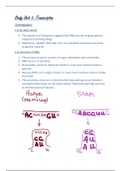
5. The secondary structure is formed when base pairing occurs between
complementary bases on the same strand. These base pairings can lead
to the formation of hairpins.
, 1.3) Classes of RNA:
Full name Abbreviation Additional info:
Ribosomal RNA rRNA Component of
ribosomes
Messenger RNA mRNA Carries genetic code
for proteins
Transfer RNA tRNA Carries amino acids to
the ribosome to be
incorporated into the
growing polypeptide
strain
Small nuclear RNA snRNA Involved in the
processing of pre-
mRNA
Small nucleolar RNA snoRNA Processes of rRNA
Micro RNA miRNA Inhibits translation of
mRNA
Small interfering RNA siRNA Triggers degradation of
other RNA molecules
CRISPR RNA ciRNA Destruction of foreign
DNA
Piwi-interacting RNA piDNA Surpress transcription
of transposable
elements (jumping
genes)
1.4) Comparing DNA and RNA:
Characteristic DNA RNA
Sugars deoxyribose Ribose
Bases T, A, G, C U, A, G, C
Structure Double strand forming Single strand forming
double helix hairpins
Stability Stable Unstable
2) Transcription: DNA to RNA:
2.1) What will be transcribed:
1. In prokaryotes and eukaryotes:
1) Introduction:
1.1) An early world:
1. The existence of ribozymes suggests that RNA was the original genetic
material of all living things
2. Ribozymes: catalytic RNA that carry out metabolic processes and serve
as genetic material
1.2) Structure of RNA:
1. The primary structure consists of sugar, phosphate and nucleotides
2. RNA has a 5’-3’ direction
3. Nucleotides can bind: adenosine binds to uracil and cytosine binds to
guanine
4. Because RNA is in a single strand it is much more reactive and less stable
than DNA
5. The secondary structure is formed when base pairing occurs between
complementary bases on the same strand. These base pairings can lead
to the formation of hairpins.
, 1.3) Classes of RNA:
Full name Abbreviation Additional info:
Ribosomal RNA rRNA Component of
ribosomes
Messenger RNA mRNA Carries genetic code
for proteins
Transfer RNA tRNA Carries amino acids to
the ribosome to be
incorporated into the
growing polypeptide
strain
Small nuclear RNA snRNA Involved in the
processing of pre-
mRNA
Small nucleolar RNA snoRNA Processes of rRNA
Micro RNA miRNA Inhibits translation of
mRNA
Small interfering RNA siRNA Triggers degradation of
other RNA molecules
CRISPR RNA ciRNA Destruction of foreign
DNA
Piwi-interacting RNA piDNA Surpress transcription
of transposable
elements (jumping
genes)
1.4) Comparing DNA and RNA:
Characteristic DNA RNA
Sugars deoxyribose Ribose
Bases T, A, G, C U, A, G, C
Structure Double strand forming Single strand forming
double helix hairpins
Stability Stable Unstable
2) Transcription: DNA to RNA:
2.1) What will be transcribed:
1. In prokaryotes and eukaryotes:


