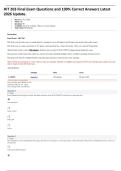
HIT 203 Final Exam Questions and 100% Correct Answers Latest
2026 Update.
• Due May 14 at 11pm
• Points 100
• Questions 50
• Available Apr 25 at 12:05am - May 14 at 11pm 20 days
• Time Limit 180 Minutes
Instructions
Final Exam – HIT 203
The final exam for this course is comprehensive; meaning it covers all chapters and all topics discussed in this entire course.
The final exam is worth a maximum of 100 points. Each question has a value of 2 points. There are a total of 50 questions.
Allotted time for this exam is 180 minutes. Students may use only the ICD-10-PCS coding manual during this exam.
The questions on this final exam will be in a variety of formats including multiple choice, true/false, matching and short answer.
The final exam must be completed before stated due date and time as listed on the course calendar.
There will be no extensions or redo’s; there is only one attempt. Students are highly encouraged to NOT wait until due date and/or near due
time to begin to take the final exam.
Attempt History
Attempt Time Score
LATEST Attempt 1 120 minutes 90 out of 100
Correct answers are hidden.
Score for this quiz: 90 out of 100
Submitted May 9 at 7:15pm
This attempt took 120 minutes.
Question 1
pts
In the Medical and Surgical section, the third character of the ICD-CM-PCS code always represents the:
root operation
body system
body part
device
Question 2
pts
This modality is used in Radiation Oncology and delivers treatment at a close proximity, often internally with probes or Palladium seeds, such as to
the prostate.
Stereotastic Radiosurgery
,Brachytherapy
Beam Radiation
Teletherapy
Question 3
pts
Anatomically the left lung has:
Upper lobe, lower lobe and lingula
Upper lobe, middle lobe, and lower lobe
Bronchioles, upper lobe and lower lobe
Bronchi, Bronchioles, and upper and lower lobes
Answer: Upper lobe, lower lobe and lingula
The left lung and right lung fields are different. The left lung has upper lobe, lower lobe, and lingula in the middle. The right lung has an upper lobe,
a middle lobe, and a lower lobe.
Reference; Ch 10
Question 4
pts
Which one below is not an anatomical division of the stomach?
Cardia
Fundus
Antrum
Colon
Answer: Colon
The anatomical divisions of the stomach are cardia, fundus, body, antrum, and pylorus
Reference Ch 12
Question 5
pts
, Which one of the below is not a part of the CNS?
Brain
Meninges
Spinal Cord
Somatic nerves
Answer: Somatic nerves
The somatic nerves are part of the Peripheral nervous system (PNS) not the Central Nervous System.
The CNS includes the brain, meninges, the cranial nerves, and the spinal cord
Reference: Chapter 8
Question 6
pts
What is found on the outer edge of the right kidney?
Renal cortex
Renal medulla
Renal pyramid
Glomerulus
Answer: Renal Cortex
Reference Ch 17
The renal cortex is found on the outer edge of both kidneys
Question 7
pts
Review the below operative report -
DIAGNOSIS: Low back pain, lumbar facet arthropathy, lumbar radiculopathy, failure of conservative management.
PROCEDURE: Neural modulation with a spinal cord stimulator implant under fluoroscopic guidance.
INTERIM HISTORY: Patient is well known to me. She has had conservative management with injections and medication from other pain physicians.
At this time, the patient is unable to return to work because of the persistent pain, and she had a spinal cord stimulator trial which gave her significant
relief so we are going ahead with the spinal cord stimulator implant. The patient understands the risks and benefits of this. Patient understands if she
has any side effects, she has to reach me or reach the emergency room.
DESCRIPTION OF PROCEDURE: After taking informed consent, with the patient in prone position the back was prepped aseptically and draped
aseptically. The patient was then spontaneously breathing and communicating throughout the procedure. Under AP view of fluoroscopy, L1
interspinous process was identified. Local was infiltrated using 3 mL of 1% lidocaine and 4 mL of 1% preservative-free Marcaine using a 2S-gauge
needle. Number 14-gauge epidural needle was then advanced under continuous AP and then under continuous lateral fluoroscopy to reach the
2026 Update.
• Due May 14 at 11pm
• Points 100
• Questions 50
• Available Apr 25 at 12:05am - May 14 at 11pm 20 days
• Time Limit 180 Minutes
Instructions
Final Exam – HIT 203
The final exam for this course is comprehensive; meaning it covers all chapters and all topics discussed in this entire course.
The final exam is worth a maximum of 100 points. Each question has a value of 2 points. There are a total of 50 questions.
Allotted time for this exam is 180 minutes. Students may use only the ICD-10-PCS coding manual during this exam.
The questions on this final exam will be in a variety of formats including multiple choice, true/false, matching and short answer.
The final exam must be completed before stated due date and time as listed on the course calendar.
There will be no extensions or redo’s; there is only one attempt. Students are highly encouraged to NOT wait until due date and/or near due
time to begin to take the final exam.
Attempt History
Attempt Time Score
LATEST Attempt 1 120 minutes 90 out of 100
Correct answers are hidden.
Score for this quiz: 90 out of 100
Submitted May 9 at 7:15pm
This attempt took 120 minutes.
Question 1
pts
In the Medical and Surgical section, the third character of the ICD-CM-PCS code always represents the:
root operation
body system
body part
device
Question 2
pts
This modality is used in Radiation Oncology and delivers treatment at a close proximity, often internally with probes or Palladium seeds, such as to
the prostate.
Stereotastic Radiosurgery
,Brachytherapy
Beam Radiation
Teletherapy
Question 3
pts
Anatomically the left lung has:
Upper lobe, lower lobe and lingula
Upper lobe, middle lobe, and lower lobe
Bronchioles, upper lobe and lower lobe
Bronchi, Bronchioles, and upper and lower lobes
Answer: Upper lobe, lower lobe and lingula
The left lung and right lung fields are different. The left lung has upper lobe, lower lobe, and lingula in the middle. The right lung has an upper lobe,
a middle lobe, and a lower lobe.
Reference; Ch 10
Question 4
pts
Which one below is not an anatomical division of the stomach?
Cardia
Fundus
Antrum
Colon
Answer: Colon
The anatomical divisions of the stomach are cardia, fundus, body, antrum, and pylorus
Reference Ch 12
Question 5
pts
, Which one of the below is not a part of the CNS?
Brain
Meninges
Spinal Cord
Somatic nerves
Answer: Somatic nerves
The somatic nerves are part of the Peripheral nervous system (PNS) not the Central Nervous System.
The CNS includes the brain, meninges, the cranial nerves, and the spinal cord
Reference: Chapter 8
Question 6
pts
What is found on the outer edge of the right kidney?
Renal cortex
Renal medulla
Renal pyramid
Glomerulus
Answer: Renal Cortex
Reference Ch 17
The renal cortex is found on the outer edge of both kidneys
Question 7
pts
Review the below operative report -
DIAGNOSIS: Low back pain, lumbar facet arthropathy, lumbar radiculopathy, failure of conservative management.
PROCEDURE: Neural modulation with a spinal cord stimulator implant under fluoroscopic guidance.
INTERIM HISTORY: Patient is well known to me. She has had conservative management with injections and medication from other pain physicians.
At this time, the patient is unable to return to work because of the persistent pain, and she had a spinal cord stimulator trial which gave her significant
relief so we are going ahead with the spinal cord stimulator implant. The patient understands the risks and benefits of this. Patient understands if she
has any side effects, she has to reach me or reach the emergency room.
DESCRIPTION OF PROCEDURE: After taking informed consent, with the patient in prone position the back was prepped aseptically and draped
aseptically. The patient was then spontaneously breathing and communicating throughout the procedure. Under AP view of fluoroscopy, L1
interspinous process was identified. Local was infiltrated using 3 mL of 1% lidocaine and 4 mL of 1% preservative-free Marcaine using a 2S-gauge
needle. Number 14-gauge epidural needle was then advanced under continuous AP and then under continuous lateral fluoroscopy to reach the