

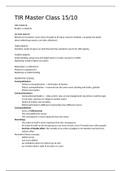
TIR Master Class 15/10
FIRST DEBATE:
Realists vs idealists
SECOND DEBATE:
Behavioral revolution: exact sience brought to IR (eg by research methods, not going into depth
about underlying reasons, just data collections)
THIRD DEBATE:
Scientists could not agree on what theories they wanted to use for IR, still ongoing
FOURTH DEBATE:
Understanding: going more into depth about a certain concept or conflict
Explaining: trying to figure out causes
Rationalism vs reflectivism
Positivist vs postposivist
Explaining vs Understanding
NORMATIVE SCIENCE:
Cosmopolitanism:
- Political cosmopolitanism -> elimination of borders
- Ethical cosmopolitanism -> everyone has the same moral standing and duties, globally
- Ethical universalism
Communitarianism :
- Communitarian Realism -> state-centric view on moral judgements (eg torture could be legal
in one state, whereas it is illegal in another state)
- Notion of insiders and outsiders
- Ethical particularism (different communities have different norms)
Consequentialism:
- Same as Utilitarianism
- The end justifies the means
- The consequence is more important than the action
Deontology:
- The action in itself is more important than the consequence
- An action in itself can be wrong (eg you can never torture, even if it would save other people)
- Doctrine of Double effect: the morality of an action is judged on its intention and not by its
indirect effect
Normative theory concepts:
- Settled norms
- Just war tradition
- Jus ad bellum (when is it right to go to war)
- Jus in bello (what is right to do when in a war)
FIRST DEBATE:
Realists vs idealists
SECOND DEBATE:
Behavioral revolution: exact sience brought to IR (eg by research methods, not going into depth
about underlying reasons, just data collections)
THIRD DEBATE:
Scientists could not agree on what theories they wanted to use for IR, still ongoing
FOURTH DEBATE:
Understanding: going more into depth about a certain concept or conflict
Explaining: trying to figure out causes
Rationalism vs reflectivism
Positivist vs postposivist
Explaining vs Understanding
NORMATIVE SCIENCE:
Cosmopolitanism:
- Political cosmopolitanism -> elimination of borders
- Ethical cosmopolitanism -> everyone has the same moral standing and duties, globally
- Ethical universalism
Communitarianism :
- Communitarian Realism -> state-centric view on moral judgements (eg torture could be legal
in one state, whereas it is illegal in another state)
- Notion of insiders and outsiders
- Ethical particularism (different communities have different norms)
Consequentialism:
- Same as Utilitarianism
- The end justifies the means
- The consequence is more important than the action
Deontology:
- The action in itself is more important than the consequence
- An action in itself can be wrong (eg you can never torture, even if it would save other people)
- Doctrine of Double effect: the morality of an action is judged on its intention and not by its
indirect effect
Normative theory concepts:
- Settled norms
- Just war tradition
- Jus ad bellum (when is it right to go to war)
- Jus in bello (what is right to do when in a war)


