P age | 1
| | | | |
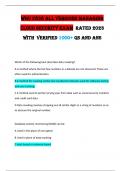
AIC 301 2026 BRAND NEW ACTUAL EXAM WITH 100%
VERIFIED QUESTIONS AND CORRECT SOLUTIONS
.What are the elements of a legally binding contract? - correct
| | | | | | | | | |
answer -To be legally binding, contracts must:
| | | | | | |
• Contain an agreement between all parties | | | | |
• Involve parties with the legal capacity to contract
| | | | | | |
• Contain mutual assent | |
• Involve consideration |
• Have a legal purpose | | |
• Be in the form prescribed by law
| | | | | |
What are the similarities and differences between bilateral and
| | | | | | | |
unilateral contracts? - correct answer -In bilateral contracts, each
| | | | | | | | |
party promises to perform an act in exchange for the act of the other
| | | | | | | | | | | | | |
party. In a unilateral contract, one party promises to pay for an act of
| | | | | | | | | | | | | |
the other party. If the act isn't performed, no payment is required
| | | | | | | | | | | |
What are the similarities and differences between voidable and void
| | | | | | | | |
contracts? - correct answer -A voidable contract is a valid contract
| | | | | | | | | | |
that can continue in force, and the parties can execute it
| | | | | | | | | | |
, P age | 2 | | | | |
completely unless an innocent or injured party chooses to avoid it. | | | | | | | | | |
The behavior of one of the contracting parties, such as an act of
| | | | | | | | | | | | |
fraud or illegal deceit, can also make a contract voidable. A void
| | | | | | | | | | | |
contract is an agreement that never met the necessary criteria to be
| | | | | | | | | | | |
considered a contract
| | |
What are the two remedies available to the plaintiff if fraud is proved
| | | | | | | | | | | |
in a given case? - correct answer -If fraud is proved, the plaintiff can
| | | | | | | | | | | | | |
seek one of two remedies: •
| | | | | |
Rescission—If the court rescinds the contract, the plaintiff has no | | | | | | | | |
further duties under it and is entitled to reimbursement of all
| | | | | | | | | | |
payments made to the defendant. The plaintiff also must return
| | | | | | | | | |
anything of value received under the contract. The court's goal is to
| | | | | | | | | | | |
restore the parties to the condition they were in before they entered
| | | | | | | | | | | |
the contract.
| |
• Sue for damages—If rescission wouldn't make the plaintiff
| | | | | | |
whole, the plaintiff can sue for damages in a tort action. The
| | | | | | | | | | | |
plaintiff can seek compensatory damages for quantifiable harm
| | | | | | | |
and punitive damages to further punish the defendant and deter
| | | | | | | | | |
future, similar fraudulent actions. The plaintiff must prove the
| | | | | | | | |
extent of the loss to receive damages.
| | | | | | |
What are two things the insurer must prove to establish that
| | | | | | | | | |
fraudulent concealment occurred? - correct answer -To establish
| | | | | | | |
, P age | 3 | | | | |
that fraudulent concealment occurred, the insurer must prove two
| | | | | | | |
things:
|
• The insured knew that the fact concealed was material.
| | | | | | | |
• The insured concealed the fact with the intent to defraud.
| | | | | | | | |
What is the difference between unilateral and bilateral mistakes in a
| | | | | | | | | |
contract? - correct answer -A unilateral mistake is made by one
| | | | | | | | | | |
party to a contract. Bilateral mistakes occur when both parties to a
| | | | | | | | | | | |
contract make the same mistake involving a material fact.
| | | | | | | | |
On what grounds can a person who has reasonably relied on an
| | | | | | | | | | |
innocently misrepresented material fact later avoid a contract? -
| | | | | | | | |
correct answer -A person who relies on a misrepresented material
| | | | | | | | | |
fact can later avoid a resulting contract because he or she didn't
| | | | | | | | | | | |
achieve mutual assent
| | |
What is the purpose of the parol evidence rule? - correct answer -
| | | | | | | | | | | |
The parol evidence rule serves three purposes:
| | | | | | |
• Carry out the parties' presumed intention.
| | | | |
• Achieve certainty and finality as to the parties' rights and duties
| | | | | | | | | |
. • Exclude fraudulent and perjured claims
| | | | | |
, P age | 4 | | | | |
How do courts resolve doubts and ambiguities in the language of a
| | | | | | | | | | |
contract? - correct answer -Courts use well-accepted interpretation
| | | | | | | |
guidelines to resolve doubts and ambiguities in an existing
| | | | | | | | |
contract. These guidelines are not strict legal rules, and they aren't
| | | | | | | | | | |
designed to create a new contract or rewrite an old one
| | | | | | | | | | |
. What's the difference between entire and divisible contracts? -
| | | | | | | | |
correct answer -Contracts can be characterized as entire or
| | | | | | | | |
divisible. In an entire contract, one party must fulfill all terms of the
| | | | | | | | | | | | |
contract to be entitled to the other party's specified act. In a divisible
| | | | | | | | | | | | |
contract, one party is entitled to payment for each portion of the
| | | | | | | | | | | |
contract completed
| |
How do courts prioritize the types of changes that can be made to
| | | | | | | | | | | |
printed contract forms? - correct answer -Courts prioritize any
| | | | | | | | |
changes to printed contract forms in this order:
| | | | | | | |
• Handwriting prevails over printing. | | |
• Words prevail over numbers
| | |
Why might contract rights be unassignable? - correct answer -
| | | | | | | | |
Contract rights are unassignable if:
| | | | |
| | | | |
AIC 301 2026 BRAND NEW ACTUAL EXAM WITH 100%
VERIFIED QUESTIONS AND CORRECT SOLUTIONS
.What are the elements of a legally binding contract? - correct
| | | | | | | | | |
answer -To be legally binding, contracts must:
| | | | | | |
• Contain an agreement between all parties | | | | |
• Involve parties with the legal capacity to contract
| | | | | | |
• Contain mutual assent | |
• Involve consideration |
• Have a legal purpose | | |
• Be in the form prescribed by law
| | | | | |
What are the similarities and differences between bilateral and
| | | | | | | |
unilateral contracts? - correct answer -In bilateral contracts, each
| | | | | | | | |
party promises to perform an act in exchange for the act of the other
| | | | | | | | | | | | | |
party. In a unilateral contract, one party promises to pay for an act of
| | | | | | | | | | | | | |
the other party. If the act isn't performed, no payment is required
| | | | | | | | | | | |
What are the similarities and differences between voidable and void
| | | | | | | | |
contracts? - correct answer -A voidable contract is a valid contract
| | | | | | | | | | |
that can continue in force, and the parties can execute it
| | | | | | | | | | |
, P age | 2 | | | | |
completely unless an innocent or injured party chooses to avoid it. | | | | | | | | | |
The behavior of one of the contracting parties, such as an act of
| | | | | | | | | | | | |
fraud or illegal deceit, can also make a contract voidable. A void
| | | | | | | | | | | |
contract is an agreement that never met the necessary criteria to be
| | | | | | | | | | | |
considered a contract
| | |
What are the two remedies available to the plaintiff if fraud is proved
| | | | | | | | | | | |
in a given case? - correct answer -If fraud is proved, the plaintiff can
| | | | | | | | | | | | | |
seek one of two remedies: •
| | | | | |
Rescission—If the court rescinds the contract, the plaintiff has no | | | | | | | | |
further duties under it and is entitled to reimbursement of all
| | | | | | | | | | |
payments made to the defendant. The plaintiff also must return
| | | | | | | | | |
anything of value received under the contract. The court's goal is to
| | | | | | | | | | | |
restore the parties to the condition they were in before they entered
| | | | | | | | | | | |
the contract.
| |
• Sue for damages—If rescission wouldn't make the plaintiff
| | | | | | |
whole, the plaintiff can sue for damages in a tort action. The
| | | | | | | | | | | |
plaintiff can seek compensatory damages for quantifiable harm
| | | | | | | |
and punitive damages to further punish the defendant and deter
| | | | | | | | | |
future, similar fraudulent actions. The plaintiff must prove the
| | | | | | | | |
extent of the loss to receive damages.
| | | | | | |
What are two things the insurer must prove to establish that
| | | | | | | | | |
fraudulent concealment occurred? - correct answer -To establish
| | | | | | | |
, P age | 3 | | | | |
that fraudulent concealment occurred, the insurer must prove two
| | | | | | | |
things:
|
• The insured knew that the fact concealed was material.
| | | | | | | |
• The insured concealed the fact with the intent to defraud.
| | | | | | | | |
What is the difference between unilateral and bilateral mistakes in a
| | | | | | | | | |
contract? - correct answer -A unilateral mistake is made by one
| | | | | | | | | | |
party to a contract. Bilateral mistakes occur when both parties to a
| | | | | | | | | | | |
contract make the same mistake involving a material fact.
| | | | | | | | |
On what grounds can a person who has reasonably relied on an
| | | | | | | | | | |
innocently misrepresented material fact later avoid a contract? -
| | | | | | | | |
correct answer -A person who relies on a misrepresented material
| | | | | | | | | |
fact can later avoid a resulting contract because he or she didn't
| | | | | | | | | | | |
achieve mutual assent
| | |
What is the purpose of the parol evidence rule? - correct answer -
| | | | | | | | | | | |
The parol evidence rule serves three purposes:
| | | | | | |
• Carry out the parties' presumed intention.
| | | | |
• Achieve certainty and finality as to the parties' rights and duties
| | | | | | | | | |
. • Exclude fraudulent and perjured claims
| | | | | |
, P age | 4 | | | | |
How do courts resolve doubts and ambiguities in the language of a
| | | | | | | | | | |
contract? - correct answer -Courts use well-accepted interpretation
| | | | | | | |
guidelines to resolve doubts and ambiguities in an existing
| | | | | | | | |
contract. These guidelines are not strict legal rules, and they aren't
| | | | | | | | | | |
designed to create a new contract or rewrite an old one
| | | | | | | | | | |
. What's the difference between entire and divisible contracts? -
| | | | | | | | |
correct answer -Contracts can be characterized as entire or
| | | | | | | | |
divisible. In an entire contract, one party must fulfill all terms of the
| | | | | | | | | | | | |
contract to be entitled to the other party's specified act. In a divisible
| | | | | | | | | | | | |
contract, one party is entitled to payment for each portion of the
| | | | | | | | | | | |
contract completed
| |
How do courts prioritize the types of changes that can be made to
| | | | | | | | | | | |
printed contract forms? - correct answer -Courts prioritize any
| | | | | | | | |
changes to printed contract forms in this order:
| | | | | | | |
• Handwriting prevails over printing. | | |
• Words prevail over numbers
| | |
Why might contract rights be unassignable? - correct answer -
| | | | | | | | |
Contract rights are unassignable if:
| | | | |