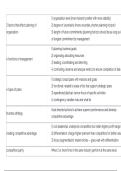
1) organization level (more heirarchy better with more stability)
3 factors that effect planning of 2) degree of uncertainty (more uncertain, shorter planning horizon)
organization 3) length of future commitments (planning horizon should be as long as le
of longest commitment by management
1) planning: business goals
2) organizing: allocating resources
4 functions of management
3) leading: coordinating and directing
4) controlling: observe and analyze metrics to ensure completion of task
1) strategic: broad plans with missions and goals
2) functional: related to areas of biz that support strategic plans
4 types of plans
3) operational/tactical: narrow focus of specific activities
4) contingency: handles risks and what-ifs
Goal directed actions to achieve superior performance and develop
business strategy
competitive advantage
1) cost leadership: underprice competition but retain higher profit margin
creating competitive advantage 2) differentiation: charge higher premium than competitors for better valu
3) focus (segmentation): market niches -- goes well with differentiation
competitive parity When 2 or more firms in the same industry perform at the same level
, Results of prior choices processes and relationships that are unique to the
firm's business model
that help explain performance along with strategy
1) markets service served: selection of markets firm chooses to compete i
2) firm infrastructure: development of core competencies to create
components of a business model
competitive advantage
3) economic model and how revenues are generated and sources of cost
Unique capabilities and resources that enable the firm to deliver and supp
core competencies
value proposition to its customer
Diagnostic tool that can be used to understand how an organization conn
its value prop to the activities that enable the organization to create a
competitive advantage
- Darker circles represent foundations of the business model
activity map
- Lighter circler show how strategy is implemented through clusters of tigh
linked activities
- Useful for strengthening strategic fit and assessing source and strength o
competitive advantage
, 1) corporate level strategy: what businesses company will vest in and what
will do + sets grand strategies
2) business unit level strategy: competitive strategy is developed (small fir
levels of strategy biz and corp function as one // large firm -- each of biz units develop the
own buisness unit level strategy)
3) functional level strategy: activities of different functional areas to help
achieve overall biz strategy
1) growth strategy: organization attempts to increase level of its operation
increase revenue and profitability
2) stability strategy: absence of significant change -- maintaining market s
(small firm -- reduces risk and defends position // large firm -- use in com
grand strategies (business strategies)
other strategies while pursuing expansion for others)
3) renewal strategy: defensive strategy -- reducing in size or seeking stab
(retrenchment: short run strategy for minor performance problems //
turnaround: for more serious issues like bankruptcy)
1) concentration: focusing on core business and increasing volume of prod
offered or number of markets served
2) diversification: growth via different industry -- determined at corp level
4 ways firms grow
3) vertical integration: growing by gaining control of either firm inputs or
outputs
4) horizontal integration: growing by combining with a competitor
, 1) analysis: vision, mission, values, external and interal analysis
2) formulation: corporate, business, and functional strategy
AFI framework
3) implementation: structure, culture, processes, capabilities, tech, govern
and business ethics
1) identify organization's mission, obj, and strategies
2) analyze external environment
3) evaluated internal resources
strategic management process ^^ SWOT analysis
4) managers formulate strategies
5) implementation of strategies
6) managers evaluate results
vision statement Expression about what the organization ultimately wants to accomplish
Staking out of a desired leadership position in the industry -- focus on futu
strategic intent
and attainment of ambitious, challenging goals
- confirm mission, vision, core values
- deviated from purpose and vision?
strategic planning process - is vision aspirational?
- our strategic intent clear and effectively communicated to employees an
stakeholders?
3 factors that effect planning of 2) degree of uncertainty (more uncertain, shorter planning horizon)
organization 3) length of future commitments (planning horizon should be as long as le
of longest commitment by management
1) planning: business goals
2) organizing: allocating resources
4 functions of management
3) leading: coordinating and directing
4) controlling: observe and analyze metrics to ensure completion of task
1) strategic: broad plans with missions and goals
2) functional: related to areas of biz that support strategic plans
4 types of plans
3) operational/tactical: narrow focus of specific activities
4) contingency: handles risks and what-ifs
Goal directed actions to achieve superior performance and develop
business strategy
competitive advantage
1) cost leadership: underprice competition but retain higher profit margin
creating competitive advantage 2) differentiation: charge higher premium than competitors for better valu
3) focus (segmentation): market niches -- goes well with differentiation
competitive parity When 2 or more firms in the same industry perform at the same level
, Results of prior choices processes and relationships that are unique to the
firm's business model
that help explain performance along with strategy
1) markets service served: selection of markets firm chooses to compete i
2) firm infrastructure: development of core competencies to create
components of a business model
competitive advantage
3) economic model and how revenues are generated and sources of cost
Unique capabilities and resources that enable the firm to deliver and supp
core competencies
value proposition to its customer
Diagnostic tool that can be used to understand how an organization conn
its value prop to the activities that enable the organization to create a
competitive advantage
- Darker circles represent foundations of the business model
activity map
- Lighter circler show how strategy is implemented through clusters of tigh
linked activities
- Useful for strengthening strategic fit and assessing source and strength o
competitive advantage
, 1) corporate level strategy: what businesses company will vest in and what
will do + sets grand strategies
2) business unit level strategy: competitive strategy is developed (small fir
levels of strategy biz and corp function as one // large firm -- each of biz units develop the
own buisness unit level strategy)
3) functional level strategy: activities of different functional areas to help
achieve overall biz strategy
1) growth strategy: organization attempts to increase level of its operation
increase revenue and profitability
2) stability strategy: absence of significant change -- maintaining market s
(small firm -- reduces risk and defends position // large firm -- use in com
grand strategies (business strategies)
other strategies while pursuing expansion for others)
3) renewal strategy: defensive strategy -- reducing in size or seeking stab
(retrenchment: short run strategy for minor performance problems //
turnaround: for more serious issues like bankruptcy)
1) concentration: focusing on core business and increasing volume of prod
offered or number of markets served
2) diversification: growth via different industry -- determined at corp level
4 ways firms grow
3) vertical integration: growing by gaining control of either firm inputs or
outputs
4) horizontal integration: growing by combining with a competitor
, 1) analysis: vision, mission, values, external and interal analysis
2) formulation: corporate, business, and functional strategy
AFI framework
3) implementation: structure, culture, processes, capabilities, tech, govern
and business ethics
1) identify organization's mission, obj, and strategies
2) analyze external environment
3) evaluated internal resources
strategic management process ^^ SWOT analysis
4) managers formulate strategies
5) implementation of strategies
6) managers evaluate results
vision statement Expression about what the organization ultimately wants to accomplish
Staking out of a desired leadership position in the industry -- focus on futu
strategic intent
and attainment of ambitious, challenging goals
- confirm mission, vision, core values
- deviated from purpose and vision?
strategic planning process - is vision aspirational?
- our strategic intent clear and effectively communicated to employees an
stakeholders?