
Enzymes
Enzymes are biological catalysts that speed up metabolic reactions.
-globular proteins with a specific, precise 3D structure containing ionic, hydrogen, disulfide, hydrophobic
Metabolic reactions can include anabolic reactions and catabolic reactions.
Anabolism is the building up of molecules and catabolism is the breakdown of molecules
Enzymes lower the activation energy of a reaction.
Enzymes are globular proteins. They have a very specific 3D shape which is important in allowing enzymes
to be specific.
Enzymes are specific which means they only act on one substrate
Enzymes act on substrates.
For the reaction to occur the enzyme and substrate must successfully collide
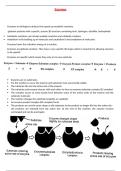
The substrate fits into the active site of the enzyme
The substrate and enzyme interact with each other to form an enzyme-substrate complex (ES complex)
The complex occurs as some bonds form between some of the amino acids of the enzyme and the
substrate molecule.
The reaction changes the substrate (anabolic or catabolic)
An enzyme-product complex (EP complex) forms
The products are not the same shape as the substrate so the product no longer fits into the active site –
the products are released from the active site. At the end of the reaction, the enzyme remains
unchanged and can be used again.
, The active site of the enzyme is usually only a very small part of the whole protein structure of the enzyme.
Enzyme specificity describes the fact that each enzyme is specific to only one particular substrate.
The substrate is complementary in shape to the active site of the enzyme
Activation Energy
The activation energy is the energy barrier that must be overcome for a reaction to take place
In living organisms, the temperature must be controlled to stop all enzymes in the organism from
becoming denatured so living organisms cannot increase the temperature to overcome the energy barrier.
Enzymes lower the activation energy to make it easier to overcome the energy barrier.
Enzyme Action Models
The Lock and Key model:
o Proposes that the shape of the enzyme active site and the shape of the substrate are exactly
complementary to each other.
o They are an exact fit
Induced Fit model:
o Proposes that the enzyme active site and substrate are not an exact fit. They are a very close
match.
o The active site is flexible and can mould itself around the substrate.
o The flexible active site changes shape to fit the substrate.
o This model can explain how the enzyme could put pressure on the substrate – this pressure
could explain how bonds in the substrate are broken or formed.
o This will lower the activation energy allowing the reaction to take place
o Once the products are formed they are released.
o The enzyme then returns to its original shape (pre-reaction shape)
Enzymes are biological catalysts that speed up metabolic reactions.
-globular proteins with a specific, precise 3D structure containing ionic, hydrogen, disulfide, hydrophobic
Metabolic reactions can include anabolic reactions and catabolic reactions.
Anabolism is the building up of molecules and catabolism is the breakdown of molecules
Enzymes lower the activation energy of a reaction.
Enzymes are globular proteins. They have a very specific 3D shape which is important in allowing enzymes
to be specific.
Enzymes are specific which means they only act on one substrate
Enzymes act on substrates.
For the reaction to occur the enzyme and substrate must successfully collide
The substrate fits into the active site of the enzyme
The substrate and enzyme interact with each other to form an enzyme-substrate complex (ES complex)
The complex occurs as some bonds form between some of the amino acids of the enzyme and the
substrate molecule.
The reaction changes the substrate (anabolic or catabolic)
An enzyme-product complex (EP complex) forms
The products are not the same shape as the substrate so the product no longer fits into the active site –
the products are released from the active site. At the end of the reaction, the enzyme remains
unchanged and can be used again.
, The active site of the enzyme is usually only a very small part of the whole protein structure of the enzyme.
Enzyme specificity describes the fact that each enzyme is specific to only one particular substrate.
The substrate is complementary in shape to the active site of the enzyme
Activation Energy
The activation energy is the energy barrier that must be overcome for a reaction to take place
In living organisms, the temperature must be controlled to stop all enzymes in the organism from
becoming denatured so living organisms cannot increase the temperature to overcome the energy barrier.
Enzymes lower the activation energy to make it easier to overcome the energy barrier.
Enzyme Action Models
The Lock and Key model:
o Proposes that the shape of the enzyme active site and the shape of the substrate are exactly
complementary to each other.
o They are an exact fit
Induced Fit model:
o Proposes that the enzyme active site and substrate are not an exact fit. They are a very close
match.
o The active site is flexible and can mould itself around the substrate.
o The flexible active site changes shape to fit the substrate.
o This model can explain how the enzyme could put pressure on the substrate – this pressure
could explain how bonds in the substrate are broken or formed.
o This will lower the activation energy allowing the reaction to take place
o Once the products are formed they are released.
o The enzyme then returns to its original shape (pre-reaction shape)


