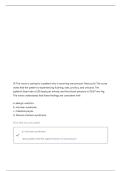
19. The nurse is caring for a patient who is receiving vancomycin (Vancocin). The nurse
notes that the patient is experiencing flushing, rash, pruritus, and urticaria. The
patient's heart rate is 120 beats per minute, and the blood pressure is 92/57 mm Hg.
The nurse understands that these findings are consistent with:
a. allergic reaction.
b. red man syndrome.
c. rhabdomyolysis.
d. Stevens-Johnson syndrome.
Give this one a try later!
b. red man syndrome.
*associated with the rapid infusion of vancomycin
,146. A patient who reports regular consumption of two or three alcoholic beverages
per day asks about taking acetaminophen when needed for occasional, recurrent
pain. What will the nurse tell the patient?
a. "Do not take more than 2 gm of acetaminophen a day."
b. "Do not take more than 3 gm of acetaminophen a day."
c. "Do not take more than 4 gm of acetaminophen a day."
d. "Do not take a fixed-dose preparation with opioid analgesics."
Give this one a try later!
a. "Do not take more than 2 gm of acetaminophen a day."
*Patient is an alcoholic and daily recommended amount is 2 gm / day. 4 gm
would be for non-alcoholic adults.
33. A nurse teaches a patient about sulfonamides. Which statement by the patient
indicates a need for further teaching?
a. "I need to drink extra fluids while taking this medication."
b. "I need to use sunscreen when taking this drug."
C "I should call my provider if I develop a rash while taking this drug."
d. "I should stop taking this drug when my symptoms are gone."
Give this one a try later!
d. "I should stop taking this drug when my symptoms are gone."
*it is crucial to complete the entire course of medication as prescribed
,39. A patient with histoplasmosis is being treated with itraconazole (Sporanox). The
nurse will teach this patient to report which symptoms?
a. Gynecomastia and decreased libido
b. Headache and rash
c. Nausea, vomiting, and anorexia
d. Visual disturbances
Give this one a try later!
c. Nausea, vomiting, and anorexia
*well tolerated medication, but lowers potassium levels leads to
dysrhythmias
65. A patient who has had abdominal surgery has been receiving morphine sulfate via
a patient-controlled analgesia (PCA) pump. The nurse assesses the patient and notes
that the patient's pupils are dilated and that the patient is drowsy and lethargic. The
patient's heart rate is 84 beats per minute, the respiratory rate is 10 breaths per minute,
and the blood pressure is 90/50 mm Hg. What will the nurse do?
a. Discuss possible opiate dependence with the patient's provider.
b. Encourage the patient to turn over and cough and take deep breaths.
c. Note the effectiveness of the analgesia in the patient's chart.
d. Prepare to administer naloxone and possibly ventilatory support.
Give this one a try later!
d. Prepare to administer naloxone and possibly ventilatory support.
*dilated pupils, drowsiness, lethargy, and respiratory depression, are
indicative of opioid overdose
, 145. A nurse is providing teaching for an adult patient with arthritis who has been
instructed to take ibuprofen (Motrin) for discomfort. Which statement by the patient
indicates a need for further teaching?
a. "I may experience tinnitus with higher doses of this medication."
b . "I may take up to 800 mg 4 times daily for pain."
c. "I should limit alcohol intake to fewer than three drinks a day."
d. "I will take this medication with meals to help prevent stomach upset."
Give this one a try later!
b . "I may take up to 800 mg 4 times daily for pain."
*The maximum recommended dose for ibuprofen in adults is typically 800
mg three times daily or 600 mg four times daily, not 800 mg four times daily.
137. A patient who is taking acetaminophen for pain wants to know why it does not
cause gastrointestinal upset, as do other over-the-counter pain medications. The
nurse will explain that this is most likely because of which property of
acetaminophen?
a. It does not inhibit cyclooxygenase.
b. It has minimal effects at peripheral sites.
c. It is more similar to opioids than to nonsteroidal anti-inflammatory drugs (NSAIDs).
d. It is selective for cyclooxygenase-2.
Give this one a try later!
b. It has minimal effects at peripheral sites.
*it primarily acts centrally (in the brain) rather than peripherally (at the site
of inflammation).
notes that the patient is experiencing flushing, rash, pruritus, and urticaria. The
patient's heart rate is 120 beats per minute, and the blood pressure is 92/57 mm Hg.
The nurse understands that these findings are consistent with:
a. allergic reaction.
b. red man syndrome.
c. rhabdomyolysis.
d. Stevens-Johnson syndrome.
Give this one a try later!
b. red man syndrome.
*associated with the rapid infusion of vancomycin
,146. A patient who reports regular consumption of two or three alcoholic beverages
per day asks about taking acetaminophen when needed for occasional, recurrent
pain. What will the nurse tell the patient?
a. "Do not take more than 2 gm of acetaminophen a day."
b. "Do not take more than 3 gm of acetaminophen a day."
c. "Do not take more than 4 gm of acetaminophen a day."
d. "Do not take a fixed-dose preparation with opioid analgesics."
Give this one a try later!
a. "Do not take more than 2 gm of acetaminophen a day."
*Patient is an alcoholic and daily recommended amount is 2 gm / day. 4 gm
would be for non-alcoholic adults.
33. A nurse teaches a patient about sulfonamides. Which statement by the patient
indicates a need for further teaching?
a. "I need to drink extra fluids while taking this medication."
b. "I need to use sunscreen when taking this drug."
C "I should call my provider if I develop a rash while taking this drug."
d. "I should stop taking this drug when my symptoms are gone."
Give this one a try later!
d. "I should stop taking this drug when my symptoms are gone."
*it is crucial to complete the entire course of medication as prescribed
,39. A patient with histoplasmosis is being treated with itraconazole (Sporanox). The
nurse will teach this patient to report which symptoms?
a. Gynecomastia and decreased libido
b. Headache and rash
c. Nausea, vomiting, and anorexia
d. Visual disturbances
Give this one a try later!
c. Nausea, vomiting, and anorexia
*well tolerated medication, but lowers potassium levels leads to
dysrhythmias
65. A patient who has had abdominal surgery has been receiving morphine sulfate via
a patient-controlled analgesia (PCA) pump. The nurse assesses the patient and notes
that the patient's pupils are dilated and that the patient is drowsy and lethargic. The
patient's heart rate is 84 beats per minute, the respiratory rate is 10 breaths per minute,
and the blood pressure is 90/50 mm Hg. What will the nurse do?
a. Discuss possible opiate dependence with the patient's provider.
b. Encourage the patient to turn over and cough and take deep breaths.
c. Note the effectiveness of the analgesia in the patient's chart.
d. Prepare to administer naloxone and possibly ventilatory support.
Give this one a try later!
d. Prepare to administer naloxone and possibly ventilatory support.
*dilated pupils, drowsiness, lethargy, and respiratory depression, are
indicative of opioid overdose
, 145. A nurse is providing teaching for an adult patient with arthritis who has been
instructed to take ibuprofen (Motrin) for discomfort. Which statement by the patient
indicates a need for further teaching?
a. "I may experience tinnitus with higher doses of this medication."
b . "I may take up to 800 mg 4 times daily for pain."
c. "I should limit alcohol intake to fewer than three drinks a day."
d. "I will take this medication with meals to help prevent stomach upset."
Give this one a try later!
b . "I may take up to 800 mg 4 times daily for pain."
*The maximum recommended dose for ibuprofen in adults is typically 800
mg three times daily or 600 mg four times daily, not 800 mg four times daily.
137. A patient who is taking acetaminophen for pain wants to know why it does not
cause gastrointestinal upset, as do other over-the-counter pain medications. The
nurse will explain that this is most likely because of which property of
acetaminophen?
a. It does not inhibit cyclooxygenase.
b. It has minimal effects at peripheral sites.
c. It is more similar to opioids than to nonsteroidal anti-inflammatory drugs (NSAIDs).
d. It is selective for cyclooxygenase-2.
Give this one a try later!
b. It has minimal effects at peripheral sites.
*it primarily acts centrally (in the brain) rather than peripherally (at the site
of inflammation).