NR 324 Adult Health ROK 2 Answers LATEST UPDATE
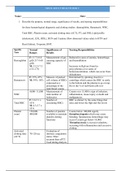
NR 324 Adult Health ROK 2 Answers LATEST UPDATE Name: _______________________________________________ Date: ___________________ 1. Describe the purpose, normal range, significance of results, and nursing responsibilities for these hematological diagnostic and clotting studies: (hemoglobin, Hematocrit, WBC, Total RBC, Platelet count, activated clotting time (ACT), PT, and INR, Lipid profile (cholesterol, LDL, HDL), BUN and Creatine (How abnormal values relate to HTN and Heart failure), Troponin, BNP. Specific Tests Normal Ranges Significance of Results Nursing Responsibilities Hemoglobin F: 11.7-16.0 g/dl (117-160 g/dl) M: 13.2-17.3 (132-173) Measurement of gas-carrying capacity of RBC Reduced in cases of anemia, hemorrhage, and hemodilution Increases in Hgb are found in polycythemia or in states of hemoconcentration, which can occur from dehydration Hematocrit F: 35%-47% M: 39%- 50% Measure of packed cell volume of RBCs expressed as a percentage of the total blood voume Determined by spinning clood in a centrifuge which causes the RBC to settle to the bottom and the plasma to go on top. Hct is the % of red blood cells in it WBC 4,000- 11,000 Measurement of total number of leukocytes Counts over 11,000 is sign of infection, inflammation, tissue injury or death and malignancies. Total RBC F: 3.8-5.1 x 10^6 M: 4.3-5.7 x 10^6 Number of circulating RBCs RBC is altered by the same things that raise and lower the Hgb and Hct levels Platelet count 150,000-400,000 Number of patelets available to maintain platelet clotting functions Counts below 100,000 signify thrombocytopenia which may cause bleeding. Spontaneous hemorrhage may occur if counts get below 10,000. Thrombocytosis is excessive platelets, occurring with inflammation and excessive clotting Activated clotting time (ACT) 70-120 sec Evaluation of intrinsic coagulation status. More accurate than aPTT. Used during dialysis, coronary artery bypass procedure, arteriograms. Prothrombin time PT 11-16 sec Assessment of extrinsic coagulation by measurement factors I, II, V, VII, X INR 2-3 Standardized system of reporting PT based on a reference calibration model and calculated by comparing the patient’s PT with a control value Cholesterol < 200 mg/dL Blood lipid. Elevated cholesterol is a risk for cardiovascular heart disease Cholesterol levels can be obtained in a nonfasting state
Written for
Document information
- Uploaded on
- February 25, 2021
- Number of pages
- 38
- Written in
- 2020/2021
- Type
- Exam (elaborations)
- Contains
- Questions & answers
Subjects
- normal range
- significance of results
- and nurs
-
nr 324 adult health rok 2 answers latest update name date 1 describe the purpose

Also available in package deal