Lecture 10 – Havekes 5,6
Chapter 24
Hippocampus-dependent learning tasks
- Spatial water maze
- Contextual fear conditioning
- Object-location memory task
Hippocampus-independent learning tasks
- Non-spatial water maze
- Tone-cued fear conditioning
- Active shock avoidance (=operant learning)
- Rotarod task
Classic conditioning
Pavlovian conditioning: association between a neutral stimulus (CS) and a positive or negative
stimulus (US).
Operant conditioning: association between a neutral stimulus (CS) and a positive or negative
stimulus (US). In addition to Pavlovian conditioning, it is associating a voluntary behaviour with a
consequence (e.g. tapping a bell or hand for food, or jumping to the other side for avoiding a shock).
Fear conditioning stimulates “freezing behavior”
Tone cued fear is hippocampus independent, and amygdala dependent
Contextual fear is hippocampus dependent and amygdala dependent as well.
Fear conditioning is also Pavlovian conditioning because it can do nothing to avoid the shock by doing
voluntarily behaviour, in contrast, active shock avoidance is operant conditioning.
Object-location memory and rotarod task
The object location memory task requires the hippocampus and the rotarod task requires the motor
cortex and cerebellum.
, How is a memory stored in the brain?
Anisomycin is a protein synthesis inhibitor. It blocks the development of new proteins, it blocks the
translational parts in neurons. Blocking this synthesis negatively influences fear conditioning.
For the storage of information the spines and axon terminals, the connection needs to be
strengthened, this is the basis of memory. For strengthening this connection and making it bigger,
new proteins are needed for building blocks.
So:
- Protein synthesis is required for making new axonal-dendritic connections
- Protein synthesis is required for strengthening existing connection
- Synaptic plasticity is the process of making new connections and/or changing the strength of
existing connections (the estrus cycle is an example)
- Long term potentiation is a form of synaptic plasticity and the molecular basis of memory
storage.
Studying long-term potentiation (LTP) in hippocampal slices
- These kinds of studies allows researchers to study individual pathways and signaling
mechanisms using antagonists and agonists.
- Multiple slices and thus studies from a single hippocampus
- Also great temporal resolution in terms of drug treatment
E-LTP and L-LTP
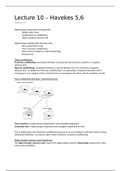
Early LTP is a weak form of learning that is not persistent (short-term memory that is not
consolidated into long-term memory). EPSP is a measure of relative strength of the neuronal
connections before and after a stimulation.
Late LTP is a strong form of learning that is persistent (short-term memory that is successfully
consolidated into long-term memory).
Blocking protein synthesis does not only prevent long term memory formation and L-LTP, it also
prevents the growth of dendritic spines, following LTP-induction.
Chapter 24
Hippocampus-dependent learning tasks
- Spatial water maze
- Contextual fear conditioning
- Object-location memory task
Hippocampus-independent learning tasks
- Non-spatial water maze
- Tone-cued fear conditioning
- Active shock avoidance (=operant learning)
- Rotarod task
Classic conditioning
Pavlovian conditioning: association between a neutral stimulus (CS) and a positive or negative
stimulus (US).
Operant conditioning: association between a neutral stimulus (CS) and a positive or negative
stimulus (US). In addition to Pavlovian conditioning, it is associating a voluntary behaviour with a
consequence (e.g. tapping a bell or hand for food, or jumping to the other side for avoiding a shock).
Fear conditioning stimulates “freezing behavior”
Tone cued fear is hippocampus independent, and amygdala dependent
Contextual fear is hippocampus dependent and amygdala dependent as well.
Fear conditioning is also Pavlovian conditioning because it can do nothing to avoid the shock by doing
voluntarily behaviour, in contrast, active shock avoidance is operant conditioning.
Object-location memory and rotarod task
The object location memory task requires the hippocampus and the rotarod task requires the motor
cortex and cerebellum.
, How is a memory stored in the brain?
Anisomycin is a protein synthesis inhibitor. It blocks the development of new proteins, it blocks the
translational parts in neurons. Blocking this synthesis negatively influences fear conditioning.
For the storage of information the spines and axon terminals, the connection needs to be
strengthened, this is the basis of memory. For strengthening this connection and making it bigger,
new proteins are needed for building blocks.
So:
- Protein synthesis is required for making new axonal-dendritic connections
- Protein synthesis is required for strengthening existing connection
- Synaptic plasticity is the process of making new connections and/or changing the strength of
existing connections (the estrus cycle is an example)
- Long term potentiation is a form of synaptic plasticity and the molecular basis of memory
storage.
Studying long-term potentiation (LTP) in hippocampal slices
- These kinds of studies allows researchers to study individual pathways and signaling
mechanisms using antagonists and agonists.
- Multiple slices and thus studies from a single hippocampus
- Also great temporal resolution in terms of drug treatment
E-LTP and L-LTP
Early LTP is a weak form of learning that is not persistent (short-term memory that is not
consolidated into long-term memory). EPSP is a measure of relative strength of the neuronal
connections before and after a stimulation.
Late LTP is a strong form of learning that is persistent (short-term memory that is successfully
consolidated into long-term memory).
Blocking protein synthesis does not only prevent long term memory formation and L-LTP, it also
prevents the growth of dendritic spines, following LTP-induction.