
Noor Bijvang
Cell biology and immunology
Lecture 1 van Haastert Cell-cell communication
Chapter 15
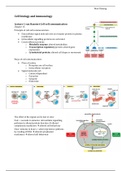
Principle of cell-cell communication:
• Extracellular signal molecule sits on receptor protein in plasma
membrane
• Intracellular signalling proteins are activated
• Create effector proteins
o Metabolic enzyme: altered metabolism
o Transcription regulatory protein: altered gene
expression
o Cytoskeletal protein: altered cell shape or movement
Ways of cell communication:
• Place of action:
o Receptors on cell surface
o Intracellular receptors
• Signal molecules act:
o Contact-dependent
o Paracrine
o Synaptic
o Endocrine
The effect of the signal can be fast or slow
Fast: < seconds to minutes: intracellular signalling
pathway to altered protein function → altered
cytoplasmic machinery → altered cell behaviour
Slow: minutes to hours >: altered proteins synthesis
by reading of DNA → altered cytoplasmic
machinery → altered cell behaviour
, Noor Bijvang
In multicellular organisms cells need signals to survive, if no
survival signals are present cells will go into apoptosis and cells will
die.
Lung cells secrete lung cell specific signals, thereby cells
know they are surrounded by other lung cells. If they are in
the blood the cells do not get the signals and will die
If cells get different signals, they might differentiate into other cells
Different cells can react differently on the same signal molecule
Types of signal molecules and their transduction:
• Hydrophilic signal cell surface receptor (most signals)
• Hydrophobic signal intracellular receptor
o Pass plasma membrane and act inside the cell
o Oestradiol and testosterone are hydrophobic
o Thyroid hormone activates metabolism and contains 4 iodine
▪ Lack of iodine → lack of thyroid hormone → struma:
enlargement of thyroid
• Gas: NO radical
o Relaxation smooth muscle, improved blood circulation
o Endotherial cells produce NO → NO steal electron from
guanylyl cyclase → smooth muscle cells relax → blood vessel
will be more open → more blood trough the blood vessel
, Noor Bijvang
Nuclear receptors
• Nuclear receptors in chicken:
o Oestradiol binds to oestradiol receptor (OR)
o OR binds to specific DNA in liver
o Induces expression of ovalbumin (main protein in
white of egg)
o Transport ovalbumin to oviduct and egg
• Nuclear receptors in rooster (haan):
o Has no oestradiol but testosterone
o Testosterone binds to testosterone receptor (TR)
o TR binds to different part of DNA
o Expression proteins for rooster behaviour
• Modified mutated rooster:
o Replace DNA-binding domain of TR by DNA-
binding domain of OR
o Testosterone activates this hybrid receptor
o Hybrid receptor binds to DNA for OR
o Thus, testosterone induces ovalbumin in liver
rooster
Transduction of hydrophilic signals
• Ion channels
• G-protein coupled receptors, second messengers
• Protein-protein interactions
, Noor Bijvang
Molecular switches: regulate many molecular processes
• Protein kinases phosphorylate seine, threonine,
tyrosine
o Protein kinase adds phosphate to the
protein → other shape → active
o Protein phosphatase takes phosphate →
back to normal shape → inactive
• G-proteins:
o GDP or GTP can bind to the G-protein
o GDP → inactive
o GTP → active
G-protein coupled receptors (GPCRs)
• Signal molecules:
o Hormones
o Taste and odor (geur)
o Light
• Inactive G-protein:
Activation of a G-protein: hydrophilic hormone binds to the outside of
the receptor → inside of receptor gets another conformation → G-
protein can bind to the receptor → opening of the cleft in the a-subunit
→ GDP leaves and GTP binds → a-subunit disconnects from the b-y-
subunit → effector enzymes can be activated
Cell biology and immunology
Lecture 1 van Haastert Cell-cell communication
Chapter 15
Principle of cell-cell communication:
• Extracellular signal molecule sits on receptor protein in plasma
membrane
• Intracellular signalling proteins are activated
• Create effector proteins
o Metabolic enzyme: altered metabolism
o Transcription regulatory protein: altered gene
expression
o Cytoskeletal protein: altered cell shape or movement
Ways of cell communication:
• Place of action:
o Receptors on cell surface
o Intracellular receptors
• Signal molecules act:
o Contact-dependent
o Paracrine
o Synaptic
o Endocrine
The effect of the signal can be fast or slow
Fast: < seconds to minutes: intracellular signalling
pathway to altered protein function → altered
cytoplasmic machinery → altered cell behaviour
Slow: minutes to hours >: altered proteins synthesis
by reading of DNA → altered cytoplasmic
machinery → altered cell behaviour
, Noor Bijvang
In multicellular organisms cells need signals to survive, if no
survival signals are present cells will go into apoptosis and cells will
die.
Lung cells secrete lung cell specific signals, thereby cells
know they are surrounded by other lung cells. If they are in
the blood the cells do not get the signals and will die
If cells get different signals, they might differentiate into other cells
Different cells can react differently on the same signal molecule
Types of signal molecules and their transduction:
• Hydrophilic signal cell surface receptor (most signals)
• Hydrophobic signal intracellular receptor
o Pass plasma membrane and act inside the cell
o Oestradiol and testosterone are hydrophobic
o Thyroid hormone activates metabolism and contains 4 iodine
▪ Lack of iodine → lack of thyroid hormone → struma:
enlargement of thyroid
• Gas: NO radical
o Relaxation smooth muscle, improved blood circulation
o Endotherial cells produce NO → NO steal electron from
guanylyl cyclase → smooth muscle cells relax → blood vessel
will be more open → more blood trough the blood vessel
, Noor Bijvang
Nuclear receptors
• Nuclear receptors in chicken:
o Oestradiol binds to oestradiol receptor (OR)
o OR binds to specific DNA in liver
o Induces expression of ovalbumin (main protein in
white of egg)
o Transport ovalbumin to oviduct and egg
• Nuclear receptors in rooster (haan):
o Has no oestradiol but testosterone
o Testosterone binds to testosterone receptor (TR)
o TR binds to different part of DNA
o Expression proteins for rooster behaviour
• Modified mutated rooster:
o Replace DNA-binding domain of TR by DNA-
binding domain of OR
o Testosterone activates this hybrid receptor
o Hybrid receptor binds to DNA for OR
o Thus, testosterone induces ovalbumin in liver
rooster
Transduction of hydrophilic signals
• Ion channels
• G-protein coupled receptors, second messengers
• Protein-protein interactions
, Noor Bijvang
Molecular switches: regulate many molecular processes
• Protein kinases phosphorylate seine, threonine,
tyrosine
o Protein kinase adds phosphate to the
protein → other shape → active
o Protein phosphatase takes phosphate →
back to normal shape → inactive
• G-proteins:
o GDP or GTP can bind to the G-protein
o GDP → inactive
o GTP → active
G-protein coupled receptors (GPCRs)
• Signal molecules:
o Hormones
o Taste and odor (geur)
o Light
• Inactive G-protein:
Activation of a G-protein: hydrophilic hormone binds to the outside of
the receptor → inside of receptor gets another conformation → G-
protein can bind to the receptor → opening of the cleft in the a-subunit
→ GDP leaves and GTP binds → a-subunit disconnects from the b-y-
subunit → effector enzymes can be activated



