Marketing & Sales Summary
Chapter 1
Creating customer value and engagement.
Marketing is the process by which companies engage costumers, build stronger, build stronger
customer relationships, and create customer value in order to capture value from customers in
return. The twofold goal of marketing is to attract new customers by promising superior value and to
keep and grow current customers by delivering satisfaction.
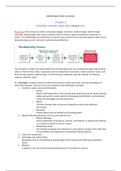
This presents a simple, five step model of the marketing process for creating and capturing customer
value. In the first four steps, companies work to understand consumers, create customer value, and
build strong customer relationships. In the final step, companies reap the rewards of creating
superior customer value.
As a first step, marketers need to understand customer needs and wants and the marketplace in
which they operate. There are five core customer and marketplace concepts:
1. Customer needs, wants and demands;
o Needs
States of felt deprivation, they include basic physical needs for food, clothing,
safety and warmth; social needs for belonging and affection; and individual
needs for knowledge and self-expression.
o Wants
The form humans take as they are shaped by culture and individual
personality.
o Demands
Human wants that are backed up by buying power
2. Market offerings (products, services and experiences)
o Market offerings
Some combination of products, services, information, or experiences offered
to a market to satisfy a need or a want.
o Marketing myopia
The mistake of paying more attention to the specific products they offer than
to the benefits and experiences produced by these products.
3. Value and satisfaction
4. Exchanges and relationships
Exchange is the act of obtaining a desired object from someone by offering something in
return.
5. Markets
A market is the set of actual and potential buyers of a product or service.
,Each part in the system adds value for the next level. The arrows represent relationships that must
be developed and managed.
Once the company fully understands its consumers and the marketplace, it must decide which
customers it will serve (the target market) and how it will bring them value (the value proposition).
Marketing management is the art and science of choosing target markets and building profitable
relationships with them. To design a winning marketing strategy, the marketing manager must
answer two important questions: what customers will we serve (what is our target market) and how
can we served these customers best (what is our value proposition).
The company first must decide whom it will serve. Market segmentation and target marketing need
to be used to achieve this.
The company also must decide how it will differentiate and position itself in the marketplace. A
brand’s value proposition is the set of benefits or values it promises to deliver to consumers to satisfy
their needs.
There are 5 alternative concepts under which organizations design and carry out their marketing
strategies:
1. Production concept
The idea that consumers will favour products that are available and highly affordable;
therefore, the organization should focus on improving production and distribution efficiency.
2. Product concept
The idea that consumers will favour
products that offer the most quality,
performance and features; therefore, the
organization should devote its energy to
making continuous product
improvements.
3. Selling concept
The idea that consumers will not buy
enough of the firm’s products unless the
firm undertakes a large-scale selling and
promotion effort. This carries high risk
4. Marketing concept
A philosophy in which achieving
organizational goals depends on knowing
, the needs and wants of target markets and delivering the desired satisfactions better than
competitions do.
The selling concept takes an inside-out view that focuses on existing products and heavy selling. The
aim is to sell what the company makes rather than making what the customer wants.
The marketing concept takes an outside-in view that focuses on satisfying customer needs as a path
to profits.
Societal marketing concept
The idea that a company’s marketing decisions should
consider consumers’ wants, the company’s
requirements, consumers’ long-run interests, and
society’s long-run interests.
Preparing an integrated marketing plan and program
The customer-driven marketing strategy discussed in
the previous section outlines which customers the
company will serve (the target market) and how it will
serve them (the value proposition). Now, the company
develops marketing plans and programs – a marketing
mix – that will actually deliver the intended customer value.
The major marketing mix tools are classified into four broad groups, called four P’s of marketing:
product, price, place and promotion.
Building customers relations
Doing a good job with the first three steps in the marketing process sets the stage for step four,
building and managing customer relationships
Consumer relationships management
The overall process of building and maintaining profitable customer relationships by delivering
superior customer value and satisfaction.
Customer-perceived value
The customer’s evaluation of the difference between all the benefits and all the costs of a marketing
offer relative to those of competing offers.
Customer satisfaction
The extent to which a product’s perceived performance matches a buyer’s expectations.
Customer-managed relationships
Marketing relationships in which customers, empowered by today’s new digital technologies,
interact with companies and with each other to shape their relationships with brands.
Consumer-generated marketing
Brand exchanges created by consumers themselves – both invited and uninvited - by which
consumers are playing an increasing role in shaping their own brand experiences and those of other
consumers.
Partner relationship management
Working closely with partners in other company departments and outside the company to jointly
bring greater value to customers. Marketers can’t create customer value and build customer
, relationships by themselves. They must work closely with other company departments and partners
outside the firm.
Good customer relationship management creates customer satisfaction. In turn, satisfied customers
remain loyal and talk favourably to others about the company and its products. Keeping customers
loyal makes good economic sense. Loyal customers spend more and stay around longer. Research
also shows that it’s five times cheaper to keep an old customer than acquire a new one.
Customer lifetime value
The value of the entire stream of purchases a customer makes over a lifetime of patronage.
Share of customers
The portion of the customer’s purchasing that a company gets in its product categories.
Customer equity
The total combined customer lifetime values of all of the company’s customers.
The changing marketing landscape
Marketing doesn’t take place in a vacuum. Now that we’ve discussed the five steps in the
marketing process, let’s examine how the ever-changing marketplace affects both
consumers and the marketers who serve them.
Greatest Changes:
o The Changing Economic Environment
o The digital Age
Internet:
A vast public web of computer networks that connect users of all types all
around the world to each other and to an amazingly large information
repository.
o The Growth of Not-for-Profit Marketing
o Rapid Globalization
o Sustainable Marketing – The Call for More Social Responsibility
Putting it all together:
Based on everything we’ve discussed in this chapter, we can expand the figure, which
outlined the marketing process (FIG. 1.1), to provide a road map for learning marketing
throughout the remainder of this text.
Chapter 1
Creating customer value and engagement.
Marketing is the process by which companies engage costumers, build stronger, build stronger
customer relationships, and create customer value in order to capture value from customers in
return. The twofold goal of marketing is to attract new customers by promising superior value and to
keep and grow current customers by delivering satisfaction.
This presents a simple, five step model of the marketing process for creating and capturing customer
value. In the first four steps, companies work to understand consumers, create customer value, and
build strong customer relationships. In the final step, companies reap the rewards of creating
superior customer value.
As a first step, marketers need to understand customer needs and wants and the marketplace in
which they operate. There are five core customer and marketplace concepts:
1. Customer needs, wants and demands;
o Needs
States of felt deprivation, they include basic physical needs for food, clothing,
safety and warmth; social needs for belonging and affection; and individual
needs for knowledge and self-expression.
o Wants
The form humans take as they are shaped by culture and individual
personality.
o Demands
Human wants that are backed up by buying power
2. Market offerings (products, services and experiences)
o Market offerings
Some combination of products, services, information, or experiences offered
to a market to satisfy a need or a want.
o Marketing myopia
The mistake of paying more attention to the specific products they offer than
to the benefits and experiences produced by these products.
3. Value and satisfaction
4. Exchanges and relationships
Exchange is the act of obtaining a desired object from someone by offering something in
return.
5. Markets
A market is the set of actual and potential buyers of a product or service.
,Each part in the system adds value for the next level. The arrows represent relationships that must
be developed and managed.
Once the company fully understands its consumers and the marketplace, it must decide which
customers it will serve (the target market) and how it will bring them value (the value proposition).
Marketing management is the art and science of choosing target markets and building profitable
relationships with them. To design a winning marketing strategy, the marketing manager must
answer two important questions: what customers will we serve (what is our target market) and how
can we served these customers best (what is our value proposition).
The company first must decide whom it will serve. Market segmentation and target marketing need
to be used to achieve this.
The company also must decide how it will differentiate and position itself in the marketplace. A
brand’s value proposition is the set of benefits or values it promises to deliver to consumers to satisfy
their needs.
There are 5 alternative concepts under which organizations design and carry out their marketing
strategies:
1. Production concept
The idea that consumers will favour products that are available and highly affordable;
therefore, the organization should focus on improving production and distribution efficiency.
2. Product concept
The idea that consumers will favour
products that offer the most quality,
performance and features; therefore, the
organization should devote its energy to
making continuous product
improvements.
3. Selling concept
The idea that consumers will not buy
enough of the firm’s products unless the
firm undertakes a large-scale selling and
promotion effort. This carries high risk
4. Marketing concept
A philosophy in which achieving
organizational goals depends on knowing
, the needs and wants of target markets and delivering the desired satisfactions better than
competitions do.
The selling concept takes an inside-out view that focuses on existing products and heavy selling. The
aim is to sell what the company makes rather than making what the customer wants.
The marketing concept takes an outside-in view that focuses on satisfying customer needs as a path
to profits.
Societal marketing concept
The idea that a company’s marketing decisions should
consider consumers’ wants, the company’s
requirements, consumers’ long-run interests, and
society’s long-run interests.
Preparing an integrated marketing plan and program
The customer-driven marketing strategy discussed in
the previous section outlines which customers the
company will serve (the target market) and how it will
serve them (the value proposition). Now, the company
develops marketing plans and programs – a marketing
mix – that will actually deliver the intended customer value.
The major marketing mix tools are classified into four broad groups, called four P’s of marketing:
product, price, place and promotion.
Building customers relations
Doing a good job with the first three steps in the marketing process sets the stage for step four,
building and managing customer relationships
Consumer relationships management
The overall process of building and maintaining profitable customer relationships by delivering
superior customer value and satisfaction.
Customer-perceived value
The customer’s evaluation of the difference between all the benefits and all the costs of a marketing
offer relative to those of competing offers.
Customer satisfaction
The extent to which a product’s perceived performance matches a buyer’s expectations.
Customer-managed relationships
Marketing relationships in which customers, empowered by today’s new digital technologies,
interact with companies and with each other to shape their relationships with brands.
Consumer-generated marketing
Brand exchanges created by consumers themselves – both invited and uninvited - by which
consumers are playing an increasing role in shaping their own brand experiences and those of other
consumers.
Partner relationship management
Working closely with partners in other company departments and outside the company to jointly
bring greater value to customers. Marketers can’t create customer value and build customer
, relationships by themselves. They must work closely with other company departments and partners
outside the firm.
Good customer relationship management creates customer satisfaction. In turn, satisfied customers
remain loyal and talk favourably to others about the company and its products. Keeping customers
loyal makes good economic sense. Loyal customers spend more and stay around longer. Research
also shows that it’s five times cheaper to keep an old customer than acquire a new one.
Customer lifetime value
The value of the entire stream of purchases a customer makes over a lifetime of patronage.
Share of customers
The portion of the customer’s purchasing that a company gets in its product categories.
Customer equity
The total combined customer lifetime values of all of the company’s customers.
The changing marketing landscape
Marketing doesn’t take place in a vacuum. Now that we’ve discussed the five steps in the
marketing process, let’s examine how the ever-changing marketplace affects both
consumers and the marketers who serve them.
Greatest Changes:
o The Changing Economic Environment
o The digital Age
Internet:
A vast public web of computer networks that connect users of all types all
around the world to each other and to an amazingly large information
repository.
o The Growth of Not-for-Profit Marketing
o Rapid Globalization
o Sustainable Marketing – The Call for More Social Responsibility
Putting it all together:
Based on everything we’ve discussed in this chapter, we can expand the figure, which
outlined the marketing process (FIG. 1.1), to provide a road map for learning marketing
throughout the remainder of this text.