3.4 Alkenes
3.3.4.1 Structure, bonding, and reactivity
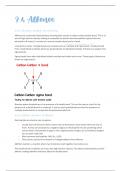
Alkenes are unsaturated hydrocarbons meaning they contain a carbon-carbon double bond. This is an
area of high electron density making it susceptible to attack from electrophiles (species that are
attracted to - areas). It consists of a normal covalent bond and a π bond.
One sigma, One pi One sigma, 2 pi bonds.
π bonds form when multiple bonds are involved such as in double and triple bonds. Usually formed
from unhybridized p orbitals which are perpendicular to hybridized orbitals. Pi bonds are weaker than
sigma bonds.
Sigma bonds form when hybridized orbitals overlap each other end-to-end. These types of bonds are
known as single bonds.
Carbon-Carbon π bond
Carbon-Carbon sigma bond
Testing for alkenes with bromine water
Bromine water decolourises in the presence of a double bond. This can be used as a test for the
presence of a double bond in a molecule. It can be used quantitatively to show the presence of
multiple double bonds in compounds like polyunsaturated oils.
3.3.4.2 Addition reactions of alkenes
Electrophiles are electron pair acceptors.
- Usually short of electrons which means they’re attracted to areas where there are lots of
them. As they are attracted to a negative region an electrophile mist be something which
carries either a full positive charge or has a slight positive charge such as Positively charged
ions or polar molecules
- Most common electrophiles: HBr, Br2, H2SO4
- They can be used to form alcohols or halogenoalkanes from alkenes.
Addition reaction: a reaction where two molecules react together to produce one.
The double bonds in alkenes are areas with high electron density. This attracts electrophiles and the
alkenes undergo addition reactions about the double bond.
, Electrophilic Addition
This is the reaction mechanism that shows how electrophiles attack the double bond in alkenes.
When the double bond is broken, a carbocation forms. This is a carbon atom with only three bonds,
meaning it has a positive charge.
- The stability of a carbocation intermediate can affect the product distribution of the reaction,
resulting in the formation of major and minor products.
- Carbocations have varying stability, with tertiary being the most stable and primary the least.
Primary carbocations have one carbon atom attached to the positively charged carbon atom.
Secondary carbocations have two carbon atoms attached to the positively charged carbon
atom. Tertiary carbocations have three carbon atoms attached to the positively charged
carbon atom. The more stable the carbocation, the more likely it is to form.
- Therefore in an addition reaction, multiple products can form but the major product will
always be the most stable possible. The most stable carbocation intermediate will be formed
in greater proportion, resulting in the formation of the major product.
The order of stability for carbocations is tertiary > secondary >primary.
1. Reaction of bromine with alkenes
2. Reaction of hydrogen bromine with alkenes
In electrophilic addition to alkenes, the major product is formed via the
more stable carbocation intermediate.
3.3.4.1 Structure, bonding, and reactivity
Alkenes are unsaturated hydrocarbons meaning they contain a carbon-carbon double bond. This is an
area of high electron density making it susceptible to attack from electrophiles (species that are
attracted to - areas). It consists of a normal covalent bond and a π bond.
One sigma, One pi One sigma, 2 pi bonds.
π bonds form when multiple bonds are involved such as in double and triple bonds. Usually formed
from unhybridized p orbitals which are perpendicular to hybridized orbitals. Pi bonds are weaker than
sigma bonds.
Sigma bonds form when hybridized orbitals overlap each other end-to-end. These types of bonds are
known as single bonds.
Carbon-Carbon π bond
Carbon-Carbon sigma bond
Testing for alkenes with bromine water
Bromine water decolourises in the presence of a double bond. This can be used as a test for the
presence of a double bond in a molecule. It can be used quantitatively to show the presence of
multiple double bonds in compounds like polyunsaturated oils.
3.3.4.2 Addition reactions of alkenes
Electrophiles are electron pair acceptors.
- Usually short of electrons which means they’re attracted to areas where there are lots of
them. As they are attracted to a negative region an electrophile mist be something which
carries either a full positive charge or has a slight positive charge such as Positively charged
ions or polar molecules
- Most common electrophiles: HBr, Br2, H2SO4
- They can be used to form alcohols or halogenoalkanes from alkenes.
Addition reaction: a reaction where two molecules react together to produce one.
The double bonds in alkenes are areas with high electron density. This attracts electrophiles and the
alkenes undergo addition reactions about the double bond.
, Electrophilic Addition
This is the reaction mechanism that shows how electrophiles attack the double bond in alkenes.
When the double bond is broken, a carbocation forms. This is a carbon atom with only three bonds,
meaning it has a positive charge.
- The stability of a carbocation intermediate can affect the product distribution of the reaction,
resulting in the formation of major and minor products.
- Carbocations have varying stability, with tertiary being the most stable and primary the least.
Primary carbocations have one carbon atom attached to the positively charged carbon atom.
Secondary carbocations have two carbon atoms attached to the positively charged carbon
atom. Tertiary carbocations have three carbon atoms attached to the positively charged
carbon atom. The more stable the carbocation, the more likely it is to form.
- Therefore in an addition reaction, multiple products can form but the major product will
always be the most stable possible. The most stable carbocation intermediate will be formed
in greater proportion, resulting in the formation of the major product.
The order of stability for carbocations is tertiary > secondary >primary.
1. Reaction of bromine with alkenes
2. Reaction of hydrogen bromine with alkenes
In electrophilic addition to alkenes, the major product is formed via the
more stable carbocation intermediate.