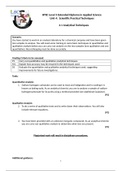
BTEC Level 3 Extended Diploma in Applied Science
Unit 4: Scientific Practical Techniques
4.1 Analytical Techniques
Scenario:
You have started to work in an analysis laboratory for a chemical company and have been given
two samples to analyse. You will need some training in some basic techniques in quantitative and
qualitative analysis before you can carry out analysis on the two samples (one qualitative and one
quantitative). Record keeping must be done accurately.
Grading Criteria to be assessed:
P1 Carry out quantitative and qualitative analytical techniques.
M1 Explain how accuracy may be ensured in the techniques used.
D1 Evaluate the quantitative and qualitative analytical techniques used, suggesting
improvements for future investigations.
Tasks:
Quantitative Analysis
1. Sodium hydrogen carbonate can be used to treat acid indigestion and in cooking it is
known as baking soda. As an analytical chemist, you are to analyse a sample of sodium
hydrogencarbonate for its purity using a method provided (see Additional Guidance).
(P1)
Qualitative Analysis
2. To do a series of qualitative tests and to write down their observations. You will also
include relevant equations.
(P1)
3. You have been provided with an unknown inorganic compound. As an analytical chemist
you are carry out qualitative analysis to determine what ions are present.
(P1)
Plagiarised work will result in disciplinary procedures.
Additional guidance:
1
, Task 1: (P1) Quantitative Analysis
Method for determining the purity of a sample of sodium hydrogen carbonate
1. Carefully weigh out in a weighing boat, 0.40 g of the sample of sodium hydrogencarbonate
(NaHCO3) provided and record your readings in Table 1.
2. Transfer this sample to a 100 cm3 volumetric flask and add distilled water up to the 100 cm3
mark.
3. Swirl and shake the solution to ensure that the solution is homogenised.
4. Using a pipette and pipette filler, accurately pipette 25 cm3 of this solution into a conical
flask.
5. Add a few drops of methyl orange indicator and place on the white tile. This solution is
now ready to be titrated.
6. Set up the burrette using a stand and clamp.
7. Fill up the burrette to approximately the 0.00 mark with the 0.20 mol dm-3 of hydrochloric
acid (HCl) provided and open the burette tap to allow the solution to flow through the air
space below the tap (you may need to top-up again) back into the container.
8. Record your initial reading to 2 decimal places, with the second decimal place being either
a 0 or a 5 (you do not need to start on precisely 0.00), in Table 2.
9. Titrate your solution, whilst constantly swirling the conical flask, until a permanent colour
persists.
10. Repeat the procedure three more times. You need to slow down the flow of the HCl acid
after you have added approximately a few cm3 before the end-point is reached, to drop-by-
drop. This is to ensure your results to be as accurate as possible.
Method for determining the purity of a sample of sodium hydrogen carbonate
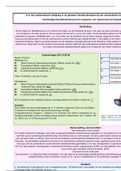
We carefully put a total of 1.68g of the sample of sodium hydrogen carbonate (NaHCO 3) that we were given
and after reading the results we then transferred the results to Table 1. We then transferred the sample into a
100cm3 volumetric flask and added distilled water until it reached the 100cm 3 mark. To ensure that the
solution was homogenised we swirled and shook the flask. After that was completed we took a pipette flask.
After that was completed we took a pipette and pipette filler and accurately piped 25cm 3 of the solution into
the conical flask. Once that was done we added two drops of methyl orange indicator into the solution in the
conical and put a flask atop the white tile. After setting up the burette with a stand and clamp, we realised that
the solution is now ready to be titrated. Using the 0.20 mol dm -3 of hydrochloric acid (HCl) that was provided
we filled up the burette to the 0.00 mark. We then slowly opened the top so that the solution could fill up the
air space underneath the top.
Mass measurements
Table 1.
Mass of weighing boat / g 1.01
Mass of weighing boat + NaHCO3 sample / g 2.69
Mass of NaHCO3 sample used / g 1.68
2
Unit 4: Scientific Practical Techniques
4.1 Analytical Techniques
Scenario:
You have started to work in an analysis laboratory for a chemical company and have been given
two samples to analyse. You will need some training in some basic techniques in quantitative and
qualitative analysis before you can carry out analysis on the two samples (one qualitative and one
quantitative). Record keeping must be done accurately.
Grading Criteria to be assessed:
P1 Carry out quantitative and qualitative analytical techniques.
M1 Explain how accuracy may be ensured in the techniques used.
D1 Evaluate the quantitative and qualitative analytical techniques used, suggesting
improvements for future investigations.
Tasks:
Quantitative Analysis
1. Sodium hydrogen carbonate can be used to treat acid indigestion and in cooking it is
known as baking soda. As an analytical chemist, you are to analyse a sample of sodium
hydrogencarbonate for its purity using a method provided (see Additional Guidance).
(P1)
Qualitative Analysis
2. To do a series of qualitative tests and to write down their observations. You will also
include relevant equations.
(P1)
3. You have been provided with an unknown inorganic compound. As an analytical chemist
you are carry out qualitative analysis to determine what ions are present.
(P1)
Plagiarised work will result in disciplinary procedures.
Additional guidance:
1
, Task 1: (P1) Quantitative Analysis
Method for determining the purity of a sample of sodium hydrogen carbonate
1. Carefully weigh out in a weighing boat, 0.40 g of the sample of sodium hydrogencarbonate
(NaHCO3) provided and record your readings in Table 1.
2. Transfer this sample to a 100 cm3 volumetric flask and add distilled water up to the 100 cm3
mark.
3. Swirl and shake the solution to ensure that the solution is homogenised.
4. Using a pipette and pipette filler, accurately pipette 25 cm3 of this solution into a conical
flask.
5. Add a few drops of methyl orange indicator and place on the white tile. This solution is
now ready to be titrated.
6. Set up the burrette using a stand and clamp.
7. Fill up the burrette to approximately the 0.00 mark with the 0.20 mol dm-3 of hydrochloric
acid (HCl) provided and open the burette tap to allow the solution to flow through the air
space below the tap (you may need to top-up again) back into the container.
8. Record your initial reading to 2 decimal places, with the second decimal place being either
a 0 or a 5 (you do not need to start on precisely 0.00), in Table 2.
9. Titrate your solution, whilst constantly swirling the conical flask, until a permanent colour
persists.
10. Repeat the procedure three more times. You need to slow down the flow of the HCl acid
after you have added approximately a few cm3 before the end-point is reached, to drop-by-
drop. This is to ensure your results to be as accurate as possible.
Method for determining the purity of a sample of sodium hydrogen carbonate
We carefully put a total of 1.68g of the sample of sodium hydrogen carbonate (NaHCO 3) that we were given
and after reading the results we then transferred the results to Table 1. We then transferred the sample into a
100cm3 volumetric flask and added distilled water until it reached the 100cm 3 mark. To ensure that the
solution was homogenised we swirled and shook the flask. After that was completed we took a pipette flask.
After that was completed we took a pipette and pipette filler and accurately piped 25cm 3 of the solution into
the conical flask. Once that was done we added two drops of methyl orange indicator into the solution in the
conical and put a flask atop the white tile. After setting up the burette with a stand and clamp, we realised that
the solution is now ready to be titrated. Using the 0.20 mol dm -3 of hydrochloric acid (HCl) that was provided
we filled up the burette to the 0.00 mark. We then slowly opened the top so that the solution could fill up the
air space underneath the top.
Mass measurements
Table 1.
Mass of weighing boat / g 1.01
Mass of weighing boat + NaHCO3 sample / g 2.69
Mass of NaHCO3 sample used / g 1.68
2