Chapter 1 – The organization and its environment
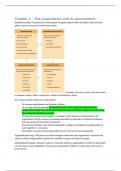
Entrepreneurship: The process by which people recognize opportunities to satisfy needs and then
gather and use resources to meet those needs.
The better this cycle is done, the more value
a company creates. Input->conversion->output->environment->input
Five reasons for the existence of organizations
- To increase specialization and division of labour
- To use large-scale technology (economies of scale: cost savings by large production,
economies of scope: the use of underutilized products for different products or tasks (using
pizza dough for multiple purposes))
- Manage the environmental output: A company is very reliant on its environment. An
organization has the resources to develop specialists to anticipate or attempt to influence
the many pressures from the environment.
- Economize transaction cost; vertical integration/ cutting out middleman by letting them al
work together in a company.
- Exert power & control; instructing people how to work to increase productivity.
Organizational design: The process in which managers determine the organizations’ structure and
culture so that an organization controls the activities necessary to achieve its goals.
Organizational change: Change of culture or structure within an organization in order to make better
use of resources and capabilities to increase an organization’s ability to create value and hence its
performance.
,àThe goal of these concepts is to increase a companies’ ability to deal with contingencies, achieve a
competitive advantage, managing diversity, and increase its efficiency and ability to innovate. These
are important now because of increasing global competition and the increasing use advanced IT.
Poor organizational design or lack of attention to it is the decline of an organization. E.g., companies
can become so big and bureaucratic that when conditions change, lack of adjustment of structure
and culture can lead to the downfall of a company. COOs are the solution, they create and overview
teams of managers who are responsible for the design, and (changes in) culture, strategy and
structure.
Measuring organizational effectiveness:
Figure 1 INTERNAL (CONTROL), EXTERNAL (INNOVATION), TECHNICAL (EFFICINECY)
, Chapter 2 – Stakeholders, Managers and Ethics
Stakeholders: People who have a claim, interest or stake in an organization, in what is does and how
well it performs.
In General, stakeholders who have bigger value of inducements then their contributions to an
organization, are motivated to participate.
Inside stakeholders worth mentioning/explaining:
Shareholders: Inside stakeholders who own the company.
~ Fund companies are since the crash more vocal to influence managers, to make sure the stocks
remain good, and the shareholders remain content. These companies are also showing increased
interest in controlling the huge salaries and bonusses of top managers. The fund companies also
lobbied to increase the power of government agencies to regulate banks. All this made it more
difficult to hide unfair/illegal transactions that benefits managers but in the end hurt other
stakeholders, especially customers. ~
Managers: Are employees of the shareholders, investing their money in the company in order to
make profit. They are chosen by the board of directors (who are chosen by the shareholders).
Outside stakeholders worth mentioning/explaining:
The government: wants companies to compete in a fair manner and obey the rules of free
competition. This includes treating employees well and abide to other socio-economic ethics.
They contribute by standardizing regulation so no company can gain an unfair competitive
advantage.
Trade unions (vakbonden): (wants to increase benefits of workers, are often independent of
companies) Their relationship with an organization can either be of conflict or of cooperation. They
can be of cooperation for example if both parties agree on an equitable division of profits. However,
they are often in conflict as the trade unions demand increased benefits which directly conflicts with
the wants of the shareholders’ demand for greater company profits.
Local communities: Stake in organizations as their performance influence the local economic well-
being of a community. Local communities contribute as a workforce or as customers.
General public: Happy when their counties’ organizations compete successfully against rivals, are
induced by pride in their country to contribute to their countries’ organizations, even if the oversees
companies are way better. U.S. residents tend to prefer competition to loyalty (so they rather switch
organizations to maintain competition than stand by one company).
Organizational effectiveness is measured by each stakeholder group by its set of own goals. These
goals often conflict, and different stakeholders must bargain over the balance between inducements
and contributions. Organizations rely on cooperation between stakeholder groups.
E.g., managers tend to get all the control of an organization. However, shareholders often seek long-
term profits (investment in R&D), while managers seek short-term goals because they are evaluated
on that by their peers and stock market analysts.
Decision making is hard for managers, but they must always satisfy all the minimal expectations of
the stakeholders.
Division of extra inducements when a company does well, is a very important subject as it affects the
stakeholders’ motivation to contribute.
Authority: Is the power to hold people accountable for their actions and make decisions regarding
the use of organizational resources.
Entrepreneurship: The process by which people recognize opportunities to satisfy needs and then
gather and use resources to meet those needs.
The better this cycle is done, the more value
a company creates. Input->conversion->output->environment->input
Five reasons for the existence of organizations
- To increase specialization and division of labour
- To use large-scale technology (economies of scale: cost savings by large production,
economies of scope: the use of underutilized products for different products or tasks (using
pizza dough for multiple purposes))
- Manage the environmental output: A company is very reliant on its environment. An
organization has the resources to develop specialists to anticipate or attempt to influence
the many pressures from the environment.
- Economize transaction cost; vertical integration/ cutting out middleman by letting them al
work together in a company.
- Exert power & control; instructing people how to work to increase productivity.
Organizational design: The process in which managers determine the organizations’ structure and
culture so that an organization controls the activities necessary to achieve its goals.
Organizational change: Change of culture or structure within an organization in order to make better
use of resources and capabilities to increase an organization’s ability to create value and hence its
performance.
,àThe goal of these concepts is to increase a companies’ ability to deal with contingencies, achieve a
competitive advantage, managing diversity, and increase its efficiency and ability to innovate. These
are important now because of increasing global competition and the increasing use advanced IT.
Poor organizational design or lack of attention to it is the decline of an organization. E.g., companies
can become so big and bureaucratic that when conditions change, lack of adjustment of structure
and culture can lead to the downfall of a company. COOs are the solution, they create and overview
teams of managers who are responsible for the design, and (changes in) culture, strategy and
structure.
Measuring organizational effectiveness:
Figure 1 INTERNAL (CONTROL), EXTERNAL (INNOVATION), TECHNICAL (EFFICINECY)
, Chapter 2 – Stakeholders, Managers and Ethics
Stakeholders: People who have a claim, interest or stake in an organization, in what is does and how
well it performs.
In General, stakeholders who have bigger value of inducements then their contributions to an
organization, are motivated to participate.
Inside stakeholders worth mentioning/explaining:
Shareholders: Inside stakeholders who own the company.
~ Fund companies are since the crash more vocal to influence managers, to make sure the stocks
remain good, and the shareholders remain content. These companies are also showing increased
interest in controlling the huge salaries and bonusses of top managers. The fund companies also
lobbied to increase the power of government agencies to regulate banks. All this made it more
difficult to hide unfair/illegal transactions that benefits managers but in the end hurt other
stakeholders, especially customers. ~
Managers: Are employees of the shareholders, investing their money in the company in order to
make profit. They are chosen by the board of directors (who are chosen by the shareholders).
Outside stakeholders worth mentioning/explaining:
The government: wants companies to compete in a fair manner and obey the rules of free
competition. This includes treating employees well and abide to other socio-economic ethics.
They contribute by standardizing regulation so no company can gain an unfair competitive
advantage.
Trade unions (vakbonden): (wants to increase benefits of workers, are often independent of
companies) Their relationship with an organization can either be of conflict or of cooperation. They
can be of cooperation for example if both parties agree on an equitable division of profits. However,
they are often in conflict as the trade unions demand increased benefits which directly conflicts with
the wants of the shareholders’ demand for greater company profits.
Local communities: Stake in organizations as their performance influence the local economic well-
being of a community. Local communities contribute as a workforce or as customers.
General public: Happy when their counties’ organizations compete successfully against rivals, are
induced by pride in their country to contribute to their countries’ organizations, even if the oversees
companies are way better. U.S. residents tend to prefer competition to loyalty (so they rather switch
organizations to maintain competition than stand by one company).
Organizational effectiveness is measured by each stakeholder group by its set of own goals. These
goals often conflict, and different stakeholders must bargain over the balance between inducements
and contributions. Organizations rely on cooperation between stakeholder groups.
E.g., managers tend to get all the control of an organization. However, shareholders often seek long-
term profits (investment in R&D), while managers seek short-term goals because they are evaluated
on that by their peers and stock market analysts.
Decision making is hard for managers, but they must always satisfy all the minimal expectations of
the stakeholders.
Division of extra inducements when a company does well, is a very important subject as it affects the
stakeholders’ motivation to contribute.
Authority: Is the power to hold people accountable for their actions and make decisions regarding
the use of organizational resources.