Bioethics Midterm 1 Questions With Complete Solutions
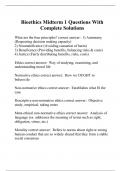
What are the four principles? correct answer: 1) Autonomy (Respecting decision making capacity) 2) Nonmaleficence (Avoiding causation of harm) 3) Beneficence (Providing benefits, balancing risks & costs) 4) Justice (Fairly distributing benefits, risks, costs) Ethics correct answer: Way of studying, examining, and understanding moral life Normative ethics correct answer: How we OUGHT to behave/do Non-normative ethics correct answer: Establishes what IS the case Descriptive non-normative ethics correct answer: Objective study, empirical, taking notes Meta-ethical non-normative ethics correct answer: Analysis of language (ex. addresses the meaning of terms such as right, obligation, virtue, etc.) Morality correct answer: Refers to norms about right or wrong human conduct that are so widely shared that they form a stable social consensus Common Morality correct answer: Refers to a set of basic norms in moral life that is shared by all morally serious persons (Note: no norm is absolute) Community Specific Morality correct answer: Springs from a particular community; culture, religion, institution, profession Public Policy correct answer: Set of normative enforceable guidelines accepted by an official public body (All laws are public policy, but not all public policies are laws) Patient Self-Determination Act (1991) correct answer: The first federal legislation to ensure that health care institutions inform patients about institutional policies that allow them to accept or refuse medical treatment and about their rights under state law, including a right to formulate advance directives Tarasoff Case correct answer: Outcome: The therapist generally ought to observe the rule of medical confidentiality, but that rule must yield in this case to the "public interest in safety from violent assault" Moral dilemma correct answer: An agent believes that, on moral grounds, he or she is obligated to perform 2 or more mutually exclusive actions Principles correct answer: General norms that leave considerable room for judgement in many cases Prima Facie obligations correct answer: Must be fulfilled unless overridden or outweighed in particular situation by equal or stronger obligation Specification correct answer: "Adds content". OK strategy for the resolution of hard cases as long as specifications are justified Weighing and Balancing correct answer: Specification useful for policy development, balancing moral norms is useful for reaching judgements in individual cases Moral Diversity and Disagreement correct answer: No simple, entirely reliable way (that everyone agrees on) to resolve all disagreements What are moral disagreements due to? correct answer: Facts, scope, which norms, specification, weight of norms, balancing of norms, genuine dilemma, insufficient information/evidence Virtues correct answer: Character Traits Moral Virtues correct answer: Morally valuable character traits Aristotle on virtue correct answer: An action may be right, but not virtuous, but virtuous actions come from a virtuous state of mind; motivation matters Ring of Gyres correct answer: "How do you behave if you know others don't know you're behaving" Technical error correct answer: Training or information falls short Judgmental error correct answer: An incorrect strategy is used Normative error correct answer: Failure of conscientiousness The ethics of care correct answer: -Emphasizes traits valued in intimate personal relationships (sympathy, compassion, love) -Originated in feminist writing -Importance of interdependence and emotional responsiveness Five Focal Virtues-Compassion correct answer: Active regard for another, deep sympathy Five Focal Virtues-Discernment correct answer: Sensitive insight, acute judgement Five Focal Virtues-Trustworthiness correct answer: Meriting confidence in another's moral character and competence Five Focal Virtues-Integrity correct answer: Integrated moral character and adherence to moral norms Five Focal Virtues-Conscientiousness correct answer: Trying to do what is right with diligence, intentionally and with effort Ordinary moral standards correct answer: Apply to everyone- the moral "minimum" Extraordinary moral standards "Supererogatory Act" correct answer: Above and beyond what is needed (optional, exceed common morality, intentionally undertake for others' good, intrinsically morally good and praiseworthy) Living organ donation correct answer: Raises complex ethical issues because the transplant team subjects a healthy person to a viably risky surgical procedure, with no medical benefit to him or her Liberty correct answer: Independence from controlling influences Agency correct answer: Capacity for intentional action Autonomous actions for choosers who act: correct answer: -Intentionally -With understanding -Without controlling influences Respect for autonomy correct answer: Is not a mere ideal in health care; it is a positive obligation (however, it only has prima facie standing, can be overridden by competing moral considerations) Kant idea for respecting autonomy correct answer: Autonomous agents owed respect because they "self-legislate" the moral law Utilitarian idea for respecting autonomy correct answer: Agents owed respect because they undergo consequences of their actions Informed Consent correct answer: An autonomous authorization of medical intervention or medical research Express consent correct answer: Usually informed consent or refusal Implied consent correct answer: Consent to one procedure may imply consent to other actions or policies Presumed/tacit consent correct answer: ex: pelvic examinations and organ donations Elements of express informed consent correct answer: 1) Disclosure 2) Understanding 3) Voluntariness 4) Competence 5) Consent Informed consent- Competence correct answer: - Capacity to reach decision based on rational reasons - Capacity to reach reasonable result through a decision - Capacity to make any decision at all *Note: may vary over time and be intermittent Competence judgements correct answer: Distinctive normative role of qualifying or disqualifying persons for certain decisions or actions (by psychiatric tests) Informed Consent-Voluntariness correct answer: Must be free from coercion, persuasion, or manipulation Coercion correct answer: Voids act of autonomy (under threat) Persuasion correct answer: Through merits or arguments Manipulation correct answer: "Playing with numbers", providing selective information Therapeutic Privilege correct answer: A physician may legitimately withhold information based on a sound medical judgement that divulging the information would potentially harm a depressed, emotionally drained, or unstable patient Intentional non-disclosure correct answer: Therapeutic privilege, emergency, incompetence, waiver Therapeutic use of placebos correct answer: You cannot prescribe a placebo without informed consent Miss A had cancer, doctor told her that her pains are sue to arthritis correct answer: If Miss A actually has arthritis, or if Dr. B is convinced that everyone at her age does have at least a mild case of arthritis, his answer is not morally wrong Surrogate Decision Making correct answer: Authorized to make medical decisions for doubtfully autonomous and non-autonomous persons Substituted Judgement correct answer: Weak autonomy standard, make decision the now-incompetent would have made Pure autonomy correct answer: Advance directives available, but imprecise statements provide little guidance and are sometimes dangerous Best interest correct answer: Determine highest net benefit among options, apply patient preferences, values, perspectives What to tell cancer patient study correct answer: From 1961 to 1979 doctors that would tell their patients that they had cancer went from rare to 98% Critiques of informed consent correct answer: Specifies minimal disclosure obligations, lots of "disclaimer language", doctors still make decisions Understanding correct answer: Persons understand if they have acquired pertinent information and have relevant beliefs about the nature and consequences of their actions Nonmaleficence correct answer: One ought not inflict evil or harm *Obligation of beneficence takes priority over the obligation of nonmaleficence Wronging correct answer: Violating someone's rights Harm correct answer: Defeating or setting back party's interest, but it is not always wrong or unjustified *People can be wronged without being harmed Negligence correct answer: Imposing a risk of harm Types of negligence correct answer: 1) Intentionally imposing unreasonable risks of harm 2) Unintentionally but carelessly imposing risks of harm Professional malpractice correct answer: An instance of negligence that involves failure to follow professional standards of care Rule of Double Effect correct answer: Invoked to justify claims that a single act having two foreseen effects, one good and one harmful, is not always morally prohibited Four Principles of Double Effect correct answer: 1) Nature of the act must be good 2) Agent must intend only the goof effect 3) The bad effect must not be a means to the good effect 4) The good effect must outweigh the bad effect Sacrifice of Fetus correct answer: OK if death of fetus is foreseen but unintentional Witholding v. Withdrawing Treatment correct answer: The distinction is morally irrelevant and potentially dangerous Ordinary v. Extraordinary Treatment correct answer: -Conclude that the distinction between ordinary and extraordinary treatment is morally irrelevant -The distinction between optional and obligatory treatment, as determined by the balance of benefits and burdens of the patient, is the pertinent distinction Sustenance Technologies v. Medical Treatments correct answer: -Some argue that technologies for dispensing sustenance-namely, those that supply nutrition and hydration are non medical means of maintaining life that are unlike optional forms of life-sustaining technologies, such as respirators and dialysis machines. HOWEVER, the text disagrees Futile correct answer: A situation in which irreversibly dying patients have reached a point at which further treatment provides no physiological benefit or is hopeless and becomes optional Quinlan Case correct answer: Believed that it was ok to be taken off respirator, but not food supply (despite getting the okay from the Catholic Church._ Quinlan survived an extra 9 years Terri Schiavo Case correct answer: Schiavo's husband fought the Florida court to remove his wife's feeding supply after 15 years, allowing her to die. When can you override the prima facie obligation to treat? correct answer: -Futile or pointless treatment -Burdens outweigh benefits -Centrality of quality-of-life judgements -Children with serious illnesses or disabilities Killing v. Letting Die correct answer: Letting die is not necessarily more morally acceptable than killing Letting die is prima facie acceptable when: correct answer: Treatment would be physiologically futile or valid patient refusal Kevorkian correct answer: Created the death machine. This is UNJUSTIFIED physician assistance in dying Oregon death with dignity act (ODWDA) correct answer: Physician fills a lethal prescription...but does not make patient take it...therefore neither killing or letting die Slippery Slope Arguments correct answer: Depends on speculative predictions of a progressive erosion of moral restraints. Quill Case correct answer: Justified assisted suicide:prescribed barbiturates to a 45 year old patient who refused risky, painful, and often unsuccessful treatments for leukemia Advance Directive correct answer: Competent person selects surrogate to make decisions if they were to become incompetent Positive beneficence correct answer: Must provide benefits Utility correct answer: Balance benefits and harms Beneficence correct answer: An action done to benefit others Benevolence correct answer: Character trait/virtue of being disposed to benefit others Principle of beneficence (B&C) correct answer: Obligation to act for the benefit of others General beneficence (Peter Singer) correct answer: Distinguishes preventing evil from promoting good, and contends that "if it is in our power to prevent something bad from happening, without thereby sacrificing anything of comparable moral importance, we ought, morally, to do it" Principles of Positive Beneficence correct answer: 1) Protect and defend rights of others 2) Prevent harm from occurring to others 3) Remove conditions causing harm 4) Help persons with disabilities 5) Rescue persons in danger McFall-Shimp Case correct answer: The law did not allow the judge to force Shimp to engage in such acts of positive beneficence...but, it was "morally indefensible" Reciprocity correct answer: Act or practice of making an appropriate and often proportional return. This is considered an unrealistic idea Paternalism correct answer: The intentional overriding of one person's known preferences or actions by another person, where the person who overrides justifies the action by the goal of benefiting or avoiding harm to the person whose preferences or actions are overridden Weak/soft paternalism correct answer: Agent intervenes on ground of beneficence or non-maleficence only to prevent substantially non-voluntary conduct Strong/hard paternalism correct answer: Interventions intended to benefit a person against their informed, voluntary and substantially autonomous wishes Anti-paternalists correct answer: Believes that paternalism violates individual rights and restricts free choice; often libertarians who believe "everyone is entitled to be the author of their own tragedy" When is strong paternalism justified? correct answer: 1) Patient at risk of significant, preventable harm 2) Paternalistic action will prevent harm 3) Projected benefits outweigh risks 4) Least autonomy-restrictive alternative is adopted Suicide Intervention correct answer: If we accept autonomy, then intervening in someone's suicide is not legitimate Reasons for Pro-Intervention (in someone's suicide) correct answer: 1) Failure to intervene symbolically communicates lack of communal concern, communal responsibility 2) Suicide-attempts by mentally ill, depressed, destabilized by crisis = not fully autonomous 3) Suicide attempt may be covert cry for help Passive paternalism correct answer: Requested treatment believed not to be in patient's best interest (sometimes scientifically proven, sometimes more value-laden) Medical futility correct answer: Justified claim of futility cancels professional's obligation to provide medical procedure Problems with medical futility correct answer: -Langauge confusing -Covertly value-laden -Involves predictions and evaluations -Costs may be a hidden issue QALY correct answer: A measure of health outcome which looks at both length of life and quality of life QALY-based CEA (cost effectiveness analysis) correct answer: Favors life-years over individual lives, and the number of life-years over the number of individual lives

Geschreven voor
- Instelling
- Bioethics
- Vak
- Bioethics
Documentinformatie
- Geüpload op
- 21 oktober 2023
- Aantal pagina's
- 14
- Geschreven in
- 2023/2024
- Type
- Tentamen (uitwerkingen)
- Bevat
- Vragen en antwoorden
Onderwerpen
-
bioethics midterm 1
-
bioethics midterm 1 questions with complete soluti
-
what are the four principles
-
descriptive non normative ethics
-
meta ethical non normative ethics
-
community specific morality

Ook beschikbaar in voordeelbundel