TEST Research Methodologies Exam 2023 Latest Update
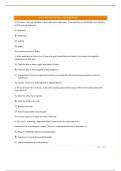
Research Methodologies in Social Sciences 1. Explain the relationship between the social and the political (0.5p), and demonstrate through some examples how studying social aspects allows us interpreting better the politics (0.5p). [1p] Social and political philosophy is a very broad area of research that includes examinations and evaluations of all aspects of social life, from the family, to the nation-state, to international relations. For example the issue of environmental conservation, which is influenced by both social attitudes towards going green and by political policies. 2. Imagine yourself researching the topic of social movement. (a) What kind of information would you consider important to know in order to understand some aspects of this topic? (0.5p); (b) How would you get that information, considering the topic documentation research approach/strategy, and methods of research, in brief? (0.5p). [1p] a) Social movement is a collective actions associated with social movements play such an important role in bringing about social change in political, religious, educational, health, corporate, government, and other institutional arenas. 3. Read Chapter 7 in your Reader (Schaffer, pp. 131-145) and complete the following tasks, in few words: (a) explain what is social mobility (0.2p); (b) explain the difference between inter- and intra-generational mobility (0.2p); and (c) explain through two different examples/cases, why some people cannot overcome their social status or condition, despite their efforts (0.6 p). [1p] a) Social mobility, movement of individuals, families, or groups through a system of social hierarchy or stratification. If, however, the move involves a change in social class, it is called vertical mobility and involves either upward mobility or downward mobility. An industrial worker who becomes a wealthy businessman moves upward in the class system; a landed aristocrat who loses everything in a revolution moves downward in the system. b) Intra-generational social mobility concerns the ability of a specific individual to move up or down the ladder within his or her lifetime. Intergenerational social mobility, on the other hand, concerns the changes of social class of different generations of family members. c) A lot of factors that triggers downward mobility. The most important is the structure of society, those who belongs to a lower social class most commonly remain there. We live in a hierarchical society. In general, people in a lower class remain at the same level, and people in the middle and higher classes are less or not differentiated at all. They have better access to education and occupy higher positions. Some people cannot overcome their social status because they have stopped in self-development or do not have enough education or are afraid to change. 4. Read Chapter 5 (“Urban economies”) in your extra reading text, Introducing Urban Anthropology (Jaffe and de Koning, pp. 71-86). Choose an urban economic place from the four ones presented between pages: 82-85 and complete the following tasks: CONTINUES...

Geschreven voor
- Instelling
- TES_Research_Methodologies_Exa 2023
- Vak
- TES_Research_Methodologies_Exa 2023
Documentinformatie
- Geüpload op
- 15 september 2023
- Aantal pagina's
- 3
- Geschreven in
- 2023/2024
- Type
- Tentamen (uitwerkingen)
- Bevat
- Vragen en antwoorden
Onderwerpen
-
2023 latest updat
-
test research methodologies exam