Chapter 1
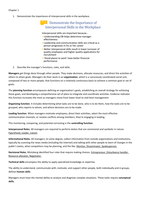
1. Demonstrate the importance of interpersonal skills in the workplace.
2. Describe the manager’s functions, roles, and skills.
Managers get things done through other people. They make decisions, allocate resources, and direct the activities of
others to attain goals. Managers do their work in an organization, which is a consciously coordinated social unit,
composed of two or more people, that functions on a relatively continuous basis to achieve a common goal or set of
goals.
The planning function encompasses defining an organization’s goals, establishing an overall strategy for achieving
those goals, and developing a comprehensive set of plans to integrate and coordinate activities. Evidence indicates
this function increases the most as managers move from lower-level to mid-level management
Organizing function. It includes determining what tasks are to be done, who is to do them, how the tasks are to be
grouped, who reports to whom, and where decisions are to be made.
Leading function. When managers motivate employees, direct their activities, select the most effective
communication channels, or resolve conflicts among members, they’re engaging in leading.
This monitoring, comparing, and potential correcting is the controlling function.
Interpersonal Roles. All managers are required to perform duties that are ceremonial and symbolic in nature.
Figurehead, Leader, Liaison
Informational Roles. All managers, to some degree, collect information from outside organizations and institutions,
typically by scanning the news media (including the Internet) and talking with other people to learn of changes in the
public’s tastes, what competitors may be planning, and the like. Monitor, Disseminator, Spokesperson.
Decisional Roles. Mintzberg identified four roles that require making choices. Entrepreneur, Disturbance handler,
Resource allocator, Negotiator.
Technical skills encompass the ability to apply specialized knowledge or expertise.
The ability to understand, communicate with, motivate, and support other people, both individually and in groups,
defines human skills.
Managers must have the mental ability to analyze and diagnose complex situations. These tasks require conceptual
skills.
1. Demonstrate the importance of interpersonal skills in the workplace.
2. Describe the manager’s functions, roles, and skills.
Managers get things done through other people. They make decisions, allocate resources, and direct the activities of
others to attain goals. Managers do their work in an organization, which is a consciously coordinated social unit,
composed of two or more people, that functions on a relatively continuous basis to achieve a common goal or set of
goals.
The planning function encompasses defining an organization’s goals, establishing an overall strategy for achieving
those goals, and developing a comprehensive set of plans to integrate and coordinate activities. Evidence indicates
this function increases the most as managers move from lower-level to mid-level management
Organizing function. It includes determining what tasks are to be done, who is to do them, how the tasks are to be
grouped, who reports to whom, and where decisions are to be made.
Leading function. When managers motivate employees, direct their activities, select the most effective
communication channels, or resolve conflicts among members, they’re engaging in leading.
This monitoring, comparing, and potential correcting is the controlling function.
Interpersonal Roles. All managers are required to perform duties that are ceremonial and symbolic in nature.
Figurehead, Leader, Liaison
Informational Roles. All managers, to some degree, collect information from outside organizations and institutions,
typically by scanning the news media (including the Internet) and talking with other people to learn of changes in the
public’s tastes, what competitors may be planning, and the like. Monitor, Disseminator, Spokesperson.
Decisional Roles. Mintzberg identified four roles that require making choices. Entrepreneur, Disturbance handler,
Resource allocator, Negotiator.
Technical skills encompass the ability to apply specialized knowledge or expertise.
The ability to understand, communicate with, motivate, and support other people, both individually and in groups,
defines human skills.
Managers must have the mental ability to analyze and diagnose complex situations. These tasks require conceptual
skills.