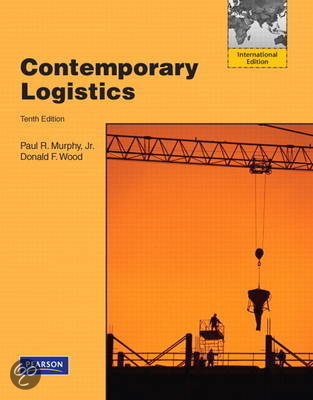
Summary of the book: Contemporary logistics
by: Paul R. Murphy, Jr. Donald F. Wood
Tenth edition. Pearson
Summary of Chapters:1, 5, 7, 8, 10 & 14
20 Pages in total
1
, Chapter 1 An overview of logistics
Economic impacts of logistics
Economic utility (the value or usefulness of a product in fulfilling customer needs or wants)
4 general types:
Possession utility : the value or usefulness that comes from a customer being able to take
possession of a product
Form utility : a product’s being in a form that can be used by the customer and is of
value to the customer(allocation; smaller quantities that are desired by customers)
Place utility :having products available where they are needed by customers
Time utility : having products available when they are needed by customers
What is logistics?
‘logistics management is that part of Supply Chain Management that plans, implements, and controls
the efficient, effective forward and reverse flow and storage of goods, services, and related information
between the point of origin and the point of consumption in order to meet customers’ requirements.’
Mass logistics: every customer gets the same type and levels of logistics service(then some will be
overserved/underserved)
Tailored logistics: groups of customers with similar logistical needs and wants are provided with logistics
service appropriate to these needs and wants
Increased importance of logistics by:
A reduction in economic regulation
Changes in consumer behavior
Technological advances
The growing power of retailers
Globalization of trade
The systems and total cost approaches to logistics
Systems approach: indicates that a company’s objectives can be realized by recognizing the mutual
interdependence of the major functional areas(marketing, production, finance and logistics) of the firm.
Stock-keeping units(SKUs): each different type or package size of a good is a different SKU.
Materials management: movement and storage of materials into a firm.
2
by: Paul R. Murphy, Jr. Donald F. Wood
Tenth edition. Pearson
Summary of Chapters:1, 5, 7, 8, 10 & 14
20 Pages in total
1
, Chapter 1 An overview of logistics
Economic impacts of logistics
Economic utility (the value or usefulness of a product in fulfilling customer needs or wants)
4 general types:
Possession utility : the value or usefulness that comes from a customer being able to take
possession of a product
Form utility : a product’s being in a form that can be used by the customer and is of
value to the customer(allocation; smaller quantities that are desired by customers)
Place utility :having products available where they are needed by customers
Time utility : having products available when they are needed by customers
What is logistics?
‘logistics management is that part of Supply Chain Management that plans, implements, and controls
the efficient, effective forward and reverse flow and storage of goods, services, and related information
between the point of origin and the point of consumption in order to meet customers’ requirements.’
Mass logistics: every customer gets the same type and levels of logistics service(then some will be
overserved/underserved)
Tailored logistics: groups of customers with similar logistical needs and wants are provided with logistics
service appropriate to these needs and wants
Increased importance of logistics by:
A reduction in economic regulation
Changes in consumer behavior
Technological advances
The growing power of retailers
Globalization of trade
The systems and total cost approaches to logistics
Systems approach: indicates that a company’s objectives can be realized by recognizing the mutual
interdependence of the major functional areas(marketing, production, finance and logistics) of the firm.
Stock-keeping units(SKUs): each different type or package size of a good is a different SKU.
Materials management: movement and storage of materials into a firm.
2