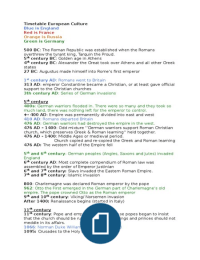
Timetable European Culture
Blue is England
Red is France
Orange is Russia
Green is Germany
500 BC: The Roman Republic was established when the Romans
overthrew the tyrant king, Tarquin the Proud.
5th century BC: Golden age in Athens
4th century BC: Alexander the Great took over Athens and all other Greek
states
27 BC: Augustus made himself into Rome’s first emperor
1st century AD: Romans went to Britain
313 AD: emperor Constantine became a Christian, or at least gave official
support to the Christian churches
3th century AD: Series of German invasions
5th century
400s: German warriors flooded in. There were so many and they took so
much land, there was nothing left for the emperor to control.
+- 400 AD: Empire was permanently divided into east and west
410 AD: Romans departed Britain
476 AD: German warriors had destroyed the empire in the west.
476 AD – 1400: Odd mixture ‘’German warriors support Roman Christian
church, which preserves Greek & Roman learning’’ held together.
476 AD - 1400: Middle Ages or medieval period.
Church copied and re-copied the Greek and Roman learning
476 AD: The western half of the Empire fell
5th and 6th century: German peoples (Angles, Saxons and Jutes) invaded
England
6th century AD: Most complete compendium of Roman law was
assembled by the order of Emperor Justinian
6th and 7th century: Slavs invaded the Eastern Roman Empire.
7th and 8th century: Islamic invasion
800: Charlemagne was declared Roman emperor by the pope
962: Otto the First emerged in the German part of Charlemagne’s old
empire. The pope crowned Otto as the Roman emperor
9th and 10th century: Viking/ Norsemen invasion
After 1400: Renaissance begins (started in Italy)
11th century
11th century: Pope and emperor fell out because popes began to insist
that the church should be run from Rome and kings and princes should not
meddle in its affairs.
1066: Norman Duke William conquered England
1095: Crusades to the Holy Land
, 15th century
+- 1400: European civilization was unstable and began to fall apart
15th century: Europe started to expand overseas Growth of commerce,
banking and shipping and hence the growth of towns.
1453: Constantinople was captured by the Muslims
The Roman Empire came to an end
1480: Ming emperor of China ruled that overseas exploration and trade
were forbidden
1492: Last Muslims driven from Spain
16th century
16th century: Protestant Reformation (started mainly in Germany)
1534: Henry VII declared that he himself was head of the Catholic Church
in England
17th century
17th century: Scientific Revolution
17th century: English monarchs tried to become absolute monarch on
European lines
18th century
18th century: Enlightenment
18th century: The destruction that Latin, Greek, Slavonic and German
language all descended from Indo-European
Mid 18th century: Industrial Revolution in England (1760-1850, also
Belgium)
1780s: The French monarch was close to bankrupt Reformers got their
chance
1789: Revolution France
The Assembly of the Third Estate used a manifesto: The Declaration
of the Rights of Man and of the Citizen
1792: Republic proclaimed
1793: King Louis XVI was executed
Late 18th century, early 19th century: Romantic movement
1799: Napoleon Bonaparte took charge in France
19th century
1815: Napoleon I was defeated
1820: Push for reform recommenced
1830: French Revolution
1832: Reform Act gave vote to middle class and wiped out the
representation of the tiny or non-existing towns
1840: German Friedrich Engels ‘’The Condition of the Working Class’’ in
England
1848: French Revolution
Working men and their representatives were part of the first
revolutionary
government
Blue is England
Red is France
Orange is Russia
Green is Germany
500 BC: The Roman Republic was established when the Romans
overthrew the tyrant king, Tarquin the Proud.
5th century BC: Golden age in Athens
4th century BC: Alexander the Great took over Athens and all other Greek
states
27 BC: Augustus made himself into Rome’s first emperor
1st century AD: Romans went to Britain
313 AD: emperor Constantine became a Christian, or at least gave official
support to the Christian churches
3th century AD: Series of German invasions
5th century
400s: German warriors flooded in. There were so many and they took so
much land, there was nothing left for the emperor to control.
+- 400 AD: Empire was permanently divided into east and west
410 AD: Romans departed Britain
476 AD: German warriors had destroyed the empire in the west.
476 AD – 1400: Odd mixture ‘’German warriors support Roman Christian
church, which preserves Greek & Roman learning’’ held together.
476 AD - 1400: Middle Ages or medieval period.
Church copied and re-copied the Greek and Roman learning
476 AD: The western half of the Empire fell
5th and 6th century: German peoples (Angles, Saxons and Jutes) invaded
England
6th century AD: Most complete compendium of Roman law was
assembled by the order of Emperor Justinian
6th and 7th century: Slavs invaded the Eastern Roman Empire.
7th and 8th century: Islamic invasion
800: Charlemagne was declared Roman emperor by the pope
962: Otto the First emerged in the German part of Charlemagne’s old
empire. The pope crowned Otto as the Roman emperor
9th and 10th century: Viking/ Norsemen invasion
After 1400: Renaissance begins (started in Italy)
11th century
11th century: Pope and emperor fell out because popes began to insist
that the church should be run from Rome and kings and princes should not
meddle in its affairs.
1066: Norman Duke William conquered England
1095: Crusades to the Holy Land
, 15th century
+- 1400: European civilization was unstable and began to fall apart
15th century: Europe started to expand overseas Growth of commerce,
banking and shipping and hence the growth of towns.
1453: Constantinople was captured by the Muslims
The Roman Empire came to an end
1480: Ming emperor of China ruled that overseas exploration and trade
were forbidden
1492: Last Muslims driven from Spain
16th century
16th century: Protestant Reformation (started mainly in Germany)
1534: Henry VII declared that he himself was head of the Catholic Church
in England
17th century
17th century: Scientific Revolution
17th century: English monarchs tried to become absolute monarch on
European lines
18th century
18th century: Enlightenment
18th century: The destruction that Latin, Greek, Slavonic and German
language all descended from Indo-European
Mid 18th century: Industrial Revolution in England (1760-1850, also
Belgium)
1780s: The French monarch was close to bankrupt Reformers got their
chance
1789: Revolution France
The Assembly of the Third Estate used a manifesto: The Declaration
of the Rights of Man and of the Citizen
1792: Republic proclaimed
1793: King Louis XVI was executed
Late 18th century, early 19th century: Romantic movement
1799: Napoleon Bonaparte took charge in France
19th century
1815: Napoleon I was defeated
1820: Push for reform recommenced
1830: French Revolution
1832: Reform Act gave vote to middle class and wiped out the
representation of the tiny or non-existing towns
1840: German Friedrich Engels ‘’The Condition of the Working Class’’ in
England
1848: French Revolution
Working men and their representatives were part of the first
revolutionary
government