

Podcast notes ISFE
Podcast 1
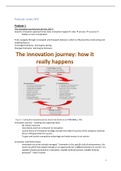
The innovation journey (van de Ven, 2017)
Systems innovation approach (how does innovation happen?): idea → process → success (?)
- Reality is more complicated
Firms navigate through convergent and divergent behavior, which is influenced by constraining and
enabling factors:
Convergent behavior: learning by testing
Divergent behavior: learning by discovery
Innovation journey – creating and capturing value:
- No certain outcome
- Uncertainty and risk is inherent to innovation
- Luck & choice of innovation strategy increase the odds of success of the company, however
there is NO guarantee for success
- To gain and sustain competitive advantage and make money is not certain
Innovation and Performance:
- Innovation has to be actively managed: “Innovation is the specific tool of entrepreneurs, the
means by which they exploit change as an opportunity for a different business or service. It is
capable of being presented as a discipline, capable of being learned, capable of being
practiced” - Peter Drucker
1
,Podcast 2
Startups (young innovative enterprises):
- Trying a new business model to disrupt the market
- Small and new
- Not all startups are very innovative (they don’t often use that much new technology but use
existing technologies, old wine in new bottles), so not all startups are new technology-based
firms while most new technology-based firms are startups
- Are often seen to contribute to economic growth and to help solve societal challenges
- Also known as new technology-based firms
Business incubators (programs and organizations that primarily support new technology-based
startups):
- Apply different support mechanisms to help startups grow, survive and compete (e.g.
through providing resources)
- Supplying startups with resources:
1. Tangible resources: physical capital and financial capital
2. Intangible resources: knowledge, social capital and legitimacy
- Not all startups need the same resources
- Resources need to be high quality and should match the needs of the startups
- Startups often do not know what resources they need/miss, perceptions on resources
between incubator and entrepreneur differ
- Incubators should identify the needs of the startups and make the startup aware
of/stimulate or push the startup to develop these resources and needs
- The incubator thus needs to take the specific startup into account on how assertive it should
be to guide the startup
- Perceptions of resource importance: Initially, startups often expect incubators to give them
access to tangible resources
But after a while, experienced entrepreneurs become more aware of the great importance/
high value of intangible resources, which is more in line with the claims incubators perceive
as important resources.
• Resources and their quality did not always meet the needs of the start-ups
• Experience influences which resources an entrepreneur needs
• Start-ups are often focused on technology.
They are often:
– “Unconsciously incompetent” → entrepreneurs are unaware of what they
need/miss/are unable to do
– Short term oriented and focused on day-to-day business
– Unwilling to leave their comfort zone and grow
2
,Implications for incubators:
- For inexperienced “incompetent” entrepreneurs → Strong intervention approach
• Aggressive coaching
• Mandatory participation
• Fixed mile stones
• Recruit additional entrepreneurs
- For experienced “competent” entrepreneurs → Laissez-faire approach
• Demand driven support
Assertive incubator → inexperienced entrepreneurs:
- Make more strong interventions to motivate the entrepreneurs
- Stricter/strong intervention approach
- Rich vs. king dilemma → giving up control (king) when looking for investors to grow the
company (rich)
Podcast 3
Schumpeter → product and process innovation
Meeus & Edquist (2006)
- Innovation can be classified based on their effects on market
- An innovation can cause:
• continuous small incremental changes; The incremental mode implies a more step-by-step
approach of gradually improving existing products or processes.
• discontinuous radical innovations; change the entire order of things, making obsolete the
old ways and perhaps sending entire businesses into the ditch of history.
• massive shifts in some pervasive general purpose technology (GPT), sometimes called
‘techno-economic paradigms’
Product innovation:
- What is produced? What is sold to the customer?
- Tangible and intangible (e.g. (online) services)
- Any new or better product or product variety that is being produced and sold on the market
Process innovation:
- How is it produced? How do you make or create that what is sold?
- Technological (e.g. new machines) and organizational (e.g. agile or scrum software
development process) innovations in the way a product is produced
Some innovations can be two types of innovations at the same time (e.g. a new machine can be a
product AND process innovation), however this should be well argued. This also holds for overlaps
between and within frameworks.
Innovation classification based on effects on market and society:
- Incremental innovation: small improvement on the last technology, small and gradual step
to make a better product
- Radical innovation: big changes that change the entire incumbent order of things
- Paradigm innovation: a massive shift in some big/pervasive general purpose technology that
influences and changes the whole techno-economic paradigm/society as a whole.
An innovation that facilitates other innovations and that really changes the fabric of our
society, changes the world in fundamentally new ways and changes how we as humanity
look at things and live our lives. They also bring about a whole new range of other types of
innovations. Examples: the internet, electricity, the cellphone, AI.
3
, The type of changes product and process innovations can enforce:
- Changes at the level of the innovative product or process (technological characteristics,
functions, quality);
- Changes induced by the innovation at the level of the innovating agent (competencies,
organizational structures, market position);
- Changes induced by the innovation throughout the value chain (outside the innovating
agent)—for example, for users’ competencies, or supplier involvement, infrastructure →
higher/more systemic level of change
Henderson & Clark (1990) → linkages between core concepts and components and general
architecture of which it is made up:
1. Modular innovation:
- One or more core concepts and components within the product system design, are radically
changed. Entire new components of the innovation.
- The architecture/the linkages between these concepts and components, so how they relate
to each other, do not change.
- The outside architecture of the product stays the same, but there have been some
significant changes within the product.
- Example: electric engine in the car
2. Incremental innovation:
- The core concepts and components of which the product is made of, improve but do not
radically change
- The architecture/the linkages between these concepts and components, so how they relate
to each other, also do not change
3. Radical innovation:
- The core concepts and components of which the product is made of, are radically changed.
Entire new components of the innovation.
- The architecture/the linkages between these concepts and components and how they relate
to each other, also change
4. Architectural innovation:
- The core concepts and components of which the product is made of, improve but do not
radically change
- Rearrangement of the ways in which the core concepts and components relate to each other
within a product system design.
- Example: motorcycle with three wheels
4
Podcast 1
The innovation journey (van de Ven, 2017)
Systems innovation approach (how does innovation happen?): idea → process → success (?)
- Reality is more complicated
Firms navigate through convergent and divergent behavior, which is influenced by constraining and
enabling factors:
Convergent behavior: learning by testing
Divergent behavior: learning by discovery
Innovation journey – creating and capturing value:
- No certain outcome
- Uncertainty and risk is inherent to innovation
- Luck & choice of innovation strategy increase the odds of success of the company, however
there is NO guarantee for success
- To gain and sustain competitive advantage and make money is not certain
Innovation and Performance:
- Innovation has to be actively managed: “Innovation is the specific tool of entrepreneurs, the
means by which they exploit change as an opportunity for a different business or service. It is
capable of being presented as a discipline, capable of being learned, capable of being
practiced” - Peter Drucker
1
,Podcast 2
Startups (young innovative enterprises):
- Trying a new business model to disrupt the market
- Small and new
- Not all startups are very innovative (they don’t often use that much new technology but use
existing technologies, old wine in new bottles), so not all startups are new technology-based
firms while most new technology-based firms are startups
- Are often seen to contribute to economic growth and to help solve societal challenges
- Also known as new technology-based firms
Business incubators (programs and organizations that primarily support new technology-based
startups):
- Apply different support mechanisms to help startups grow, survive and compete (e.g.
through providing resources)
- Supplying startups with resources:
1. Tangible resources: physical capital and financial capital
2. Intangible resources: knowledge, social capital and legitimacy
- Not all startups need the same resources
- Resources need to be high quality and should match the needs of the startups
- Startups often do not know what resources they need/miss, perceptions on resources
between incubator and entrepreneur differ
- Incubators should identify the needs of the startups and make the startup aware
of/stimulate or push the startup to develop these resources and needs
- The incubator thus needs to take the specific startup into account on how assertive it should
be to guide the startup
- Perceptions of resource importance: Initially, startups often expect incubators to give them
access to tangible resources
But after a while, experienced entrepreneurs become more aware of the great importance/
high value of intangible resources, which is more in line with the claims incubators perceive
as important resources.
• Resources and their quality did not always meet the needs of the start-ups
• Experience influences which resources an entrepreneur needs
• Start-ups are often focused on technology.
They are often:
– “Unconsciously incompetent” → entrepreneurs are unaware of what they
need/miss/are unable to do
– Short term oriented and focused on day-to-day business
– Unwilling to leave their comfort zone and grow
2
,Implications for incubators:
- For inexperienced “incompetent” entrepreneurs → Strong intervention approach
• Aggressive coaching
• Mandatory participation
• Fixed mile stones
• Recruit additional entrepreneurs
- For experienced “competent” entrepreneurs → Laissez-faire approach
• Demand driven support
Assertive incubator → inexperienced entrepreneurs:
- Make more strong interventions to motivate the entrepreneurs
- Stricter/strong intervention approach
- Rich vs. king dilemma → giving up control (king) when looking for investors to grow the
company (rich)
Podcast 3
Schumpeter → product and process innovation
Meeus & Edquist (2006)
- Innovation can be classified based on their effects on market
- An innovation can cause:
• continuous small incremental changes; The incremental mode implies a more step-by-step
approach of gradually improving existing products or processes.
• discontinuous radical innovations; change the entire order of things, making obsolete the
old ways and perhaps sending entire businesses into the ditch of history.
• massive shifts in some pervasive general purpose technology (GPT), sometimes called
‘techno-economic paradigms’
Product innovation:
- What is produced? What is sold to the customer?
- Tangible and intangible (e.g. (online) services)
- Any new or better product or product variety that is being produced and sold on the market
Process innovation:
- How is it produced? How do you make or create that what is sold?
- Technological (e.g. new machines) and organizational (e.g. agile or scrum software
development process) innovations in the way a product is produced
Some innovations can be two types of innovations at the same time (e.g. a new machine can be a
product AND process innovation), however this should be well argued. This also holds for overlaps
between and within frameworks.
Innovation classification based on effects on market and society:
- Incremental innovation: small improvement on the last technology, small and gradual step
to make a better product
- Radical innovation: big changes that change the entire incumbent order of things
- Paradigm innovation: a massive shift in some big/pervasive general purpose technology that
influences and changes the whole techno-economic paradigm/society as a whole.
An innovation that facilitates other innovations and that really changes the fabric of our
society, changes the world in fundamentally new ways and changes how we as humanity
look at things and live our lives. They also bring about a whole new range of other types of
innovations. Examples: the internet, electricity, the cellphone, AI.
3
, The type of changes product and process innovations can enforce:
- Changes at the level of the innovative product or process (technological characteristics,
functions, quality);
- Changes induced by the innovation at the level of the innovating agent (competencies,
organizational structures, market position);
- Changes induced by the innovation throughout the value chain (outside the innovating
agent)—for example, for users’ competencies, or supplier involvement, infrastructure →
higher/more systemic level of change
Henderson & Clark (1990) → linkages between core concepts and components and general
architecture of which it is made up:
1. Modular innovation:
- One or more core concepts and components within the product system design, are radically
changed. Entire new components of the innovation.
- The architecture/the linkages between these concepts and components, so how they relate
to each other, do not change.
- The outside architecture of the product stays the same, but there have been some
significant changes within the product.
- Example: electric engine in the car
2. Incremental innovation:
- The core concepts and components of which the product is made of, improve but do not
radically change
- The architecture/the linkages between these concepts and components, so how they relate
to each other, also do not change
3. Radical innovation:
- The core concepts and components of which the product is made of, are radically changed.
Entire new components of the innovation.
- The architecture/the linkages between these concepts and components and how they relate
to each other, also change
4. Architectural innovation:
- The core concepts and components of which the product is made of, improve but do not
radically change
- Rearrangement of the ways in which the core concepts and components relate to each other
within a product system design.
- Example: motorcycle with three wheels
4



