Populations and evolution
Population genetics
• All the alleles of all the genes of all the individuals in a population at a given time are known as
the gene pool.
• The number of times an allele occurs within the gene pool is referred to as the allele frequency
Gene pools
• If there are 100 people in a population, there will be 200 alleles in the gene pool of a gene due to
the homologous chromosomes
• You can then calculate the frequency of each allele and the probability of each phenotype
Hardy-Weinberg principle
Provided there are no environmental changes, the allele frequency in a population will remain
constant over generations.
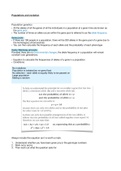
• Equation to calculate the frequencies of alleles of a gene in a population
• Conditions:
No mutations
Population is isolated (so no gene flow)
No selection - each allele is equally likely to be passed on
Large population
Mating is random
Always include this equation as it is worth a mark.
1. Understand whether you have been given p/q or the genotype numbers
2. Work out p and q
3. Then work out what the question asks for
, Variation in phenotype
Variation due to genetic factors
• Mutations: sudden changes to genes which may pass on to the next generation
• Meiosis: new combinations of alleles
• Random fertilisation of gametes: sexual reproduction produces new combinations of alleles and
offspring that are genetically different to the parents
Environmental influences
• Affect the way an organisms genes are expressed
• The genes set limits, but it is largely the environment that determines where, within those limits,
an organism lies
• Influences include climatic conditions, soil conditions, pH and food availability
• Some characteristics are in a continuum and these are controlled by many genes (polygenes)
• These characteristics display a normal distribution curve:
Natural selection
Environmental factors that limit the population of a species are called selection pressures
These pressures include predation, disease and competition and determine the frequency of
alleles in the gene pool
The process of evolution by natural selection depends on…
• A variety of phenotypes that selection operates against
• Genetic variation within the populations
• Organisms producing more offspring that can be supported
Over production
• Overproduction is where each generation has more offspring than
can be supported by the environment
• With no external factors, populations would grow exponentially,
however this doesn’t happen in nature
• There are two routes to a successful population:
High reproductive rates to ensure a sufficiently large population
survives
Lower reproductive rates with high degree of parental care
• When there are too many offspring for the available resources then
there is intraspecific competition. The greater the population size, the more competition
• The individuals best suited to the conditions will be more likely to survive, reproduce and pass
on their alleles
• The next generation will therefore have a different allele frequency from the previous one
Population genetics
• All the alleles of all the genes of all the individuals in a population at a given time are known as
the gene pool.
• The number of times an allele occurs within the gene pool is referred to as the allele frequency
Gene pools
• If there are 100 people in a population, there will be 200 alleles in the gene pool of a gene due to
the homologous chromosomes
• You can then calculate the frequency of each allele and the probability of each phenotype
Hardy-Weinberg principle
Provided there are no environmental changes, the allele frequency in a population will remain
constant over generations.
• Equation to calculate the frequencies of alleles of a gene in a population
• Conditions:
No mutations
Population is isolated (so no gene flow)
No selection - each allele is equally likely to be passed on
Large population
Mating is random
Always include this equation as it is worth a mark.
1. Understand whether you have been given p/q or the genotype numbers
2. Work out p and q
3. Then work out what the question asks for
, Variation in phenotype
Variation due to genetic factors
• Mutations: sudden changes to genes which may pass on to the next generation
• Meiosis: new combinations of alleles
• Random fertilisation of gametes: sexual reproduction produces new combinations of alleles and
offspring that are genetically different to the parents
Environmental influences
• Affect the way an organisms genes are expressed
• The genes set limits, but it is largely the environment that determines where, within those limits,
an organism lies
• Influences include climatic conditions, soil conditions, pH and food availability
• Some characteristics are in a continuum and these are controlled by many genes (polygenes)
• These characteristics display a normal distribution curve:
Natural selection
Environmental factors that limit the population of a species are called selection pressures
These pressures include predation, disease and competition and determine the frequency of
alleles in the gene pool
The process of evolution by natural selection depends on…
• A variety of phenotypes that selection operates against
• Genetic variation within the populations
• Organisms producing more offspring that can be supported
Over production
• Overproduction is where each generation has more offspring than
can be supported by the environment
• With no external factors, populations would grow exponentially,
however this doesn’t happen in nature
• There are two routes to a successful population:
High reproductive rates to ensure a sufficiently large population
survives
Lower reproductive rates with high degree of parental care
• When there are too many offspring for the available resources then
there is intraspecific competition. The greater the population size, the more competition
• The individuals best suited to the conditions will be more likely to survive, reproduce and pass
on their alleles
• The next generation will therefore have a different allele frequency from the previous one