

Neurobiology of aging
Lecture 1 – introduction on brain aging
Long-living creatures:
- neurons cannot be renewed, so neurons have to be that old as well. Loss of neurons
results in neurodegenerative disorders that induce death.
- Determined by individual variation: a dichotomy represents the branching between
healthy and pathological aging. There is also variation within one individual, even within
neurons: diseases and healthy synapses.
Why does one neuron/synapse grow old in a healthy way, but another one in a
pathological way? Even if they live in the same environment, in the same brain regions.
- Aging groups have a very large variation
Cognition and motor skills are strongly interconnected
- They develop jointly in the brain
- Cognition skills include memory and learning, which is mainly located in the temporal
lobe (hippocampus, amygdala).
- Motor areas are located in the frontal lobe (primary motor areas, areas involved in
planning, execution)
- So the temporal lobe and frontal lobe develop jointly and often change jointly in aging.
- So motor development and cognitive development cannot be viewed separately.
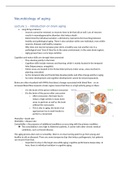
Brains are often visualized with fMRIs that detect changes associated with blood flow – so an
increased blood flow towards a brain region means that there is a high activity going on there.
- A is the brain of the person without concussion
- B is the brain of the person after concussion
o After concussion, the brain has to
induce a high activity in many brain
areas to perform as well as the brain
without the concussion.
o This is also in aging, the brain of an
aged person has to work harder to
perform a movement
Mortality = death rate
Morbidity = disease rate
Comorbidity = the presence of additional conditions co-occurring with the primary condition
The comorbidity is very high in Alzheimer patients, it comes with other chronic medical
conditions, such as thyroid disease.
The aging process does not run smoothly, there is no clear turning point to go from young and
healthy to old an diseased. There are some temporary dips that induce pathogenesis, but patients
can recover from that.
- Important to stay in the target area while aging: cognitive performance keeps okay. In
here, there is individual variation in cognitive aging.
,Neurodegenerative diseases are often associated with aging, such as
- Parkinson’s disease: degeneration of dopamin cells in the substantia nigra, followed by
other brain regions such as striatum, globus pallidus and nucleus subthalamus.
This is caused by Lewy bodies: deposits of the protein α-synuclein that are responsible
for loss of dopaminergic cells.
- Alzheimer’s disease: beta-amyloid plagues and tangles caused by tau proteins, causing
massive shrinkage of the brain – associated with the Braak stages.
o The Snowdon Nun Study: nuns were healthy despite the fact that there are
plaques present. This indicates that AD is a very complex disease, and having
only plaques does not necessarily mean that you develop AD.
Brain regions are regulated by ascending systems – they provide input to the brain
- Acetylcholine
o Nucleus basalis
o Medial septum
- Serotonin
o Raphe nuclei
- Dopamin
o Substantia nigra
- Noradrenalin
o Locus coeruleus
Difference in rate of aging in these systems
Noradrenalin and dopamin age at the same rate, but they age earlier than acetylcholine and even
earlier than serotonin. There is a 10% loss per 10 year from the beginning of adultness.
(noradrenalin = dopamin > acetylcholine > serotonin).
o Loss of more than 60% of dopaminergic cells results in locomotive defects
Overall, three general features in aging
- Prefrontal cortex overactivation, particularly the dorsolateral PFC
- Shift from posterior to anterior brain activity
o The anterior part is seen as the PFC, which is indeed overactivated in aged brains
o A reduction of the posterior part results in a decreased activity of the occipital
cortex, a brain area involved in visual processing.
- Loss of lateralization
o Decreased unilateral recruitment
o Increased bilateral communication
o Loss of activity as well – the strength of activation is lower as well and the brain
is compensating for this by using both hemispheres in a task that can be done by
one hemisphere in younger people.
- Successful cognitive aging is achieved when these three features are observed
These features are compensation mechanisms the brain invents to still be able to deal
with processing information.
Which brain regions are most affected by aging? The aging hotspots – a number of brain areas that
change as first and strongest with aging
1. Dorsolateral prefrontal cortex
a. Functions in planning, working memory, executive functions
b. Overactivation, particularly in dorsolateral PFC, is seen in aging
c. A low cognitive load results in a larger PFC in aged people, which means that a
relative simple task requires a highly active prefrontal cortex.
, d. In case of a high cognitive load, aged brains show much less PFC activity, indicating
that a high cognitive load cannot be dealt with anymore.
2. Hippocampus (dentate gyrus)
3. Cerebellum (purkinje cells)
a. These are GABAergic (inhibitory) cells located in the cerebellum. Each purkinje cell
receives information from ~500 climbing fibers.
- Follows the ‘last in, first out’ principle the brain areas latest developed contain the
most vulnerable links, forming the aging hotspots.
And other important structural changes:
- The cingulate gyrus, the area involved in personal identity, reduces in volume about 5,5%
between the age 20-80 years.
The cingulate gyrus is generally larger in females compared to males.
The cingulate gyrus consist of several subregions – part of the limbic system, together
with the septum, amygdala, hypothalamus and olfactory bulb: all important in sensory
and emotional tasks.
- The ventricles will enlarge during aging, particularly in converted MCI (mild cognitive
impairment). If the ventricles enlarge in a high scale, the risk of Alzheimer’s disease is
very high. Ventricles are mainly enlarged due to a larger production of cerebrospinal fluid
and due to atrophy, an increased loss of neurons.
- The white matter will reduce during aging, a large increase of white matter induces the
onset of Alzheimer’s disease.
o White matter has relatively few cell bodies and many myelinated axons
- The grey matter will reduce during aging. If there is no decrease in grey matter, but the
baseline is already very low in young age, the development of Alzheimer’s disease is
stimulated.
o Grey matter contains many cell bodies
The default modus/network DMN
- A network of brain regions that is active when an individual is not focused but “still
awake”.
- Brain areas active during DMN are different compared to the brain areas active during
alertness. Moreover, the brain areas that are active during alertness induce a higher
activity.
The brain is constantly switching from the DMN to a cognitive performance state (being alert)
- The cognitive performance state makes the brain tired, costs a lot of energy, which is
why the switch is needed
- An aged brain stays longer in the default mode and it takes more energy to switch to the
cognitive performance state.
Lecture 1 – introduction on brain aging
Long-living creatures:
- neurons cannot be renewed, so neurons have to be that old as well. Loss of neurons
results in neurodegenerative disorders that induce death.
- Determined by individual variation: a dichotomy represents the branching between
healthy and pathological aging. There is also variation within one individual, even within
neurons: diseases and healthy synapses.
Why does one neuron/synapse grow old in a healthy way, but another one in a
pathological way? Even if they live in the same environment, in the same brain regions.
- Aging groups have a very large variation
Cognition and motor skills are strongly interconnected
- They develop jointly in the brain
- Cognition skills include memory and learning, which is mainly located in the temporal
lobe (hippocampus, amygdala).
- Motor areas are located in the frontal lobe (primary motor areas, areas involved in
planning, execution)
- So the temporal lobe and frontal lobe develop jointly and often change jointly in aging.
- So motor development and cognitive development cannot be viewed separately.
Brains are often visualized with fMRIs that detect changes associated with blood flow – so an
increased blood flow towards a brain region means that there is a high activity going on there.
- A is the brain of the person without concussion
- B is the brain of the person after concussion
o After concussion, the brain has to
induce a high activity in many brain
areas to perform as well as the brain
without the concussion.
o This is also in aging, the brain of an
aged person has to work harder to
perform a movement
Mortality = death rate
Morbidity = disease rate
Comorbidity = the presence of additional conditions co-occurring with the primary condition
The comorbidity is very high in Alzheimer patients, it comes with other chronic medical
conditions, such as thyroid disease.
The aging process does not run smoothly, there is no clear turning point to go from young and
healthy to old an diseased. There are some temporary dips that induce pathogenesis, but patients
can recover from that.
- Important to stay in the target area while aging: cognitive performance keeps okay. In
here, there is individual variation in cognitive aging.
,Neurodegenerative diseases are often associated with aging, such as
- Parkinson’s disease: degeneration of dopamin cells in the substantia nigra, followed by
other brain regions such as striatum, globus pallidus and nucleus subthalamus.
This is caused by Lewy bodies: deposits of the protein α-synuclein that are responsible
for loss of dopaminergic cells.
- Alzheimer’s disease: beta-amyloid plagues and tangles caused by tau proteins, causing
massive shrinkage of the brain – associated with the Braak stages.
o The Snowdon Nun Study: nuns were healthy despite the fact that there are
plaques present. This indicates that AD is a very complex disease, and having
only plaques does not necessarily mean that you develop AD.
Brain regions are regulated by ascending systems – they provide input to the brain
- Acetylcholine
o Nucleus basalis
o Medial septum
- Serotonin
o Raphe nuclei
- Dopamin
o Substantia nigra
- Noradrenalin
o Locus coeruleus
Difference in rate of aging in these systems
Noradrenalin and dopamin age at the same rate, but they age earlier than acetylcholine and even
earlier than serotonin. There is a 10% loss per 10 year from the beginning of adultness.
(noradrenalin = dopamin > acetylcholine > serotonin).
o Loss of more than 60% of dopaminergic cells results in locomotive defects
Overall, three general features in aging
- Prefrontal cortex overactivation, particularly the dorsolateral PFC
- Shift from posterior to anterior brain activity
o The anterior part is seen as the PFC, which is indeed overactivated in aged brains
o A reduction of the posterior part results in a decreased activity of the occipital
cortex, a brain area involved in visual processing.
- Loss of lateralization
o Decreased unilateral recruitment
o Increased bilateral communication
o Loss of activity as well – the strength of activation is lower as well and the brain
is compensating for this by using both hemispheres in a task that can be done by
one hemisphere in younger people.
- Successful cognitive aging is achieved when these three features are observed
These features are compensation mechanisms the brain invents to still be able to deal
with processing information.
Which brain regions are most affected by aging? The aging hotspots – a number of brain areas that
change as first and strongest with aging
1. Dorsolateral prefrontal cortex
a. Functions in planning, working memory, executive functions
b. Overactivation, particularly in dorsolateral PFC, is seen in aging
c. A low cognitive load results in a larger PFC in aged people, which means that a
relative simple task requires a highly active prefrontal cortex.
, d. In case of a high cognitive load, aged brains show much less PFC activity, indicating
that a high cognitive load cannot be dealt with anymore.
2. Hippocampus (dentate gyrus)
3. Cerebellum (purkinje cells)
a. These are GABAergic (inhibitory) cells located in the cerebellum. Each purkinje cell
receives information from ~500 climbing fibers.
- Follows the ‘last in, first out’ principle the brain areas latest developed contain the
most vulnerable links, forming the aging hotspots.
And other important structural changes:
- The cingulate gyrus, the area involved in personal identity, reduces in volume about 5,5%
between the age 20-80 years.
The cingulate gyrus is generally larger in females compared to males.
The cingulate gyrus consist of several subregions – part of the limbic system, together
with the septum, amygdala, hypothalamus and olfactory bulb: all important in sensory
and emotional tasks.
- The ventricles will enlarge during aging, particularly in converted MCI (mild cognitive
impairment). If the ventricles enlarge in a high scale, the risk of Alzheimer’s disease is
very high. Ventricles are mainly enlarged due to a larger production of cerebrospinal fluid
and due to atrophy, an increased loss of neurons.
- The white matter will reduce during aging, a large increase of white matter induces the
onset of Alzheimer’s disease.
o White matter has relatively few cell bodies and many myelinated axons
- The grey matter will reduce during aging. If there is no decrease in grey matter, but the
baseline is already very low in young age, the development of Alzheimer’s disease is
stimulated.
o Grey matter contains many cell bodies
The default modus/network DMN
- A network of brain regions that is active when an individual is not focused but “still
awake”.
- Brain areas active during DMN are different compared to the brain areas active during
alertness. Moreover, the brain areas that are active during alertness induce a higher
activity.
The brain is constantly switching from the DMN to a cognitive performance state (being alert)
- The cognitive performance state makes the brain tired, costs a lot of energy, which is
why the switch is needed
- An aged brain stays longer in the default mode and it takes more energy to switch to the
cognitive performance state.



