Week 2
Lecture 2.1 Cultures of Q&S
Organizational culture is a relatively stable, multidimensional, holistic construct shared by (groups of)
organizational members that supplies a frame of reference and which gives meaning to and/or is
typically revealed in certain practices (Guidemond)
Problems with cultures of quality: how can we get to shared understanding of quality across disciplinary
and organizational boundaries? How can we create safe and open reflective cultures in healthcare?
Problem with current definitions of culture:
Usually very static: denying. Differences within cultures, dynamics of cultures, emergent
properties.
Presuppose 1 best culture denying: differences in traditions, organizational embedding, relation
to wider context, relation to different types of problems.
Cultures often depicted as resistant to change
The cultural challenge:
- Different understandings of quality – ie professions-managers-patients
- Silo cultures – different professions or units ‘do’ care differently, hardly any coordination
- Defensive cultures – no openness about mistakes, no pro-active safety management
Managerial and professional cultures? Governmentality and soft autonomy.
- Professional: focus on flexibility, closed clan culture, resistant to change, paternalistic, evidence-
based
- Managerial: focus on standardization, open culture, change as normal practice, consumerist,
strategic, practical
Professional vs managerial cultures reprise:
Over time, shifts in professional cultures
o Professionals taking up managerial instruments, eg accreditation, benchmarking,
incident analysis
o But integrating these within profession – making them fit with professional cultures, eg
registries: numerical control, but indicators defined by professionals
Shows rise of new type of organizational profession, building new types of (soft) autonomy and
regulation (governmentality)
-> cultures change over time, on the basis of external and internal instruments and
developments
, Safety I and II:
Safety I focused at prevention of failure. Much attention for standards and standardization and
curtailing professional autonomy.
Safety II focused at increasing resilience. Standards are still important but reflective and open
cultures as important: deviate from standards when necessary, focus on reflexive professionals
working in teams, account for and reflect on behavior and performance
o Resilience: humans are the solution, not the problem.
Just culture: reflection-in-action crucial for safety. Needs open attitude. Just culture is an organizational
culture that allows for open, non-punitive accounting, targeted at restitutive practices (in case of failure)
and open conversations (in case of ‘normal practice’). Closely aligned to safety II.
The problem with safety cultures
Culture is a mixture of: intermingling of different repertoires of action (managerial, professional),
guidelines become part of self-definition of professionalism, guidelines change professional practices
and routine actions, redefining what the case is, changing the way care is accounted for.
Culture seems to be a combination of: routinized practice, ontologies (the way we view the world and
act on it), accounting for practices
Relations between cultures and structures
Culture is related to structure as it is influenced by: the use of specific instruments, the practices of who
is involved in defining quality and acting upon it, the for a in which accounting takes shape
And culture influences structure through: organizational routines, status within and between groups,
dominant problem definitions
Lecture 2.2, 2.3, 2.4 Q&S in everyday practice, talking about culture (guest speaker)
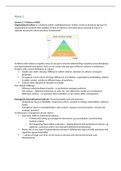
Development of safety (in healthcare): knowing (technological norms), being able to (human factors),
wanting (safety management), daring (safety culture), doing(safety I/II, just culture)
(1) plan (problem definition, actual situation, cause-effect analysis), (2) do (solutions), (3) check (results),
(4) act (standardization, evaluation and adjust).
WAI: work as imagined. Wanting to go from a to b.
WAD: work as done. Going from a to b via c and d.
Lecture 2.1 Cultures of Q&S
Organizational culture is a relatively stable, multidimensional, holistic construct shared by (groups of)
organizational members that supplies a frame of reference and which gives meaning to and/or is
typically revealed in certain practices (Guidemond)
Problems with cultures of quality: how can we get to shared understanding of quality across disciplinary
and organizational boundaries? How can we create safe and open reflective cultures in healthcare?
Problem with current definitions of culture:
Usually very static: denying. Differences within cultures, dynamics of cultures, emergent
properties.
Presuppose 1 best culture denying: differences in traditions, organizational embedding, relation
to wider context, relation to different types of problems.
Cultures often depicted as resistant to change
The cultural challenge:
- Different understandings of quality – ie professions-managers-patients
- Silo cultures – different professions or units ‘do’ care differently, hardly any coordination
- Defensive cultures – no openness about mistakes, no pro-active safety management
Managerial and professional cultures? Governmentality and soft autonomy.
- Professional: focus on flexibility, closed clan culture, resistant to change, paternalistic, evidence-
based
- Managerial: focus on standardization, open culture, change as normal practice, consumerist,
strategic, practical
Professional vs managerial cultures reprise:
Over time, shifts in professional cultures
o Professionals taking up managerial instruments, eg accreditation, benchmarking,
incident analysis
o But integrating these within profession – making them fit with professional cultures, eg
registries: numerical control, but indicators defined by professionals
Shows rise of new type of organizational profession, building new types of (soft) autonomy and
regulation (governmentality)
-> cultures change over time, on the basis of external and internal instruments and
developments
, Safety I and II:
Safety I focused at prevention of failure. Much attention for standards and standardization and
curtailing professional autonomy.
Safety II focused at increasing resilience. Standards are still important but reflective and open
cultures as important: deviate from standards when necessary, focus on reflexive professionals
working in teams, account for and reflect on behavior and performance
o Resilience: humans are the solution, not the problem.
Just culture: reflection-in-action crucial for safety. Needs open attitude. Just culture is an organizational
culture that allows for open, non-punitive accounting, targeted at restitutive practices (in case of failure)
and open conversations (in case of ‘normal practice’). Closely aligned to safety II.
The problem with safety cultures
Culture is a mixture of: intermingling of different repertoires of action (managerial, professional),
guidelines become part of self-definition of professionalism, guidelines change professional practices
and routine actions, redefining what the case is, changing the way care is accounted for.
Culture seems to be a combination of: routinized practice, ontologies (the way we view the world and
act on it), accounting for practices
Relations between cultures and structures
Culture is related to structure as it is influenced by: the use of specific instruments, the practices of who
is involved in defining quality and acting upon it, the for a in which accounting takes shape
And culture influences structure through: organizational routines, status within and between groups,
dominant problem definitions
Lecture 2.2, 2.3, 2.4 Q&S in everyday practice, talking about culture (guest speaker)
Development of safety (in healthcare): knowing (technological norms), being able to (human factors),
wanting (safety management), daring (safety culture), doing(safety I/II, just culture)
(1) plan (problem definition, actual situation, cause-effect analysis), (2) do (solutions), (3) check (results),
(4) act (standardization, evaluation and adjust).
WAI: work as imagined. Wanting to go from a to b.
WAD: work as done. Going from a to b via c and d.