Lecture Food toxicology
Food toxicology = a branch of science which includes the nature, causes, effects and detection of
toxic substances in the food. Effects of toxic substances in food:
- Food allergy
- Food intolerance
- Food-borne diseases: caused by food borne pathogens, toxic chemicals or pesticides present
in food. It can also be due to chemical reactions due to the presence of particular ingredients
or impropriate handling during production process.
o 1/10 people fall ill due to food borne diseases every year
o 33 million healthy life years lost
o 420.000 deaths every year, from which 1/3 is child
- Infections
What chemical hazards contribute to food-borne diseases?
- Food additives
- Veterinary drug residues
- Pesticide residues
- Environmental contaminants
- Natural toxicants
- Adulterants (chemicals that make food look appealing)
- Improper handling during the production process
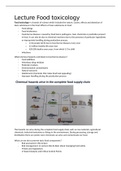
The hazards can arise during the complete food supply chain such as raw materials, agricultural
chemicals, industrial emissions or things in the environment. During processing, storage and
distribution there are points were chemicals can arise and contaminate our food.
What can we do to prevent toxic food components?
- Risk assessment: this lecture
- Risk management: in Lecture Alie de Boer about managing food safety
• Rules and regulations
• Hazard Analysis and Critical Control Points
,Risk assesment
What is risk assessment?
Risk can be calculated with the help of the hazard, exposure and vulnerability of a certain compound.
If you can reduce the risk, you can also reduce the risk of food borne diseases.
- If you can identify the hazard and monitor it you can provide a risk
- Also when the exposure of a compound is very low we still don’t get sick of it even if the
compound is still be eten.
- Also the vulnerability is very important, som people are just less vulnerable to a certain
compound (or certain alergy) you don’t get sick of it even though there is hazard and you are
exposed.
Hazard = is the potential of a substance to cause damage. Toxicity is the hazard of a substance which
can cause poisoning.
Risk = a measure of the probability that harm will occur under defined conditions of exposure to a
chemical. If there can be no exposure to a chemical, no matter how dangerous (hazardous) it may be,
there is no risk of harm
When is a compound toxic?
In definition every compound can be toxic depending on the dose. It is from Paracelsus. A dose
respones curve can be made from every chemical. Every chemical can be toxic, even water. Ofcourse,
there are components which are more toxic than others.
, Potency and efficacy
Different compounds have a difference in potency and efficacy. So e.g. compound a has greater
biological activity per dosing unit and is therefore more potent than drug b and c. so, A reaches a
high response earlier with a lower concentration. A and C can reach a similar efficacy in the end
(maximal obtainable response), while for B the componant has a lower maximum efficacy.
Pharmacodynamics and pharmacokinetics
Pharmacodynamics = the study of how a substance affects an organism the response, a
component can go to a particular organ and there cause a certain effect.
Pharmacokinetics = the study of how the organism affects the substance organism can have
effect/actions with particular substances. Some components are better absorbed than others
because of the receptors in the intestinal lining GIT, than the drug can come into the circulation via
blood and will be distributed through the body. Some particular tissue are more vulnerable to certain
components because in some tissue they can accumulate, which in the end results in a
pharmacodynamic effect. Once in the circulation, substance will first pass the liver (important
detoxifying organ), but also on the epithelial cells there are some metabolising enzymes that can help
detoxifying, also some cells in the kidney. Aims of metabolization is increase the water solubility of
compounds which enhances excretion of the compounds via kidney and stool.
Food toxicology = a branch of science which includes the nature, causes, effects and detection of
toxic substances in the food. Effects of toxic substances in food:
- Food allergy
- Food intolerance
- Food-borne diseases: caused by food borne pathogens, toxic chemicals or pesticides present
in food. It can also be due to chemical reactions due to the presence of particular ingredients
or impropriate handling during production process.
o 1/10 people fall ill due to food borne diseases every year
o 33 million healthy life years lost
o 420.000 deaths every year, from which 1/3 is child
- Infections
What chemical hazards contribute to food-borne diseases?
- Food additives
- Veterinary drug residues
- Pesticide residues
- Environmental contaminants
- Natural toxicants
- Adulterants (chemicals that make food look appealing)
- Improper handling during the production process
The hazards can arise during the complete food supply chain such as raw materials, agricultural
chemicals, industrial emissions or things in the environment. During processing, storage and
distribution there are points were chemicals can arise and contaminate our food.
What can we do to prevent toxic food components?
- Risk assessment: this lecture
- Risk management: in Lecture Alie de Boer about managing food safety
• Rules and regulations
• Hazard Analysis and Critical Control Points
,Risk assesment
What is risk assessment?
Risk can be calculated with the help of the hazard, exposure and vulnerability of a certain compound.
If you can reduce the risk, you can also reduce the risk of food borne diseases.
- If you can identify the hazard and monitor it you can provide a risk
- Also when the exposure of a compound is very low we still don’t get sick of it even if the
compound is still be eten.
- Also the vulnerability is very important, som people are just less vulnerable to a certain
compound (or certain alergy) you don’t get sick of it even though there is hazard and you are
exposed.
Hazard = is the potential of a substance to cause damage. Toxicity is the hazard of a substance which
can cause poisoning.
Risk = a measure of the probability that harm will occur under defined conditions of exposure to a
chemical. If there can be no exposure to a chemical, no matter how dangerous (hazardous) it may be,
there is no risk of harm
When is a compound toxic?
In definition every compound can be toxic depending on the dose. It is from Paracelsus. A dose
respones curve can be made from every chemical. Every chemical can be toxic, even water. Ofcourse,
there are components which are more toxic than others.
, Potency and efficacy
Different compounds have a difference in potency and efficacy. So e.g. compound a has greater
biological activity per dosing unit and is therefore more potent than drug b and c. so, A reaches a
high response earlier with a lower concentration. A and C can reach a similar efficacy in the end
(maximal obtainable response), while for B the componant has a lower maximum efficacy.
Pharmacodynamics and pharmacokinetics
Pharmacodynamics = the study of how a substance affects an organism the response, a
component can go to a particular organ and there cause a certain effect.
Pharmacokinetics = the study of how the organism affects the substance organism can have
effect/actions with particular substances. Some components are better absorbed than others
because of the receptors in the intestinal lining GIT, than the drug can come into the circulation via
blood and will be distributed through the body. Some particular tissue are more vulnerable to certain
components because in some tissue they can accumulate, which in the end results in a
pharmacodynamic effect. Once in the circulation, substance will first pass the liver (important
detoxifying organ), but also on the epithelial cells there are some metabolising enzymes that can help
detoxifying, also some cells in the kidney. Aims of metabolization is increase the water solubility of
compounds which enhances excretion of the compounds via kidney and stool.