100% tevredenheidsgarantie Direct beschikbaar na je betaling Lees online óf als PDF Geen vaste maandelijkse kosten 4,6 TrustPilot
logo-home
Tentamen (uitwerkingen)

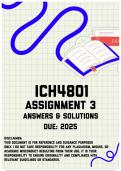
ICH4801 Assignment 3 Memo | Due 2025

Beoordeling
-
Verkocht
-
Pagina's
17
Cijfer
A+
Geüpload op
16-04-2025
Geschreven in
2024/2025

ICH4801 Assignment 3 Memo | Due 2025. All questions fully answered. SECTION A: COMPULSORY SECTION Question 1 [40 marks] Questions 1(a) (20 marks) and 1(b) (20 marks) – compulsory 1(a) Comparative education (chapter 8 of the prescribed book) 1. Define "comparative education". (4) 2. Discuss any four phases of the historical evolution of the field of comparative and international education. (8) 3. Discuss four areas that show the value and the purpose of comparative education and its contribution to education as a whole. (8) [20] 32 AND 1(b) Tanzania (chapters 7 and 10 of the prescribed book) "[I]f education in Tanzania and, indeed, in other parts of Africa is to mean anything, it must aim at equipping children with the knowledge, skills and attitudes for tackling … societal problems" (Ndunguru 1976:75). 1. What is your understanding of education for self-reliance? (2) 2. What is generally understood by the concept "Ujamaa"? (2) 3. In a few sentences, explain the aim of education for self-reliance. (8) 4. What were the challenges of education for self-reliance? (8) [20] Question 2 Answer 2.1 or 2.2. 2.1 South Africa (chapter 14 of the prescribed book) "Recent calls for a decolonised curriculum from movements such as #FeesMustFall in South Africa have amplified and refuelled a quest to reassess and develop a curriculum that is relevant to the problems of countries in the Global South. More specifically, these calls are for a decolonised curriculum for these countries. In South Africa, the calls for a decolonised curriculum must be interpreted within broader contextual debates for the internationalisation of the curriculum, and rebuttal of its regressive racial, economic, and political status. The arguments for a decolonised curriculum need to take this broader context into consideration." a) Account for the recent calls for a decolonised curriculum by movements such as #FeesMustFall in South Africa. (10) b) Explain the successes and the failures of #FeesMustFall. (5) [15] OR ICH4801/101/0/2025 33 2.2 India (chapter 9 of the prescribed book) a) Explain the development of formal education in India. (2) b) The aims and purposes of education are determined by the sociopolitical context. There can also be a divergence between the purposes of education propagated by a government and those demanded by people at large. Indicate the aims and purposes of education in India. (8) c) What were the challenges of formal education in India? (5) [15] Question 3 (chapters 11 and 12 of the prescribed book) Answer 3.1 or 3.2. 3.1 Turkey a) Formal education in Turkey was provided through two channels. Mention the two channels and briefly describe the differences between them. (4) b) What was the purpose of centralising the education system in Turkey? (2) c) In reference to the Basic Law of National Education, what are the objectives of education in Turkey? (5) d) Formal education in Turkey comprises pre-primary education, primary education, secondary education and higher education. Pre-primary education and higher education levels are optional, while primary and secondary education levels are mandatory for all citizens. In the past 20 years, there have been three major changes in mandatory education levels, especially in primary education. Before 1997, primary education was for eight years, with five years of elementary and three years of middle school education separately, and only the first five years were mandatory. In 1997, however, these two stages were combined and eight years of primary school was made mandatory (see chapter 11 of the prescribed book). Were all Turkish people happy about this arrangement? Provide reasons for your answer. (4) [15] OR 34 3.2 Chile Is education in Chile on the path to inclusion? "Among the people who occupied Chile prior to Spanish colonisation, education was carried out within the extended family, in the 'learning by doing mode'. Emphasis was on learning to understand and communicate with others, nature and the divinity. There were no schools as such" (Seroto, Davids & Wolhuter 2020 – refer to chapter 12). a) Indicate how the education that was carried out within the extended family in Chile was affected by the arrival of Spanish colonisers. (4) b) How did the colonisers respond to families' petitions? (2) c) What were the aims/objectives of education before the return of democracy in 1990? (5) d) What were the aims/objectives of education after the return of democracy in Chile? (4) [15] Question 4 (chapter 14 of the prescribed book) Answer 4.1 or 4.2. 4.1 "The medium of teaching and learning has always been a key issue for educational institutions across the world, especially in those nations that were colonised" (Seroto, Davids & Wolhuter 2020). a) Explain how colonisation has affected the issue of the language of teaching in previously colonised nations. (5) b) Explain the thinking of Wa Thiong'o concerning the issue of the language of teaching. (10) [15] OR 4.2 Some authors claim that the issue of mother tongue is confusing, especially for those who are adopted. Critically discuss the mother tongue as a medium of teaching and learning in a multicultural/multilingual society. Use your country as an example. (15) ICH4801/101/0/2025 35 Question 5 (chapter 15 of the prescribed book) Answer 5.1 or 5.2. 5.1 Answer the following questions: a) "In the context of South Africa, the Higher Education Act (No 101 of 1997) governs higher education institutions" (Seroto, Davids & Wolhuter 2020). Indicate four important stipulations in this Act. (4) b) Account for the development of higher education during apartheid. Refer to the policies and the legislation that guided educational segregation. (6) c) After the apartheid era, the higher education system had to undergo fundamental changes to transform South Africa into a non-racial democracy. To expedite the transformation of higher education in the post-apartheid period, three important initiatives were adopted (see chapter 15 of the prescribed book). Discuss two of these initiatives. (5) [15] OR 5.2 Answer the following questions: a) Policies played an important role in the development of higher education in South Africa after 1994. Indicate any five important policies that led to the reform of higher education (refer to chapter 15 of the prescribed book). (5) b) Highlight current views on the decolonisation of South African higher education, with specific reference to the following: (10) • The concept of colonisation and Battiste's views on indigenous students • The #FeesMustFall campaign • The Africanisation of the curriculum [15]

Meer zien Lees minder
Instelling
Vak

Voorbeeld van de inhoud

, PLEASE USE THIS DOCUMENT AS A GUIDE TO ANSWER YOUR ASSIGNMENT

Please also note that the author of this document will not be responsible for any plagiarism you
commit.

 Question 1(a)

1. Define "comparative education".

Comparative education is a diverse field with no single universally accepted definition, often
described as having fluid boundaries. It adopts a three-in-one perspective, examining education
systems within their broader societal contexts—including geographic, economic, cultural, and
political influences—while also comparing different systems or aspects of them. The field has
evolved into Comparative and International Education (CIE), where international education involves
studying education from a global viewpoint. Ultimately, individual or regional studies contribute to a
broader understanding of education worldwide.

2. Discuss any four phases of the historical evolution of the field of comparative and
international education.

Phase 2: Systematic Study for Policy Borrowing (Since 1830)
The early 19th century saw government officials studying foreign education systems to adopt best
practices for national improvement. For example, France’s Victor Cousin analyzed European
systems, influencing the Guizot Act of 1833, which established primary education. This phase was
tied to nation-building but often lacked scientific rigor, leading to uncritical borrowing without
considering contextual differences between countries.

Phase 3: International Cooperation (Since 1925)
This phase shifted focus from national interests to global collaboration, driven by figures like
Marc-Antoine Jullien de Paris, the "father of Comparative Education." His vision materialized
through organizations like UNESCO, international research (e.g., IEA studies), and academic
societies, emphasizing education as a tool for universal human progress rather than just national
advancement.

Phase 5: Social Science Influence (Since 1960)
Comparative education adopted structural-functionalism and modernization theory, framing
education as a catalyst for societal change. Influenced by economics and sociology, this phase
promoted education as key to development, especially in the Global South. However, it assumed a
linear path to modernization, often overlooking local realities in favor of Western models.

Phase 7: Heterogeneity and Global Reevaluation (Since 1990)
Recent decades reflect diverse methodologies and critiques of Northern dominance. The field now
balances global trends (e.g., GERM) with local contexts, while scholars challenge Eurocentric
perspectives. The rise of the Global South demands reevaluation, with calls to decentralize
knowledge production and address power imbalances in comparative research.

Geschreven voor

Instelling
Vak

Documentinformatie

Geüpload op
16 april 2025
Aantal pagina's
17
Geschreven in
2024/2025
Type
Tentamen (uitwerkingen)
Bevat
Vragen en antwoorden

Onderwerpen

€2,86
Krijg toegang tot het volledige document:

100% tevredenheidsgarantie
Direct beschikbaar na je betaling
Lees online óf als PDF
Geen vaste maandelijkse kosten


Ook beschikbaar in voordeelbundel

Maak kennis met de verkoper

Seller avatar
De reputatie van een verkoper is gebaseerd op het aantal documenten dat iemand tegen betaling verkocht heeft en de beoordelingen die voor die items ontvangen zijn. Er zijn drie niveau’s te onderscheiden: brons, zilver en goud. Hoe beter de reputatie, hoe meer de kwaliteit van zijn of haar werk te vertrouwen is.
Aimark94 University of South Africa (Unisa)
Volgen Je moet ingelogd zijn om studenten of vakken te kunnen volgen
Verkocht
6718
Lid sinds
6 jaar
Aantal volgers
3169
Documenten
1534
Laatst verkocht
8 uur geleden
Simple & Affordable Study Materials

Study Packs & Assignments

4,2

551 beoordelingen

5
293
4
133
3
75
2
16
1
34

Populaire documenten

Recent door jou bekeken

Waarom studenten kiezen voor Stuvia

Gemaakt door medestudenten, geverifieerd door reviews

Kwaliteit die je kunt vertrouwen: geschreven door studenten die slaagden en beoordeeld door anderen die dit document gebruikten.

Niet tevreden? Kies een ander document

Geen zorgen! Je kunt voor hetzelfde geld direct een ander document kiezen dat beter past bij wat je zoekt.

Betaal zoals je wilt, start meteen met leren

Geen abonnement, geen verplichtingen. Betaal zoals je gewend bent via Bancontact, iDeal of creditcard en download je PDF-document meteen.

Student with book image

“Gekocht, gedownload en geslaagd. Zo eenvoudig kan het zijn.”

Alisha Student

Veelgestelde vragen