Integrated Regenerative Design
Lesson 3 10/10
We are going to talk about the NATURAL CITY today, and the exam and the paper
A. Fresh Water (4.2)
- Without water life on earth is not possible. The photographer Burtynsky looks at our planet
in a beautiful way, you can see this in his photography.
- Everything that we have is directly linked to water: everything is made, we eat, we clean, we
care for ourselves, etc.
- When there is no water, we die. It’s a unique element, we can’t find it in the universe, only
on earth. Nobody believes in the real harm that the climate change is causing.
- In our countries we have to look at storm water: Global warming is causing enormous
changes. Due to the warming, much more water evaporates. A summer shower causes an
intense rainfall with enormous amounts of water. In addition, we see stationary weather
phenomena. As a result, it continues to rain more in the same place, sometimes for days.
Huge amounts of water fall in one region. The power of water is enormous, our safety is at
stake. EVERY DESIGN MUST MAKE ROOM FOR WATER
- Water stress: not enough water in times of need, our regions > why? Because of our cattle,
etc.
1. Stop the Runoff > we need water
o We need to stop the runoff into the sea > instead we need to infiltrate our
water into the canals. How can we disconnect our buildings from the sea?
o We don’t lead our water into nature, but into a sewage system.
• CAN WE RETAIN WATER?
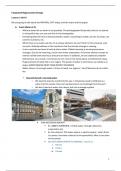
▪ Ex. ABBEY AVERBODE, it holds water, through reflection,
evaporation etc.
▪ Ex. De urbanist: The water square: a sports square > when there
is a storm, the water collects to the sportsfield. After it can drain
to the canals.
▪ DO NOT DRAIN WATER TO SEWAGE > lead it to:
i. Nature
ii. Hold it
iii. Canals
1
, 2. Stop Paving > infiltrate water
o Reduce pavement > everything is
hardened. Why are we so proud of
hardening? We don’t want to
produce this!!!
o Introduce the infiltration of water
3. Introduce the sponge city
o How can we buffer water
underground? The idea of a sponge city is simple – rather than using concrete
to channel away rainwater, you work with nature to absorb, clean and use the
water. “Floods are not enemies,” explains Professor Kongjian Yu. “We can
make friends with floods. We can make friends with water.”
o We need to absorb, clean and use the water in times of dryness.
o What are the components of a sponge city?
• Places/ wetlands/ parks that accept the rain > wet soil > permeable
pavements
• Trees absorb and infiltrate water.
• Give water space (this is the most difficult, search the balance
between.
• Rain gardens/ WADI > places that collect the water when it rains a lot,
infiltrate it later with a system.
o Case study: sponge city the raingarden LONDON BRIDGET JOYCE square
• Near a school, children play there, it gives life, joy
• All the roofs are connected to the raingarden and disconnected from
the sewage
o Case study: The green and blue roofs > accept and absorb water immediately
• When storms are predicted, a gate on the roof opens, storing the water
in a lower position. So the roof collects the water.
• DE DAKDOKTERS
2
Lesson 3 10/10
We are going to talk about the NATURAL CITY today, and the exam and the paper
A. Fresh Water (4.2)
- Without water life on earth is not possible. The photographer Burtynsky looks at our planet
in a beautiful way, you can see this in his photography.
- Everything that we have is directly linked to water: everything is made, we eat, we clean, we
care for ourselves, etc.
- When there is no water, we die. It’s a unique element, we can’t find it in the universe, only
on earth. Nobody believes in the real harm that the climate change is causing.
- In our countries we have to look at storm water: Global warming is causing enormous
changes. Due to the warming, much more water evaporates. A summer shower causes an
intense rainfall with enormous amounts of water. In addition, we see stationary weather
phenomena. As a result, it continues to rain more in the same place, sometimes for days.
Huge amounts of water fall in one region. The power of water is enormous, our safety is at
stake. EVERY DESIGN MUST MAKE ROOM FOR WATER
- Water stress: not enough water in times of need, our regions > why? Because of our cattle,
etc.
1. Stop the Runoff > we need water
o We need to stop the runoff into the sea > instead we need to infiltrate our
water into the canals. How can we disconnect our buildings from the sea?
o We don’t lead our water into nature, but into a sewage system.
• CAN WE RETAIN WATER?
▪ Ex. ABBEY AVERBODE, it holds water, through reflection,
evaporation etc.
▪ Ex. De urbanist: The water square: a sports square > when there
is a storm, the water collects to the sportsfield. After it can drain
to the canals.
▪ DO NOT DRAIN WATER TO SEWAGE > lead it to:
i. Nature
ii. Hold it
iii. Canals
1
, 2. Stop Paving > infiltrate water
o Reduce pavement > everything is
hardened. Why are we so proud of
hardening? We don’t want to
produce this!!!
o Introduce the infiltration of water
3. Introduce the sponge city
o How can we buffer water
underground? The idea of a sponge city is simple – rather than using concrete
to channel away rainwater, you work with nature to absorb, clean and use the
water. “Floods are not enemies,” explains Professor Kongjian Yu. “We can
make friends with floods. We can make friends with water.”
o We need to absorb, clean and use the water in times of dryness.
o What are the components of a sponge city?
• Places/ wetlands/ parks that accept the rain > wet soil > permeable
pavements
• Trees absorb and infiltrate water.
• Give water space (this is the most difficult, search the balance
between.
• Rain gardens/ WADI > places that collect the water when it rains a lot,
infiltrate it later with a system.
o Case study: sponge city the raingarden LONDON BRIDGET JOYCE square
• Near a school, children play there, it gives life, joy
• All the roofs are connected to the raingarden and disconnected from
the sewage
o Case study: The green and blue roofs > accept and absorb water immediately
• When storms are predicted, a gate on the roof opens, storing the water
in a lower position. So the roof collects the water.
• DE DAKDOKTERS
2