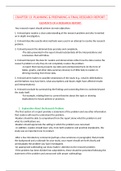
CHAPTER 13: PLANNING & PREPARING A FINAL RESEARCH REPORT:
ELEMENTS OF A RESEARCH REPORT:
-Any research report should achieve six main objectives:
1. It should give readers a clear understanding of the research problem and why it merited
an in-depth investigation.
2. It should describe exactly what methods were used in an attempt to resolve the research
problem.
3. It should present the obtained data precisely and completely.
-The data presented in the report should substantiate all the interpretations and
conclusions that will follow.
4. It should interpret the data for readers and demonstrate either how the data resolve the
research problem or why they do not completely resolve the problem.
-A report that merely presents raw data and uninterpreted facts (in the form of
tables, graphs, and other data-summary devices) is of little help to readers in
deriving meaning from those data.
5. It should alert readers to possible weaknesses of the study (e.g., what its delimitations
and limitations may have been, what assumptions and biases might have affected results
and interpretations).
6. It should conclude by summarizing the findings and connecting them to contexts beyond
the study itself.
-For example, relating them to current theories about the topic or drawing
implications for future policies or practices.
1. Explanation About the Research Problem:
-The first section of a report provides a statement of the problem and any other information
that readers will need to understand the problem.
-Readers should be able to comprehend from the report alone what the problem is and
what its ramifications are.
-Readers should appreciate the setting in which the problem was conceived.
-In addition, readers should learn why, from both academic and practical standpoints, the
study was an important one to conduct.
-After a few introductory comments (perhaps a few sentences or paragraphs) that provide
the background and a rationale for your study, your report should set forth clearly and
unmistakably the problem you have investigated.
-An appropriate subheading can draw readers’ attention to the research problem.
-If the problem has been divided into subproblems, these should be presented following the
statement of the problem and announced with proper subheadings.
, -Any preliminary hypotheses should be clearly stated early in the report.
-By presenting the problem, its subproblems, and any hypotheses, you give readers a clear
and complete understanding of the principal thrust of the research effort.
-Having this thrust in mind, readers will be in a better position to judge the merits of the
research and understand interpretations of the data.
-Also, you should define any terms that may have multiple meanings or in some other way
might be ambiguous.
2. Description of Methods:
-The researcher should state whether qualitative or quantitative methods (or both) were
used and what particular research traditions were followed.
-For example, whether the study was a longitudinal study, a survey, a single-group
time-series study, a 2-by-2 factorial design, an ethnography, a grounded theory
study, or some combination of approaches.
-Almost without exception, a research report should include a specific section labelled
“Methods,” “Methodology,” or something similar.
-The research setting, sample, assessment instruments, and procedures should be described
with as much precision as possible.
-Ideally, readers should know—from this description alone—exactly what was done, to the
point where readers could replicate the study and, in most cases, get similar results.
3. Description of The Data and Data Analysis:
-In most quantitative research reports, the obtained results are described in a single section
appropriately called “Results” or “Findings,” with interpretations to follow in a separate
section.
-In some qualitative reports, however, the data and the researcher’s interpretations of them
are woven together in one or more topic-specific sections following the “Methods” section.
-If you have performed one or more statistical analyses of the data, you should include your
rationale for employing the particular statistical approach(es) you have used.
-It’s important for readers to know not only that you used a particular technique but
also why you used it.
-If you have not conducted any statistical analyses (as might be the case in a qualitative
study), you should present your data in such a way that they speak for themselves.
-Qualitative researchers often engage in thick description, presenting the data in
such detail that readers can see for themselves what kinds of observations have
been made.
-So that readers don’t get lost in the data presentation, it is often helpful to begin the
discussion of the data with an advance organizer in which you lay out the overall
organization of your data presentation.
-Usually the data are presented as they relate to the problem and its subproblems.
-One logical approach is to devote a separate section (each with its own heading or
subheading) to each subproblem and its pertinent quantitative and/or qualitative data.
ELEMENTS OF A RESEARCH REPORT:
-Any research report should achieve six main objectives:
1. It should give readers a clear understanding of the research problem and why it merited
an in-depth investigation.
2. It should describe exactly what methods were used in an attempt to resolve the research
problem.
3. It should present the obtained data precisely and completely.
-The data presented in the report should substantiate all the interpretations and
conclusions that will follow.
4. It should interpret the data for readers and demonstrate either how the data resolve the
research problem or why they do not completely resolve the problem.
-A report that merely presents raw data and uninterpreted facts (in the form of
tables, graphs, and other data-summary devices) is of little help to readers in
deriving meaning from those data.
5. It should alert readers to possible weaknesses of the study (e.g., what its delimitations
and limitations may have been, what assumptions and biases might have affected results
and interpretations).
6. It should conclude by summarizing the findings and connecting them to contexts beyond
the study itself.
-For example, relating them to current theories about the topic or drawing
implications for future policies or practices.
1. Explanation About the Research Problem:
-The first section of a report provides a statement of the problem and any other information
that readers will need to understand the problem.
-Readers should be able to comprehend from the report alone what the problem is and
what its ramifications are.
-Readers should appreciate the setting in which the problem was conceived.
-In addition, readers should learn why, from both academic and practical standpoints, the
study was an important one to conduct.
-After a few introductory comments (perhaps a few sentences or paragraphs) that provide
the background and a rationale for your study, your report should set forth clearly and
unmistakably the problem you have investigated.
-An appropriate subheading can draw readers’ attention to the research problem.
-If the problem has been divided into subproblems, these should be presented following the
statement of the problem and announced with proper subheadings.
, -Any preliminary hypotheses should be clearly stated early in the report.
-By presenting the problem, its subproblems, and any hypotheses, you give readers a clear
and complete understanding of the principal thrust of the research effort.
-Having this thrust in mind, readers will be in a better position to judge the merits of the
research and understand interpretations of the data.
-Also, you should define any terms that may have multiple meanings or in some other way
might be ambiguous.
2. Description of Methods:
-The researcher should state whether qualitative or quantitative methods (or both) were
used and what particular research traditions were followed.
-For example, whether the study was a longitudinal study, a survey, a single-group
time-series study, a 2-by-2 factorial design, an ethnography, a grounded theory
study, or some combination of approaches.
-Almost without exception, a research report should include a specific section labelled
“Methods,” “Methodology,” or something similar.
-The research setting, sample, assessment instruments, and procedures should be described
with as much precision as possible.
-Ideally, readers should know—from this description alone—exactly what was done, to the
point where readers could replicate the study and, in most cases, get similar results.
3. Description of The Data and Data Analysis:
-In most quantitative research reports, the obtained results are described in a single section
appropriately called “Results” or “Findings,” with interpretations to follow in a separate
section.
-In some qualitative reports, however, the data and the researcher’s interpretations of them
are woven together in one or more topic-specific sections following the “Methods” section.
-If you have performed one or more statistical analyses of the data, you should include your
rationale for employing the particular statistical approach(es) you have used.
-It’s important for readers to know not only that you used a particular technique but
also why you used it.
-If you have not conducted any statistical analyses (as might be the case in a qualitative
study), you should present your data in such a way that they speak for themselves.
-Qualitative researchers often engage in thick description, presenting the data in
such detail that readers can see for themselves what kinds of observations have
been made.
-So that readers don’t get lost in the data presentation, it is often helpful to begin the
discussion of the data with an advance organizer in which you lay out the overall
organization of your data presentation.
-Usually the data are presented as they relate to the problem and its subproblems.
-One logical approach is to devote a separate section (each with its own heading or
subheading) to each subproblem and its pertinent quantitative and/or qualitative data.