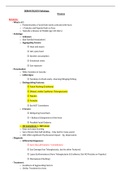
Chapter 7: memory
Memory: retention of information over time through:
Encoding: converting information into neural code
Storage: retaining info over time
Retrieval: pulling the info from storage
Shallow processing, structural encoding (physical structure of stimulus
Intermediate processing, phonemic encoding (what a word sounds like)
Deep processing, semantic encoding (meaning of verbal input)
Attention: entails selective focus on a certain input, enhances coding, focusing awareness
on a narrowed range of stimuli/event
Divided attention: undermines coding, can have negative effects on the performance of other
tasks
Levels of processing theory: proposes that deeper levels of processing result in more
durable memory codes
Elaboration: involves linking a stimulus to other information can enrich coding
According to dual-coding
theory: visual imagery
may facilitate memory by
providing two memory
codes rather than just one
Increasing the motivation
to remember at the time of
encoding can enhance
memory
Storage
Information processing
theories propose people have three memory stores:
Sensory memory: includes all the sensory info that we are exposed to, limited duration, large
capacity, iconic (visual), echoic (auditory)
Preserves information in its original form of a brief time
Memory traces in the sensory store appear to decay in about one quarter of a second
Short term (STM): selective attention,
conscious processing or information, limited
duration and capacity (7 +/- 2) chunking, Alan
Baddeley, visuospatial sketchpad
Can maintain unrehearsed information for
about 10-20 seconds
Baddeley proposed a more complex model of
STM called working memory capacity (WMC)
referring to one’s ability to hold and
manipulate information in conscious attention
, Long term (LTM): importance for identity, unlimited capacity, information organized and
indexed, encoding issue, level of processing theory (Craik and Lockhart), deep=semantic
encoding
Maintenance rehearsal: reread notes over and over
Elaborative rehearsal: as you review notes, come up with your own examples, understand
material and apply it
Organization in LTM
Encoding into LTM: visual
imagery
Massed practice (cramming,
last minute, putting cap on
performance, high vol. coding)
vs distributed practice
(spreading studying across
term, reread notes after class,
providing time for deep levels of processing, less stress)
Automatic (unconscious processing, not easy to retain info)
vs. effortful processing (attend, directing conscious attention, increase chances of success)
Explicit:
Intentionally trying to remember
Episodic: autobiographical
Semantic: facts about the world
Implicit:
Unintentional
Procedural: skills and actions
Classical conditioning effects (recall information unintentionally)
Memory is made in a particular way, organization in the brain (ex. months of the year)
Hierarchies
Chapters, sub-topics
Semantic networks
Each unit of info is a node
Spreading activation across the
network
Closer the node, stronger the
association, building associations
across ideas
Neural networks
Connectionist or parallel
distributed processing
Memory stored throughout brain
Memory: retention of information over time through:
Encoding: converting information into neural code
Storage: retaining info over time
Retrieval: pulling the info from storage
Shallow processing, structural encoding (physical structure of stimulus
Intermediate processing, phonemic encoding (what a word sounds like)
Deep processing, semantic encoding (meaning of verbal input)
Attention: entails selective focus on a certain input, enhances coding, focusing awareness
on a narrowed range of stimuli/event
Divided attention: undermines coding, can have negative effects on the performance of other
tasks
Levels of processing theory: proposes that deeper levels of processing result in more
durable memory codes
Elaboration: involves linking a stimulus to other information can enrich coding
According to dual-coding
theory: visual imagery
may facilitate memory by
providing two memory
codes rather than just one
Increasing the motivation
to remember at the time of
encoding can enhance
memory
Storage
Information processing
theories propose people have three memory stores:
Sensory memory: includes all the sensory info that we are exposed to, limited duration, large
capacity, iconic (visual), echoic (auditory)
Preserves information in its original form of a brief time
Memory traces in the sensory store appear to decay in about one quarter of a second
Short term (STM): selective attention,
conscious processing or information, limited
duration and capacity (7 +/- 2) chunking, Alan
Baddeley, visuospatial sketchpad
Can maintain unrehearsed information for
about 10-20 seconds
Baddeley proposed a more complex model of
STM called working memory capacity (WMC)
referring to one’s ability to hold and
manipulate information in conscious attention
, Long term (LTM): importance for identity, unlimited capacity, information organized and
indexed, encoding issue, level of processing theory (Craik and Lockhart), deep=semantic
encoding
Maintenance rehearsal: reread notes over and over
Elaborative rehearsal: as you review notes, come up with your own examples, understand
material and apply it
Organization in LTM
Encoding into LTM: visual
imagery
Massed practice (cramming,
last minute, putting cap on
performance, high vol. coding)
vs distributed practice
(spreading studying across
term, reread notes after class,
providing time for deep levels of processing, less stress)
Automatic (unconscious processing, not easy to retain info)
vs. effortful processing (attend, directing conscious attention, increase chances of success)
Explicit:
Intentionally trying to remember
Episodic: autobiographical
Semantic: facts about the world
Implicit:
Unintentional
Procedural: skills and actions
Classical conditioning effects (recall information unintentionally)
Memory is made in a particular way, organization in the brain (ex. months of the year)
Hierarchies
Chapters, sub-topics
Semantic networks
Each unit of info is a node
Spreading activation across the
network
Closer the node, stronger the
association, building associations
across ideas
Neural networks
Connectionist or parallel
distributed processing
Memory stored throughout brain