Cloning Developmental Mutations
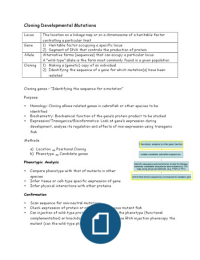
Locus The location on a linkage map or on a chromosome of a heritable factor
controlling a particular trait
Gene 1) Heritable factor occupying a specific locus
2) Segment of DNA that controls the production of protein
Allele Alternative forms (sequences) that can occupy a particular locus
A “wild-type” allele is the form most commonly found in a given population
Cloning 1) Making a (genetic) copy of an individual
2) Identifying the sequence of a gene for which mutation(s) have been
isolated
Cloning genes – “Identifying the sequence for a mutation”
Purpose
Homology: Cloning allows related genes in zebrafish or other species to be
identified
Biochemistry: Biochemical function of the gene’s protein product to be studied
Expression/Transgenics/Bioinformatics: Look at gene’s expression during
development, analyse its regulation and effects of mis-expression using transgenic
fish
Methods
a) Location Positional Cloning
b) Phenotype Candidate genes
Phenotypic Analysis
Compare phenotype with that of mutants in other
species
Infer tissue or cell-type specific expression of gene
Infer physical interactions with other proteins
Confirmation
Scan sequence for non-neutral mutations
Check expression of protein or mRNA in homozygous mutant fish
Can injection of wild-type protein or mRNA rescue the phenotype (functional
complementation) or knockdown of mRNA by antisense RNA injection phenocopy the
mutant (can the wild-type phenocopy the mutant?)
,Phenotypic Analysis Examples
no tail (Schulte-Merker et al., 1994)
Two no tail (ntl) mutants isolated in 1983; Mouse T gene cloned in 1990
Ntl is the homologue of the mouse T genes – both alleles lead to truncated protein
products
Mutant ntl die well after hatching and relatively late in development (unlike mouse
T/T embryos, die during midneurulation
and probably due to lack of allantois)
Can therefore examine effects of
mutation in later events – ntl seems to
disturn the anterior somite patterning but floorplate and neural structures are not
affected
Underlying defect in mesoderm development – posterior somites fail to form and
notochord fails to differentiate
In homozygous T/T embryos posterior somites fail to form and notochord fails to
differentiate
In 1992, putative zebrafish homologue Zf-T isolated – Zf-T amino acid sequence
69.7% identical with mouse T (high homology)
T and Zf-T expressed in early mesoderm and in the developing notochord
Zf-T and ntl are closely linked on chromosome 19
Zf-T antibodies detect no protein in homozygous mutant
ntl/ntl embryos
Coding sequence of wild-tupe and ntlb159 fish differ
(insert)
Coding sequence of wild-type and ntlb160 fish differ
(missense)
nacre (Lister et al., 1999)
Single nacre (nac) mutation isolated in 1999
Pigment (melanin) normal in eyes but absent from body,
similar phenotype to cloned black-eyed white mouse
mutants
Ie. 3 candidate mouse genes: steel, c-kit, Mitf (need to
distinguish between them)
Wild-type cells injected into nac/nac embryos generate normal pigment cells
Wild-type cells into c-kit or Mitf mutant embryos generate normal pigment cells
(transplants suggest that nacre functions cell-autonomously)
Wild-type cells injected into Steel mutant embryos unable to generate normal
pigment cells
, Zebrafish homologue of Mitf (microphthalmia-related protein) isolated and closely
linked to nac on chromosome 6
Z-Mitf is expressed in developing pigment cells
Nacre mutant carries a nonsense mutation in the coding sequence for Z-Mitf
Injection of Z-Mitf DNA rescues phenotype
Nacre encodes a zebrafish microphthalmia-related protein that regulates neural-
crest derived pigment cell fate
minifin (Connors et al., 1999)
Minifin (mfn) adults show variable loss of tail fin
Primary defect is a partial dorsalisation of the tail bud
Genetic regulation of dorso-ventral pattern formation is highly conserved across
many organisms
Drosophila dpp and tolloid lose the fly equivalent of vertebrate ventral pattern
elements
2 zebrafish dpp related genes and one tolloid homologue identified
Dpp related genes map to chromosomes 11 and 20 (Dpp eliminated from candidate)
Zebrafish tolloid and mfn map to chromosome 1
Tolloid related cDNA clones from all 5 alleles mfn sequenced and compared with the
wild-type zebrafish tolloid sequence
All 5 alleles of mfn have mutations which could affect protein function – 3 are
nonsense mutations, other 2 are missense mutations affecting conserved amino
acids
Minifin encodes zebrafish homologue of the Drosophila D-V patterning gene tolloid
sapje (Bassett et al., 2003)
Sap mutants develop lesions in skeletal muscle where fibres detach from myosepta
Zebrafish dystrophin gene (dmd) is associated with embryonic muscle attachment
sites
Both dmd and sap map to chromosome 1 close to Z5508
Homozygosity for nonsense mutation in exon 4 of dmd segregates with sap
phenotype
Injection of dmd antisense RNA phenocopies sap
Identification of Homologous Genes
, In silico Databases: BLAST:
Genome Projects Protein
EST collections Nucleotide
Translated nucleotide
In vitro Libraries Probes
Genomic cDNA
cDNA Low stringency hybridisation
Degenerate PCR products
New model organisms still developed for different purposes of research
(eg. shrimp for crustacean phylo geny, naked mole rat for ageing)
Show that the candidate gene is in a similar location to the target sequence
Linkage Analysis
Linkage analysis exploits fact that the closer 2 genes are on a
chromosome the less likely it is that recombination will take
place in the intergenic region during meiosis
Recombination creates new haplotypes (collection of specific
alleles in a cluster of tightly-linked genes on a chromosome
that are likely to be inherited together) and alleic combinations
Eg. Parental haplotypes are AB and ab
Crossovers between gene a and gene b will
generate the recombinant haplotypes Ab and
aB
Assuming we know where vestigial is (ie. need to
know the location of one of the genes) – does
purple map anywhere near vestigial?
1. Wild-type x tester stock to produce
heterozygotes
2. In heterozygotes – recombination will give an
effect (recombination in pre-cross will only
give the same combinations as they are homozygous)
3. Double heterozygotes are then backcrossed – phenotypes are easier to distinguish
4. The offspring from the backcross are then crossed together – can then see
whether pr and vg are alleles of the same gene, or are mapped closely together
For 2 loci identified by a mutant phenotype (eg. vestigial wings and purple), to
determine the frequency of recombination events we analyse the segregation of
wild type (vg+ and pr+) and mutant (vg and pr) alleles
When mapping new mutants – a dihybrid cross between wild-type and mutant
tester stock (“multiply mutant”)
Locus The location on a linkage map or on a chromosome of a heritable factor
controlling a particular trait
Gene 1) Heritable factor occupying a specific locus
2) Segment of DNA that controls the production of protein
Allele Alternative forms (sequences) that can occupy a particular locus
A “wild-type” allele is the form most commonly found in a given population
Cloning 1) Making a (genetic) copy of an individual
2) Identifying the sequence of a gene for which mutation(s) have been
isolated
Cloning genes – “Identifying the sequence for a mutation”
Purpose
Homology: Cloning allows related genes in zebrafish or other species to be
identified
Biochemistry: Biochemical function of the gene’s protein product to be studied
Expression/Transgenics/Bioinformatics: Look at gene’s expression during
development, analyse its regulation and effects of mis-expression using transgenic
fish
Methods
a) Location Positional Cloning
b) Phenotype Candidate genes
Phenotypic Analysis
Compare phenotype with that of mutants in other
species
Infer tissue or cell-type specific expression of gene
Infer physical interactions with other proteins
Confirmation
Scan sequence for non-neutral mutations
Check expression of protein or mRNA in homozygous mutant fish
Can injection of wild-type protein or mRNA rescue the phenotype (functional
complementation) or knockdown of mRNA by antisense RNA injection phenocopy the
mutant (can the wild-type phenocopy the mutant?)
,Phenotypic Analysis Examples
no tail (Schulte-Merker et al., 1994)
Two no tail (ntl) mutants isolated in 1983; Mouse T gene cloned in 1990
Ntl is the homologue of the mouse T genes – both alleles lead to truncated protein
products
Mutant ntl die well after hatching and relatively late in development (unlike mouse
T/T embryos, die during midneurulation
and probably due to lack of allantois)
Can therefore examine effects of
mutation in later events – ntl seems to
disturn the anterior somite patterning but floorplate and neural structures are not
affected
Underlying defect in mesoderm development – posterior somites fail to form and
notochord fails to differentiate
In homozygous T/T embryos posterior somites fail to form and notochord fails to
differentiate
In 1992, putative zebrafish homologue Zf-T isolated – Zf-T amino acid sequence
69.7% identical with mouse T (high homology)
T and Zf-T expressed in early mesoderm and in the developing notochord
Zf-T and ntl are closely linked on chromosome 19
Zf-T antibodies detect no protein in homozygous mutant
ntl/ntl embryos
Coding sequence of wild-tupe and ntlb159 fish differ
(insert)
Coding sequence of wild-type and ntlb160 fish differ
(missense)
nacre (Lister et al., 1999)
Single nacre (nac) mutation isolated in 1999
Pigment (melanin) normal in eyes but absent from body,
similar phenotype to cloned black-eyed white mouse
mutants
Ie. 3 candidate mouse genes: steel, c-kit, Mitf (need to
distinguish between them)
Wild-type cells injected into nac/nac embryos generate normal pigment cells
Wild-type cells into c-kit or Mitf mutant embryos generate normal pigment cells
(transplants suggest that nacre functions cell-autonomously)
Wild-type cells injected into Steel mutant embryos unable to generate normal
pigment cells
, Zebrafish homologue of Mitf (microphthalmia-related protein) isolated and closely
linked to nac on chromosome 6
Z-Mitf is expressed in developing pigment cells
Nacre mutant carries a nonsense mutation in the coding sequence for Z-Mitf
Injection of Z-Mitf DNA rescues phenotype
Nacre encodes a zebrafish microphthalmia-related protein that regulates neural-
crest derived pigment cell fate
minifin (Connors et al., 1999)
Minifin (mfn) adults show variable loss of tail fin
Primary defect is a partial dorsalisation of the tail bud
Genetic regulation of dorso-ventral pattern formation is highly conserved across
many organisms
Drosophila dpp and tolloid lose the fly equivalent of vertebrate ventral pattern
elements
2 zebrafish dpp related genes and one tolloid homologue identified
Dpp related genes map to chromosomes 11 and 20 (Dpp eliminated from candidate)
Zebrafish tolloid and mfn map to chromosome 1
Tolloid related cDNA clones from all 5 alleles mfn sequenced and compared with the
wild-type zebrafish tolloid sequence
All 5 alleles of mfn have mutations which could affect protein function – 3 are
nonsense mutations, other 2 are missense mutations affecting conserved amino
acids
Minifin encodes zebrafish homologue of the Drosophila D-V patterning gene tolloid
sapje (Bassett et al., 2003)
Sap mutants develop lesions in skeletal muscle where fibres detach from myosepta
Zebrafish dystrophin gene (dmd) is associated with embryonic muscle attachment
sites
Both dmd and sap map to chromosome 1 close to Z5508
Homozygosity for nonsense mutation in exon 4 of dmd segregates with sap
phenotype
Injection of dmd antisense RNA phenocopies sap
Identification of Homologous Genes
, In silico Databases: BLAST:
Genome Projects Protein
EST collections Nucleotide
Translated nucleotide
In vitro Libraries Probes
Genomic cDNA
cDNA Low stringency hybridisation
Degenerate PCR products
New model organisms still developed for different purposes of research
(eg. shrimp for crustacean phylo geny, naked mole rat for ageing)
Show that the candidate gene is in a similar location to the target sequence
Linkage Analysis
Linkage analysis exploits fact that the closer 2 genes are on a
chromosome the less likely it is that recombination will take
place in the intergenic region during meiosis
Recombination creates new haplotypes (collection of specific
alleles in a cluster of tightly-linked genes on a chromosome
that are likely to be inherited together) and alleic combinations
Eg. Parental haplotypes are AB and ab
Crossovers between gene a and gene b will
generate the recombinant haplotypes Ab and
aB
Assuming we know where vestigial is (ie. need to
know the location of one of the genes) – does
purple map anywhere near vestigial?
1. Wild-type x tester stock to produce
heterozygotes
2. In heterozygotes – recombination will give an
effect (recombination in pre-cross will only
give the same combinations as they are homozygous)
3. Double heterozygotes are then backcrossed – phenotypes are easier to distinguish
4. The offspring from the backcross are then crossed together – can then see
whether pr and vg are alleles of the same gene, or are mapped closely together
For 2 loci identified by a mutant phenotype (eg. vestigial wings and purple), to
determine the frequency of recombination events we analyse the segregation of
wild type (vg+ and pr+) and mutant (vg and pr) alleles
When mapping new mutants – a dihybrid cross between wild-type and mutant
tester stock (“multiply mutant”)