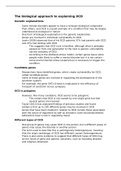
The biological approach to explaining OCD
Genetic explanations
- Some mental disorders appear to have a stronger biological component
than others, and OCD is a good example of a condition that may be largely
understood as biological in nature.
- One form of biological explanation is the genetic explanation.
- Genes are involved in individual vulnerability to OCD.
- Lewis (1936) observed that of his OCD patients 37% had parents with OCD
and 21% had siblings with OCD.
→ This suggests that OCD runs in families, although what is probably
passed on from one generation to the next is genetic vulnerability
not the certainty of OCD.
→ According to the diathesis-stress model, certain genes leave some
people mole likely to suffer a mental disorder but it is not certain -
some environmental stress (experience) is necessary to trigger the
condition.
Candidate genes
- Researchers have identified genes, which create vulnerability for OCD,
called candidate genes.
- Some of these genes are involved in regulating the development of the
serotonin system.
- For example, the gene 5HT1-D beta is implicated in the efficiency of
transport of serotonin across synapses.
OCD is polygenic
- However, like many conditions, OCD seems to be polygenic.
→ This means that OCD is not caused by one single gene but that
several genes are involved.
- Taylor (2013) has analysed findings of previous studies and found
evidence that up to 230 different genes may be involved in OCD.
- Genes that have been studied in relation to OCD include those associated
with the action of dopamine as well as serotonin, both neurotransmitters
believed to have a role in regulating mood.
Different types of OCD
- One group of genes may cause OCD in one person, but a different group of
genes may cause the disorder in another person.
- The term used to describe this is aetiologically heterogeneous, meaning
that the origin (aetiology) of OCD has different causes (heterogeneous).
- There is also some evidence to suggest that different types of OCD may
be the result of particular genetic variations, such as hoarding disorder
and religious obsession.
, Evaluation
There is good supporting evidence
- There is evidence from a variety of sources for the idea that some people
are vulnerable to OCD as a result of their genetic make-up.
- One of the best sources of evidence for the importance of genes is twin
studies.
- Nestadt et al. (2010) reviewed previous twin studies and found that 68%
of identical twins shared OCD as opposed to 31% of non-identical twins.
→ This strongly suggests a genetic influence on OCD.
Too many candidate genes
- Although twin studies strongly suggest that OCD is largely under genetic
control, psychologists have been much less successful at pinning down all
the genes involved.
- One reason for this is because it appears that several genes are involved
and that each genetic variation only increases the risk of OCD by a
fraction. The consequence is that a genetic explanation is unlikely to ever
be very useful because it provides little predictive value.
Environmental risk factors
- It seems that environmental factors can also trigger or increase the risk of
developing OCD (the diathesis-stress model).
- For example, Cromer et al. (2007) found that over half the OCD patients in
their sample had a traumatic event in their past, and that OCD was more
severe in those with more than one trauma.
→ This suggests that OCD cannot be entirely genetic in origin, at least
not in all cases.
→ It may be more productive to focus on the environmental causes
because we are more able to do something about these.
Genetic explanations
- Some mental disorders appear to have a stronger biological component
than others, and OCD is a good example of a condition that may be largely
understood as biological in nature.
- One form of biological explanation is the genetic explanation.
- Genes are involved in individual vulnerability to OCD.
- Lewis (1936) observed that of his OCD patients 37% had parents with OCD
and 21% had siblings with OCD.
→ This suggests that OCD runs in families, although what is probably
passed on from one generation to the next is genetic vulnerability
not the certainty of OCD.
→ According to the diathesis-stress model, certain genes leave some
people mole likely to suffer a mental disorder but it is not certain -
some environmental stress (experience) is necessary to trigger the
condition.
Candidate genes
- Researchers have identified genes, which create vulnerability for OCD,
called candidate genes.
- Some of these genes are involved in regulating the development of the
serotonin system.
- For example, the gene 5HT1-D beta is implicated in the efficiency of
transport of serotonin across synapses.
OCD is polygenic
- However, like many conditions, OCD seems to be polygenic.
→ This means that OCD is not caused by one single gene but that
several genes are involved.
- Taylor (2013) has analysed findings of previous studies and found
evidence that up to 230 different genes may be involved in OCD.
- Genes that have been studied in relation to OCD include those associated
with the action of dopamine as well as serotonin, both neurotransmitters
believed to have a role in regulating mood.
Different types of OCD
- One group of genes may cause OCD in one person, but a different group of
genes may cause the disorder in another person.
- The term used to describe this is aetiologically heterogeneous, meaning
that the origin (aetiology) of OCD has different causes (heterogeneous).
- There is also some evidence to suggest that different types of OCD may
be the result of particular genetic variations, such as hoarding disorder
and religious obsession.
, Evaluation
There is good supporting evidence
- There is evidence from a variety of sources for the idea that some people
are vulnerable to OCD as a result of their genetic make-up.
- One of the best sources of evidence for the importance of genes is twin
studies.
- Nestadt et al. (2010) reviewed previous twin studies and found that 68%
of identical twins shared OCD as opposed to 31% of non-identical twins.
→ This strongly suggests a genetic influence on OCD.
Too many candidate genes
- Although twin studies strongly suggest that OCD is largely under genetic
control, psychologists have been much less successful at pinning down all
the genes involved.
- One reason for this is because it appears that several genes are involved
and that each genetic variation only increases the risk of OCD by a
fraction. The consequence is that a genetic explanation is unlikely to ever
be very useful because it provides little predictive value.
Environmental risk factors
- It seems that environmental factors can also trigger or increase the risk of
developing OCD (the diathesis-stress model).
- For example, Cromer et al. (2007) found that over half the OCD patients in
their sample had a traumatic event in their past, and that OCD was more
severe in those with more than one trauma.
→ This suggests that OCD cannot be entirely genetic in origin, at least
not in all cases.
→ It may be more productive to focus on the environmental causes
because we are more able to do something about these.