2.1.1 Structure of eukaryotic cells
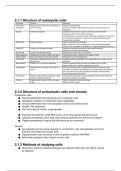
Organelle Function Structure
Cell surface Regulates the movement of substances in Made of phospholipids
membrane and out of cells Contains receptor molecules that respond to chemicals such as
hormones
Nucleus Controls cell activity Contains chromosomes made of protein-bound linear DNA
Nucleolus within it that makes ribosomes
Surrounded by a nuclear envelope with pores, isolating the contents of
the nucleus and allows for movement of substances between the
nucleus and cytoplasm
Ribosomes Protein synthesis Not surrounded by a membrane
80S in eukaryotic, 70S in prokaryotic, mitochondria, chloroplasts
Found in the cytoplasm or attached to a rough endoplasmic reticulum
Rough ER Produce and transport proteins Network of flattened tubules and sacs called cisternae
Surface is covered with ribosomes
Smooth ER Produce and transport lipids Cisternae structure without ribosomes
Golgi apparatus Package and process proteins and lipids Cisternae structure, vesicles at the edges of sacs
Golgi vesicles Store and transport proteins and lipids Membrane bound fluid filled sacs
Lysosomes Hydrolyse invading cells and worn-out cell Hydrolytic enzymes bounded by a membrane with no clear internal
components structure
Mitochondria Produce ATP by aerobic respiration Double membrane with the inner one folded to form cristae
Matrix inside which contains respiratory enzymes
Chloroplasts Photosynthesis, happens in the grana or Double membrane with an additional thylakoid membrane inside
stroma Thylakoid membranes are stacked to form grana which are linked by
thin, flat pieces of the same thylakoid membrane called lamellae
Stroma is the thick fluid inside
Cell vacuole Maintains cell pressure by keeping it rigid, Contains cell sap which is a weak sugar/salt solution bounded by a
isolates unwanted chemicals membrane called the tonoplast
Cell wall Supports cell, prevents it from changing Made of cellulose in plants and algae
shape Made of chitin in fungi
2.1.2 Structure of prokaryotic cells and viruses
Prokaryotic cells:
● Same phospholipid cell membrane as in eukaryotic cells
● Cytoplasm contains no membrane bound organelles
● Circular DNA floats free in the cytoplasm and is not protein-bound
● Smaller 70S ribosomes
● Cell wall made of murein, a glycoprotein
● Plasmids (sometimes): small DNA loops, which have genes that aid survival
● Capsule (sometimes): slime layer that protects bacteria from the immune system
● Flagella (sometimes): rotating hair-like structure for movement
Viruses:
● Are acellular and non-living meaning no cell division: host cell replicates virus for it
after the virus injects its nucleic acid
● Capsid protein coat surrounds a core of genetic material: DNA/RNA
● Attachment proteins: help it attach to host cells
2.1.3 Methods of studying cells
● Resolution: minimum distance between two objects which they can still be viewed
as separate
, ● Magnification: number of times bigger an observed specimen is compared to its
actual size
● Image = actual × magnification
● m ×100 = cm ×10 = mm ×1000 = μm ×1000 = nm
Optical Transmission Scanning
Light Electromagnets focus Electron beams scan
electron beams through across a specimen,
the specimen, denser knocking electrons off
parts absorb more from the specimen which
electrons so appear are collected in a cathode
darker ray tube
Lower res/mag due to the Higher res/mag due to Moderate res/mag due to
longer wavelength of light shorter wavelength of shorter wavelength of
electrons electrons
Simpler preparation, live More complex More complex
specimens preparation: extremely preparation: specimen in
thin specimen in vacuum, vacuum, needs coating
needs staining
2D, colour 2D, black and white 3D, black and white
● Homogenisation: grind cells in blender to break up the plasma membrane and
release organelles
● Filtration: homogenised solution is f through a gauze to remove large debris
● Ultracentrifugation: tube put in a centrifuge which is spun at a low speed. Heavier
organelles such as nuclei are forced to the bottom, forming a pellet. The remaining
solution is the supernatant
● Cold: reduce enzyme activity, Buffered: prevent enzymes from denaturing, Isotonic:
prevent osmotic lysis
2.2 All cells arise from other cells
Mitosis:
● Interphase: cell grows and prepares to divide
○ G1: new organelles and proteins are made
○ S: DNA uncoils and replicates, ATP content increases
○ G2: cell checks for damage
● Prophase: chromosomes condense, nuclear envelope breaks down. Centrioles
move to poles, forming spindle fibres
● Metaphase: chromosomes line up at the equator, attached to spindle fibres by their
centromere
● Anaphase: spindle fibres contract, causing the centromeres to divide and
chromatids to be pulled to the poles
● Telophase: chromatids reach the poles and uncoil, nuclear envelope reforms,
cytoplasm divides
Organelle Function Structure
Cell surface Regulates the movement of substances in Made of phospholipids
membrane and out of cells Contains receptor molecules that respond to chemicals such as
hormones
Nucleus Controls cell activity Contains chromosomes made of protein-bound linear DNA
Nucleolus within it that makes ribosomes
Surrounded by a nuclear envelope with pores, isolating the contents of
the nucleus and allows for movement of substances between the
nucleus and cytoplasm
Ribosomes Protein synthesis Not surrounded by a membrane
80S in eukaryotic, 70S in prokaryotic, mitochondria, chloroplasts
Found in the cytoplasm or attached to a rough endoplasmic reticulum
Rough ER Produce and transport proteins Network of flattened tubules and sacs called cisternae
Surface is covered with ribosomes
Smooth ER Produce and transport lipids Cisternae structure without ribosomes
Golgi apparatus Package and process proteins and lipids Cisternae structure, vesicles at the edges of sacs
Golgi vesicles Store and transport proteins and lipids Membrane bound fluid filled sacs
Lysosomes Hydrolyse invading cells and worn-out cell Hydrolytic enzymes bounded by a membrane with no clear internal
components structure
Mitochondria Produce ATP by aerobic respiration Double membrane with the inner one folded to form cristae
Matrix inside which contains respiratory enzymes
Chloroplasts Photosynthesis, happens in the grana or Double membrane with an additional thylakoid membrane inside
stroma Thylakoid membranes are stacked to form grana which are linked by
thin, flat pieces of the same thylakoid membrane called lamellae
Stroma is the thick fluid inside
Cell vacuole Maintains cell pressure by keeping it rigid, Contains cell sap which is a weak sugar/salt solution bounded by a
isolates unwanted chemicals membrane called the tonoplast
Cell wall Supports cell, prevents it from changing Made of cellulose in plants and algae
shape Made of chitin in fungi
2.1.2 Structure of prokaryotic cells and viruses
Prokaryotic cells:
● Same phospholipid cell membrane as in eukaryotic cells
● Cytoplasm contains no membrane bound organelles
● Circular DNA floats free in the cytoplasm and is not protein-bound
● Smaller 70S ribosomes
● Cell wall made of murein, a glycoprotein
● Plasmids (sometimes): small DNA loops, which have genes that aid survival
● Capsule (sometimes): slime layer that protects bacteria from the immune system
● Flagella (sometimes): rotating hair-like structure for movement
Viruses:
● Are acellular and non-living meaning no cell division: host cell replicates virus for it
after the virus injects its nucleic acid
● Capsid protein coat surrounds a core of genetic material: DNA/RNA
● Attachment proteins: help it attach to host cells
2.1.3 Methods of studying cells
● Resolution: minimum distance between two objects which they can still be viewed
as separate
, ● Magnification: number of times bigger an observed specimen is compared to its
actual size
● Image = actual × magnification
● m ×100 = cm ×10 = mm ×1000 = μm ×1000 = nm
Optical Transmission Scanning
Light Electromagnets focus Electron beams scan
electron beams through across a specimen,
the specimen, denser knocking electrons off
parts absorb more from the specimen which
electrons so appear are collected in a cathode
darker ray tube
Lower res/mag due to the Higher res/mag due to Moderate res/mag due to
longer wavelength of light shorter wavelength of shorter wavelength of
electrons electrons
Simpler preparation, live More complex More complex
specimens preparation: extremely preparation: specimen in
thin specimen in vacuum, vacuum, needs coating
needs staining
2D, colour 2D, black and white 3D, black and white
● Homogenisation: grind cells in blender to break up the plasma membrane and
release organelles
● Filtration: homogenised solution is f through a gauze to remove large debris
● Ultracentrifugation: tube put in a centrifuge which is spun at a low speed. Heavier
organelles such as nuclei are forced to the bottom, forming a pellet. The remaining
solution is the supernatant
● Cold: reduce enzyme activity, Buffered: prevent enzymes from denaturing, Isotonic:
prevent osmotic lysis
2.2 All cells arise from other cells
Mitosis:
● Interphase: cell grows and prepares to divide
○ G1: new organelles and proteins are made
○ S: DNA uncoils and replicates, ATP content increases
○ G2: cell checks for damage
● Prophase: chromosomes condense, nuclear envelope breaks down. Centrioles
move to poles, forming spindle fibres
● Metaphase: chromosomes line up at the equator, attached to spindle fibres by their
centromere
● Anaphase: spindle fibres contract, causing the centromeres to divide and
chromatids to be pulled to the poles
● Telophase: chromatids reach the poles and uncoil, nuclear envelope reforms,
cytoplasm divides