Managing & Organization
Part 1: Managing people in organizations
1. Managing and organizations – opening, thinking & contextualizing – part 1
Managing and managerialism
Management
= The process of communicating, coordinating, and implementing actions to pursue organizational objectives
(goes hand in hand with managerialism)
- We think we can manage people, or an organization based on a rational way of thinking/rational decisions
- You need people skills, and you need to take other things into consideration making sense!
- Managing entails sensemaking and framing
- “One size fit all’ management approach won’t work anymore we must make sense of it
- Management is not a neutral activity can’t be based on its ability to achieve additional productivity or
efficiency
Managerialism
= Combines general tools and knowledge to establish itself in organizations, public institutions and society
= A claim to special expertise based on managerial rationality characterizing organizations
= The belief in management as a means capable of solving any problems
- Knowing all the techniques of management ≠ being a good manager
Managerial rationality
= When a manager only makes rational decisions
= When managers claim to be able to make decisions that deny legitimacy to other forms of knowledge, based
on their generalized managerial competence
- A rational manager doesn’t exist anymore because they’re constantly developing (they need people skills)
- Reality is more complex and goes beyond capital accumulation
Making sense of managing
- Making sense of managing as a coherent set of assumptions, concepts, values and practices that constitute
a way of viewing reality
- Sense-making labels events and information by breaking its experience into blocks of ‘sense’
- Important part of the managerial skill set
- It’s a process where we’re trying to understand and explain what is happening around us, by making
sense of our surroundings
o Specially to give meaning to something and to explain novel and unexpected or confusing
events
- You have to manage different relationships within (stakeholders) but also outside (customers) the
organization
- If the role of a manager is to make sense, consumers gave to be critical with it (ex. Greenwashing)
Sensemaking and framing
- As managers go continually through the process of ‘sense-making’, ‘framing’ becomes a key part of their
role as a manager
- Framing = separating what needs focus and doesn’t or what is relevant and irrelevant
- Why?
- They need to ‘frame’ the sense that others have about their role within the company because the
sense that people make is never in isolation even though we make our own sense, it will always
be influenced by other components that prompt you to make sense
- Sense-breaking: managers are breaking down old frames in case of organizational change
- Sense-giving: give new meaning to frames
1
,Managing & Organization
2. Managing and organizations – opening, thinking & contextualizing – part 2
Changing paradigms
- The digital age
- Digital technologies and an increasing international division of labor between economies are
making the global economy more globalized, although it leads to deglobalizing under the pressure
of trade wars, pandemics, and their political responses
- Managing technological changes
- Responsive organizations should have employees who are capable of problem-solving
- Different generations and digital capabilities
- Increase in knowledge-intensive work = organizations employ and manage different kinds of employees
- Brains not brawn (mental, not manual labor)
- Employees need to be capable of working with sophisticated databases, software, and knowledge-
management systems
- Digital bubbles (networks & social media)
- Group together via social media and preferred websites
- The digital network is based on shared imagined experiences of those who subscribe to it
- Bubbles of highly situational emotionality are produced
- They change brand loyalty (like Apple)
- Digital nomads
- The world is shifting towards digital
- = mobile workers armed with a laptop and Wi-Fi, connecting anywhere, and choosing mobility
rather than a permanent residence
- New hypes: people work from other countries, and they work from home
Organizational culture and social relations at work
- Diversity: people with diverse experiences can contribute more varied insights, knowledge and experience
than a homogeneous workforce
- Organizations need to understand the local market to sell globally employ people who understand
- Challenges: work is more accountable and transparent as others can be online anytime and anywhere,
challenging the understandings of others
- Cultural sensitivity is needed
- Doing by learning because managers seek to make sense of others who are not only unfamiliar but often
affected by the limitations of digital communication.
Global shifts
- Growth in AI and smart teams working with intelligent machines and devices
- Organizational and spacelike decomposition of employment
- Changing skill formations globally in an international division of labor
- Global division of labor = associated asymmetry of power relations changing social systems
Leader of the international system
- The center of manufacturing in the global economy is changing towards Asia
- The global realignment of the economic center means that the major regions of capitalist investments are
no longer in the Western world
- Different kinds of capitalism & different kinds of political systems
Effects of global shifts
- Global changes have local effects on wages & production
- International division of labor
- Shifts in production
- Changes in social relations
- International demand of labor
- Growth of knowledge work tacit knowledge: organizations employ different kinds of employees
- The concept of economic neoliberalism the economy is free to do business across borders
2
, Managing & Organization
- Downside: supply chain resilience supply chain prepares for disruptions/delays due to unexpected
events
Part 2: Managing organizational practices
3. Managing cultures – part 1
Culture, norms, and artefacts
Culture
= everyday knowledge that people habitually use to make sense of the world around them
= patterns of shared meanings and understandings passed down through language, symbols & artefacts
Norms
= tacit (stilzwijgend) and unspoken assumptions and informal rules
= meanings which are negotiated in everyday interactions (how we treat each other)
Artefacts
= things with which we mark our territory symbolically, such as décor, furnishings, fittings, design…
Strong culture
= when cultural norms are defined too strictly
People within the company may begin to oppose the leaders. For example, male or female bosses in a company
who think they have the rights to sexually touch employees of the opposite sex (#MeToo).
Organization culture
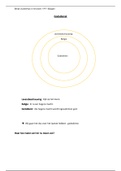
- Comprises the deep, basic assumptions, beliefs and shared values that define organizational membership
- Refers to the member’s habitual way of making decisions and presenting themselves and their
organization to those who encounter it
Levels of culture – Edgar H. Schein
Level 1: artefacts
- Physical features like architecture, furniture, uniforms etc
Level 2: espoused values
- A person’s or social group’s consistent beliefs about something in which they have an emotional
investment as they express them
Level 3: basic assumptions
- The essence of culture
- Intangible, mainly unconscious and tacit frames that subconsciously shape values and artefacts
Organization culture techniques
- Cognitive redefinition through:
- Change in old concepts
- Change in ‘adaption level’ of judgement standards like how a given behavior or perceived object is
to be judged
- The introduction of new concepts and meanings
- The aim is to produce a stronger, more cohesive culture
Techniques for cultural cohesion
Technique Description
Reference group affiliation People identify with those they’re organizationally
close to as a way of reducing anxiety about
belonging
Role modeling Organizations develop systems of role modeling and
mentoring so members learn appropriate behavior
3
Part 1: Managing people in organizations
1. Managing and organizations – opening, thinking & contextualizing – part 1
Managing and managerialism
Management
= The process of communicating, coordinating, and implementing actions to pursue organizational objectives
(goes hand in hand with managerialism)
- We think we can manage people, or an organization based on a rational way of thinking/rational decisions
- You need people skills, and you need to take other things into consideration making sense!
- Managing entails sensemaking and framing
- “One size fit all’ management approach won’t work anymore we must make sense of it
- Management is not a neutral activity can’t be based on its ability to achieve additional productivity or
efficiency
Managerialism
= Combines general tools and knowledge to establish itself in organizations, public institutions and society
= A claim to special expertise based on managerial rationality characterizing organizations
= The belief in management as a means capable of solving any problems
- Knowing all the techniques of management ≠ being a good manager
Managerial rationality
= When a manager only makes rational decisions
= When managers claim to be able to make decisions that deny legitimacy to other forms of knowledge, based
on their generalized managerial competence
- A rational manager doesn’t exist anymore because they’re constantly developing (they need people skills)
- Reality is more complex and goes beyond capital accumulation
Making sense of managing
- Making sense of managing as a coherent set of assumptions, concepts, values and practices that constitute
a way of viewing reality
- Sense-making labels events and information by breaking its experience into blocks of ‘sense’
- Important part of the managerial skill set
- It’s a process where we’re trying to understand and explain what is happening around us, by making
sense of our surroundings
o Specially to give meaning to something and to explain novel and unexpected or confusing
events
- You have to manage different relationships within (stakeholders) but also outside (customers) the
organization
- If the role of a manager is to make sense, consumers gave to be critical with it (ex. Greenwashing)
Sensemaking and framing
- As managers go continually through the process of ‘sense-making’, ‘framing’ becomes a key part of their
role as a manager
- Framing = separating what needs focus and doesn’t or what is relevant and irrelevant
- Why?
- They need to ‘frame’ the sense that others have about their role within the company because the
sense that people make is never in isolation even though we make our own sense, it will always
be influenced by other components that prompt you to make sense
- Sense-breaking: managers are breaking down old frames in case of organizational change
- Sense-giving: give new meaning to frames
1
,Managing & Organization
2. Managing and organizations – opening, thinking & contextualizing – part 2
Changing paradigms
- The digital age
- Digital technologies and an increasing international division of labor between economies are
making the global economy more globalized, although it leads to deglobalizing under the pressure
of trade wars, pandemics, and their political responses
- Managing technological changes
- Responsive organizations should have employees who are capable of problem-solving
- Different generations and digital capabilities
- Increase in knowledge-intensive work = organizations employ and manage different kinds of employees
- Brains not brawn (mental, not manual labor)
- Employees need to be capable of working with sophisticated databases, software, and knowledge-
management systems
- Digital bubbles (networks & social media)
- Group together via social media and preferred websites
- The digital network is based on shared imagined experiences of those who subscribe to it
- Bubbles of highly situational emotionality are produced
- They change brand loyalty (like Apple)
- Digital nomads
- The world is shifting towards digital
- = mobile workers armed with a laptop and Wi-Fi, connecting anywhere, and choosing mobility
rather than a permanent residence
- New hypes: people work from other countries, and they work from home
Organizational culture and social relations at work
- Diversity: people with diverse experiences can contribute more varied insights, knowledge and experience
than a homogeneous workforce
- Organizations need to understand the local market to sell globally employ people who understand
- Challenges: work is more accountable and transparent as others can be online anytime and anywhere,
challenging the understandings of others
- Cultural sensitivity is needed
- Doing by learning because managers seek to make sense of others who are not only unfamiliar but often
affected by the limitations of digital communication.
Global shifts
- Growth in AI and smart teams working with intelligent machines and devices
- Organizational and spacelike decomposition of employment
- Changing skill formations globally in an international division of labor
- Global division of labor = associated asymmetry of power relations changing social systems
Leader of the international system
- The center of manufacturing in the global economy is changing towards Asia
- The global realignment of the economic center means that the major regions of capitalist investments are
no longer in the Western world
- Different kinds of capitalism & different kinds of political systems
Effects of global shifts
- Global changes have local effects on wages & production
- International division of labor
- Shifts in production
- Changes in social relations
- International demand of labor
- Growth of knowledge work tacit knowledge: organizations employ different kinds of employees
- The concept of economic neoliberalism the economy is free to do business across borders
2
, Managing & Organization
- Downside: supply chain resilience supply chain prepares for disruptions/delays due to unexpected
events
Part 2: Managing organizational practices
3. Managing cultures – part 1
Culture, norms, and artefacts
Culture
= everyday knowledge that people habitually use to make sense of the world around them
= patterns of shared meanings and understandings passed down through language, symbols & artefacts
Norms
= tacit (stilzwijgend) and unspoken assumptions and informal rules
= meanings which are negotiated in everyday interactions (how we treat each other)
Artefacts
= things with which we mark our territory symbolically, such as décor, furnishings, fittings, design…
Strong culture
= when cultural norms are defined too strictly
People within the company may begin to oppose the leaders. For example, male or female bosses in a company
who think they have the rights to sexually touch employees of the opposite sex (#MeToo).
Organization culture
- Comprises the deep, basic assumptions, beliefs and shared values that define organizational membership
- Refers to the member’s habitual way of making decisions and presenting themselves and their
organization to those who encounter it
Levels of culture – Edgar H. Schein
Level 1: artefacts
- Physical features like architecture, furniture, uniforms etc
Level 2: espoused values
- A person’s or social group’s consistent beliefs about something in which they have an emotional
investment as they express them
Level 3: basic assumptions
- The essence of culture
- Intangible, mainly unconscious and tacit frames that subconsciously shape values and artefacts
Organization culture techniques
- Cognitive redefinition through:
- Change in old concepts
- Change in ‘adaption level’ of judgement standards like how a given behavior or perceived object is
to be judged
- The introduction of new concepts and meanings
- The aim is to produce a stronger, more cohesive culture
Techniques for cultural cohesion
Technique Description
Reference group affiliation People identify with those they’re organizationally
close to as a way of reducing anxiety about
belonging
Role modeling Organizations develop systems of role modeling and
mentoring so members learn appropriate behavior
3