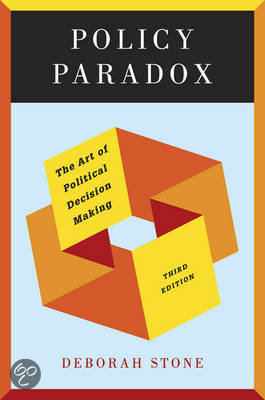
The Policy Paradox Summary Ch. 2 - 16
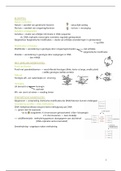
CH2. Equity
Who gets what, when and how? (recipient, item and process)
Distributions, whether of goods and services, wealth and income, health and
ilness, or opportunity and disadvantage, are at the heart of policy controversies.
In a distrubutive conflict, all sides seek ewuality; the conflict comes over how the
sides envision a fair distribution of whatever is at stake.
1. Equal slices but unequal invitations *students outside the classroom*
Membership (the boundaries of community)
2. Unequal slices for unequal merit but equal slices for equal merit
*grade A, B*
Merit-based distribution
3. Unequal slices for unequal ranks but equal slices for equal ranks
*professor vs. student*
Rank-based distribution (internal subdivisions of society)
4. Unequal slices but equal social blocs *genderroles*
Group-based distribution (major internal cleavages of society)
5. Unequal slices but equal meals *who had more gets less*
- Boundaries of the item
6. Unequal slices but equal value to recipients *doesn’t like chocolate cake but
can eat it*
- Value of the item
7. Unequal slices but fair competition with equal starting resources
*attact*
Competition (opportunity as starting resources)
8. Unequal slices but equal statistical chances of winning cake *draw
straws*
Lottery (opportunity as statistical chance)
9. Unequal slices but equal votes *democratically decide*
Voting (opportunity as political participation)
Equality often means inequality, and equal treatment often means unequal
treatment. The same distribution may look equal or unequal, depending on where
you focus.
Equality = sameness, uniformity (regarded as fair, even though they contain
(in)equalities.
The Dimensions of Equality
1. Membership (people, piece of human property, feeling)
2. Merit ‘’the reward for individual accomplishment’’
How to measure individual merit? We are shaped and nurtured by the
opportunities given us, our cultural heritage, and by the resources of our
communities, not only those of our parents. Public and private investments,
policies at all levels of government, and cultural, social, and economic
,opportunities all contribute to an individual’s capacity to do great things.
3. Rank (distribution based on rank)
It holds that for purposes of distributing resources, there are relevant differences
between segments of a larger group, and that resources should be allocated on
the basis of these subgroups rather than individual differences.
Horizontal and vertical equity: based on international ranks
Horizontal equity: meaning equal treatment of people in the same rank
Vertical equity: meaning unequal treatment of people in different ranks
How does one determine the ranks, and if that collaborates with the knowledge,
skills or other relevant factors?
4. Group-Based Distribution
It holds that some major divisions in society are relevant to distributive equity,
and that membership in a group based on these divisions should sometimes
outweigh individual characteristics in determining distribution.
In societies with liberal individualist ideologies, group-based distribution is usually
proposed as a remedy for previous violations of merit- or rank-based distribution
(African American (women) and job opportunities for example) affirmative
action.
Quotas: a means of reserving a certain portion of an item (such as medical
school class), for members of a particular group.
Rank-based distributions assagn people to groups according to more or
less fine-tuned individual measurements (past performance or
achievement). Group-based distributions assign people to groups on the
basis of traits haing nothing to do with individual qualifications or
performance (gender/race).
Arguments for affirmative action: gives the opportunity to interact with people
from other social groups and learn about and value different experiences and
outlooks. It sees diversity as a characteristic of cohesive, strong and vibrant
communities.
5. Need
The entity is viewed as a greater whole. To take something and make it part of a
larger entity is to expand the boundaries of what is being distributed, to present a
more global vision (goods or time).
‘’larger sphere’’ – cake replaces lunch (greater entity)
Challenges to the definition of an item are generally not either/or choices, but
choices about how expansively to define the item along a continuum.
What do we take into account in order to define assets?
6. Value
Standardized value of the item customized value.
, Conflicts over the value dimension of equality are especially intense in social
policy.
7, 8 & 9, Competition, Lotteries, and Elections
Focus on the process of distribution. In short, the process of distribution can
create or destroy things of value such as loyalty, community spirit, or jobs, apart
from the things they explicitly distribute.
Fair end + fair decision making process
Choosing a Distributive Method
Equal slices and lotteries, have proven to be unsuccesful.
When you confront a political issue or policy problem, begin by reading different
positions on the issue and identifying how they define the three dimensions of
recipients, items, and process.
For each of the major actors or intellectual heavies, figure out their anwsers to
three questions:
1. Who are the elegible recipients? And what criteria makes them elegible?
2. What is being distributed and how does each player define or envision it?
3. What social processes are used to carry out the distribution, and what kind of
process does each player recommend as best?
Read between the lines and interpret.
Worldview: include unspoken assumptions about individualism and community,
freedom and moral obligation, and the nature of democracy.
Inequiality
The impact of inequality on community and democracy.
Inequality and Community
‘’Being part of a community is central to individual well-being’’ How does
distribution affect communities? Inequality destroys communities.
How does a distribution affect the things that we held in common? (Assets that
are communally created and maintained, as well as used.)
- nature
- culture
- community
We will think differently about fairness and equity if we imagine these commons
items as collectively, maintained, and passed on, rather than as the result of
individual effort and achievement, and this things that can be earned and
parceled out as private property.
Inequality and Democracy
It does not mean everyone will get the same slice, but everyone has equal
representation in the process.
CH2. Equity
Who gets what, when and how? (recipient, item and process)
Distributions, whether of goods and services, wealth and income, health and
ilness, or opportunity and disadvantage, are at the heart of policy controversies.
In a distrubutive conflict, all sides seek ewuality; the conflict comes over how the
sides envision a fair distribution of whatever is at stake.
1. Equal slices but unequal invitations *students outside the classroom*
Membership (the boundaries of community)
2. Unequal slices for unequal merit but equal slices for equal merit
*grade A, B*
Merit-based distribution
3. Unequal slices for unequal ranks but equal slices for equal ranks
*professor vs. student*
Rank-based distribution (internal subdivisions of society)
4. Unequal slices but equal social blocs *genderroles*
Group-based distribution (major internal cleavages of society)
5. Unequal slices but equal meals *who had more gets less*
- Boundaries of the item
6. Unequal slices but equal value to recipients *doesn’t like chocolate cake but
can eat it*
- Value of the item
7. Unequal slices but fair competition with equal starting resources
*attact*
Competition (opportunity as starting resources)
8. Unequal slices but equal statistical chances of winning cake *draw
straws*
Lottery (opportunity as statistical chance)
9. Unequal slices but equal votes *democratically decide*
Voting (opportunity as political participation)
Equality often means inequality, and equal treatment often means unequal
treatment. The same distribution may look equal or unequal, depending on where
you focus.
Equality = sameness, uniformity (regarded as fair, even though they contain
(in)equalities.
The Dimensions of Equality
1. Membership (people, piece of human property, feeling)
2. Merit ‘’the reward for individual accomplishment’’
How to measure individual merit? We are shaped and nurtured by the
opportunities given us, our cultural heritage, and by the resources of our
communities, not only those of our parents. Public and private investments,
policies at all levels of government, and cultural, social, and economic
,opportunities all contribute to an individual’s capacity to do great things.
3. Rank (distribution based on rank)
It holds that for purposes of distributing resources, there are relevant differences
between segments of a larger group, and that resources should be allocated on
the basis of these subgroups rather than individual differences.
Horizontal and vertical equity: based on international ranks
Horizontal equity: meaning equal treatment of people in the same rank
Vertical equity: meaning unequal treatment of people in different ranks
How does one determine the ranks, and if that collaborates with the knowledge,
skills or other relevant factors?
4. Group-Based Distribution
It holds that some major divisions in society are relevant to distributive equity,
and that membership in a group based on these divisions should sometimes
outweigh individual characteristics in determining distribution.
In societies with liberal individualist ideologies, group-based distribution is usually
proposed as a remedy for previous violations of merit- or rank-based distribution
(African American (women) and job opportunities for example) affirmative
action.
Quotas: a means of reserving a certain portion of an item (such as medical
school class), for members of a particular group.
Rank-based distributions assagn people to groups according to more or
less fine-tuned individual measurements (past performance or
achievement). Group-based distributions assign people to groups on the
basis of traits haing nothing to do with individual qualifications or
performance (gender/race).
Arguments for affirmative action: gives the opportunity to interact with people
from other social groups and learn about and value different experiences and
outlooks. It sees diversity as a characteristic of cohesive, strong and vibrant
communities.
5. Need
The entity is viewed as a greater whole. To take something and make it part of a
larger entity is to expand the boundaries of what is being distributed, to present a
more global vision (goods or time).
‘’larger sphere’’ – cake replaces lunch (greater entity)
Challenges to the definition of an item are generally not either/or choices, but
choices about how expansively to define the item along a continuum.
What do we take into account in order to define assets?
6. Value
Standardized value of the item customized value.
, Conflicts over the value dimension of equality are especially intense in social
policy.
7, 8 & 9, Competition, Lotteries, and Elections
Focus on the process of distribution. In short, the process of distribution can
create or destroy things of value such as loyalty, community spirit, or jobs, apart
from the things they explicitly distribute.
Fair end + fair decision making process
Choosing a Distributive Method
Equal slices and lotteries, have proven to be unsuccesful.
When you confront a political issue or policy problem, begin by reading different
positions on the issue and identifying how they define the three dimensions of
recipients, items, and process.
For each of the major actors or intellectual heavies, figure out their anwsers to
three questions:
1. Who are the elegible recipients? And what criteria makes them elegible?
2. What is being distributed and how does each player define or envision it?
3. What social processes are used to carry out the distribution, and what kind of
process does each player recommend as best?
Read between the lines and interpret.
Worldview: include unspoken assumptions about individualism and community,
freedom and moral obligation, and the nature of democracy.
Inequiality
The impact of inequality on community and democracy.
Inequality and Community
‘’Being part of a community is central to individual well-being’’ How does
distribution affect communities? Inequality destroys communities.
How does a distribution affect the things that we held in common? (Assets that
are communally created and maintained, as well as used.)
- nature
- culture
- community
We will think differently about fairness and equity if we imagine these commons
items as collectively, maintained, and passed on, rather than as the result of
individual effort and achievement, and this things that can be earned and
parceled out as private property.
Inequality and Democracy
It does not mean everyone will get the same slice, but everyone has equal
representation in the process.