
SCI 228 (SCI228)
Chamberlain College Of Nursing
Aquí están los mejores recursos para pasar SCI 228 (SCI228). Encuentra SCI 228 (SCI228) guías de estudio, notas, tareas, y mucho más.
Examen
SCI 228 Week 2 iLab 1
Week 2 iLab 1) High Fructose Corn Syrup (HFCS-42, HFCS-55 & HFCS-90) 2) High Fructose Corn Syrup was originally discovered in 1957. It starts by making syrup out of corn starch which is mostly glucose. The syrup is then isomerized which changes some of the glucose into fructose. This process creates HFCS-42 and contains 42% fructose. When HFCS-42 is passed through an ion exchange it creates HFCS-90 that contains 90% fructose. HFCS-90 isn’t used as a sweetener. By combining HFCS-42 and HF...
 NURSECATE
Examen
SCI 228 Week 1 Discussion Question
Question dq 1 The Digestive System (graded) Imagine yourself eating a ham and cheese sandwich. What steps take place with regard to digesting the sandwich? In this discussion, present your own unique example of an item(s) of consumption, and the steps that take place in the digesting phase. Remember class, before posting your example, read, if needed, the posts of your classmates to make sure it is not repeated. In other words, only one student, not two or more students, would use the "h...
NURSECATE
Examen
SCI 228 Week 6 Quiz with Answers
(TCO 1) The maximal heart rate for a 30-year-old individual would be: 220 beats per minute (bpm). 150 beats per minute (bpm). 190 beats per minute (bpm). 100 beats per minute (bpm). (TCO 2) Which of the following describes the effect that severe dieting has on basal metabolic rate? Basal metabolic rate is decreased. Basal metabolic rate is increased. Basal metabolic rate is unchanged. The effect on basal metabolic rate varies (TCO 3) The recommended intake of cholesterol is less th...
NURSECATE
Examen
SCI 228 Final Exam with Answers
(TCO 1) The second step of the scientific method is: observation and description of a phenomenon. testing a research question or hypothesis. generating a hypothesis. collecting data. (TCO 1) Which of the following is TRUE regarding the science of nutrition? As compared to many other scientific disciplines, nutrition is a young science. Discoveries by the first nutritional scientists established the connection between deficiencies and illness. In develope...
NURSECATE
Examen
SCI 228 Week 7 Quiz with Answers
Question 1 (TCO 4) From the third month to term, the developing human is called a(n):orrect! fetus. embryo. zygote. blastocyst. Chapter 19 Question 2 2 / 2 pts (TCO 4) The average weight and height for a healthy newborn in the United States is: 5.5 pounds and 14-16 inches long. 6.5 pounds and 16-18 inches long. Correct! 7.5 pounds and 18-22 inches long. 8.5 pounds and 22-24 inches long. Chapter 19 Question 3 2 / 2 pts (TCO 5) During the first trim...
NURSECATE
Examen
SCI 228 Week 6 Quiz with Answers
(TCO 1) The maximal heart rate for a 30-year-old individual would be: 220 beats per minute (bpm). 150 beats per minute (bpm). 190 beats per minute (bpm). 100 beats per minute (bpm). (TCO 2) Which of the following describes the effect that severe dieting has on basal metabolic rate? Basal metabolic rate is decreased. Basal metabolic rate is increased. Basal metabolic rate is unchanged. The effect on basal metabolic rate varies (TCO 3) The recommended intake of cholesterol is less th...
NURSECATE
Examen
SCI 228 Final Exam with Answers
(TCO 1) The second step of the scientific method is: observation and description of a phenomenon. testing a research question or hypothesis. generating a hypothesis. collecting data. (TCO 1) Which of the following is TRUE regarding the science of nutrition? As compared to many other scientific disciplines, nutrition is a young science. Discoveries by the first nutritional scientists established the connection between deficiencies and illness. In develope...
NURSECATE
Examen
SCI 228 Week 7 Quiz with Answers
Question 1 (TCO 4) From the third month to term, the developing human is called a(n):orrect! fetus. embryo. zygote. blastocyst. Chapter 19 Question 2 2 / 2 pts (TCO 4) The average weight and height for a healthy newborn in the United States is: 5.5 pounds and 14-16 inches long. 6.5 pounds and 16-18 inches long. Correct! 7.5 pounds and 18-22 inches long. 8.5 pounds and 22-24 inches long. Chapter 19 Question 3 2 / 2 pts (TCO 5) During the first trim...
NURSECATE
Examen
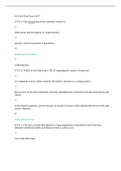
SCI 228 Final Exam._ Complete Questions with Highlighted Answers__ Rated A+
SCI 228 Final Exam 2017 (TCO 1) The second step of the scientific method is: (TCO 1) Which of the following is TRUE regarding the science of nutrition? (TCO 1) The type of study that obse rves a large population to determine factors that may influence nutritional habits and disease trends is called a (n): (TCO 1) Which of the following is NOT an essential nutrient? (TCO 2) Which of the following is associated with diets high in added sugars? (TCO 2) The type of study that observes a large popula...
 kerriejones
Examen
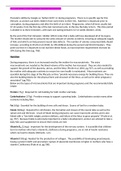
SCI 228 Week 7 iLab, Prenatal Lifecycle and Nutrition
Prenatal is define by Google as “before birth” or during pregnancy. There is no specific age for this lifecycle, as women can birth children from early teens to their 50s. Nutrition is important prior to conception, during pregnancy and after the birth of an infant. Pregnancies, when full-term usually last 37-42 weeks, from the first day of the last menstrual cycle, to the day the baby is born. This time period is divided in to three trimesters, with each one lasting between 12-14 weeks ...
NURSECATE
Examen
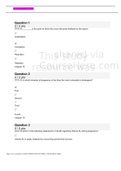
SCI 228 Week 7 Quiz
(TCO 4) is the point at which the ovum becomes fertilized by the sperm. Implantation Conception Parturition Gestation Chapter 19 (TCO 4) In which trimester of pregnancy is the fetus the most vulnerable to teratogens? First Second Third Fourth Chapter 19 (TCO 5) Which of the following statements is FALSE regarding Vitamin B12 during pregnancy? Vitamin B12 is easily obtained by consuming animal food sources.
NURSECATE
Examen
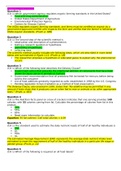
SCI 228 Week 8 Final Exam
Question 1 (CO 1) Which government agency regulates organic farming standards in the United States? • Food and Drug Administration • United States Department of Agriculture • Environmental Protection Agency • Centers for Disease Control The USDA regulates organic farming standards, and farms must be certified as organic by a government-approved certifier who inspects the farm and verifies that the farmer is following all USDA organic standards. (Pruitt, p. 689) Question 2 (CO 1...
NURSECATE

Examen
SCI 228 Week 1 iLab 1, Part 1 and 2
Listing all of the parts of the digestive system via photo
NURSECATE
Examen
SCI228 Week 8 Final Exam Compilation
1. Question: (CO 1) The Nutrition facts panel on a box of crackers indicates that one serving provides 140 calories, with 55 calories coming from fat. Calculate the percentage of calories from fat in this product. 2. Question: (CO 1) Your grandmother has recently been diagnosed with Type II diabetes. Which of the following professionals is most likely to be qualified to offer your grandmother assistance in planning her diabetic diet? 3. Question: (CO 1) The standard used to estimate the daily...
AcademicResources
Examen
SCI228 Week 8 Final Exam
1. Question:(CO 1) The two overarching goals of _____ are to increase quality and years of healthy life and to eliminate health disparities. 2. Question: (CO 1) Which of the following best describes the Delaney Clause? 3. Question: (CO 1) The second step of the scientific method is 4. Question:(CO 1) Which of the following is not an essential nutrient? 5. Question:(CO 1) Your grandmother has recently been diagnosed with Type II diabetes. Which of the following professionals is most likely...
AcademicResources
Examen
SCI228 Week 8 Final Exam
1. Question: (CO 1) Which of the following best describes the Delaney Clause? 2. Question:(CO 1) Which of the following is true regarding the science of nutrition? 3. Question:(CO 1)Which government agency regulates organic farming standards in the United States? 4. Question:(CO 1) The type of study that observes a large population to determine factors that may influence nutritional habits and disease trends is called a (n) 5. Question: (CO 1) Your grandmother has recently been diagnosed wit...
AcademicResources
Examen
SCI228 Week 8 Final Exam
1. Question:(CO 1) Which government agency regulates organic farming standards in the United States? 2. Question:(CO 1) The second step of the scientific method is 3. Question:(CO 1) Which of the following best describes the Delaney Clause? 4. Question:(CO 1) The Nutrition facts panel on a box of crackers indicates that one serving provides 140 calories, with 55 calories coming from fat. Calculate the percentage of calories from fat in this product. 5. Question:(CO 1) Your grandmother has re...
AcademicResources
Examen
SCI228 Week 8 Final Exam
1. Question: (TCO 1) Which of the following is true regarding the science of nutrition? 2. Question:(TCO 1) Which of the following BEST describes the Delaney Clause? 3. Question:(TCO 1) The Nutrition Facts Panel on a box of crackers indicate that one serving provides 14 calories, with 55 calories coming from fat. Calculate the percentage of calories from fat in this product. 4. Question:(TCO 1) Which of the following is required on all food labels? 5. Question: ( TCO 2) A diet low in fiber i...
AcademicResources
Examen
SCI228 Week 7 Quiz; Nutrition, Health, and Wellness with Lab
1. Question: (CO 7) Inadequate intakes of during pregnancy are associated with neural tube defects in the fetus. 2. Question: (CO 7) In which trimester of pregnancy is the fetus the most vulnerable to teratogens? 3. Question: (CO 7) At what point during pregnancy is adequate folate the most important? 4. Question: (CO 7) Which statement is false regarding zinc during pregnancy? 5. Question: (CO 7) Which of the following hormones is responsible for breast milk synthesis? 6. Question: (CO 7)...
AcademicResources
Examen
SCI228 Week 7 Quiz; Nutrition, Health, and Wellness with Lab
1. Question: (CO 7) The inner portion of the zygote that implants in the uterine lining is called the 2. Question: (CO 7) Recommended weight gain during pregnancy is based on the 3. Question: (CO 7) Which of the following fatty acids is critical to fetal brain and eye development? 4. Question: (CO 7) The absorption of calcium increases during pregnancy because 5. Question: (CO 7) All of the following are associated with gestational diabetes except 6. Question: (CO 7) It is best if the first...
AcademicResources