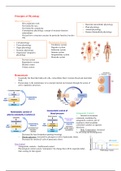
Principles of Physiology
What is Physiology?
- How organisms work
→ Bacterial (unicellular) physiology
- Not limited by taxa
→ Plant physiology
- Not limited by complexity
→ Animal physiology
- Contemporary physiology: concept of structure-function
→ Human (biomedical) physiology
relationships
- Not just how a structure executes its particular function, but also
why
→ Cell physiology Physiological Systems
→ Tissue physiology Circulatory system
→ Organ physiology Digestive system
→ Systemic physiology Endocrine system
→ Organismal/ integrative Immune system
physiology Integumentary system
Muscular system
Nervous system
Reproductive system
Skeletal system
Urinary system
Homeostasis
= Essentially the fluid that bathes all cells- extracellular fluid. Contains blood and interstitial
fluid.
= Homeostasis is the maintenance of a constant internal environment through the action of
active regulatory processes.
Antagonistic Controls
Internal environment
commonly modulated by
antagonistic controls: pair of
regulators which modulate
controlled variables in opposite
directions.
Body Temperature: increased
by shivering and thermogenesis.
Decreased by heat dissipation (panting/sweating).
Plasma (glucose): increased by glucagon (a-cells of pancreatic islets).
Decreased by insulin (𝛽-cells of pancreatic islets).
Fine Control
- Antagonistic controls + feedforward control.
- Physiological control system “anticipates” the change that will be required (rather
than waiting for that signal)
, - Event that alters the controlled variable also has a direct feedforward effect on the
effector.
Thermal Physiology
o Let temperature of the body= TA
o Let ambient temperature be= TA
o Only 4 combinatorial possibilities;
- TB could be constant or variable
- TB could be same as TA or different
Homeotherm: humans. TB is constant and different from TA.
Poikilotherm: cold blooded animals. Mimics TA. Body temperature is variable. Could be same as T A. If TA
is constant TB is constant to (same as TA).
Heterotherm: TB is variable but not necessarily same as TA.
Endotherm: organisms who increase of decrease TB internally. Humans.
Ectotherm: organisms who increase or decrease TB externally. Fish, reptiles.
Heat Transfer
→ Sequential energy transfer between molecules:
o From core (CNS) to periphery (e.g. skin).
o From periphery to boundary layer of external environment.
o From boundary layer to bulk external environment.
→ Speed of heat transfer depends on physical state of external environment:
o Heat dissipation (Wm-1K-1) fastest to a solid and slowest to a gas.
o Reflects molecular density.
Preventing Heat Loss
▪ Keep blood away from the periphery/skin- vasoconstriction of capillaries.
▪ Insulation
▪ Can be layer of air or water trapped between skin and boundary layer; by feathers, by body hair
(piloerection increases insulation).
▪ Can be under the skin (e.g. subcutaneous adipose tissue/ “blubber”-conducts thermal energy slower than
muscle).
Dissipating Excess Heat
= Can increase blood flow to periphery/skin (dilate capillaries).
= Can increase fluid on skin to accelerate heat dissipation (i.e. perspiration).
= Can evaporate saliva from tongue (i.e. panting).
= Can increase fluids in the boundary layer:
- E.g. get into water
- E.g. take fluid into digestive tract (technically outside the body, so can serve as a heat
sink).
Generating Heat-Thermogenesis
• Can break chemical bonds-i.e. metabolism of respiratory substrates (may involve futile cycling:
phosphofructokinase and fructose-1, 6-bisphosphatase.
• Can have isometric/antagonistic muscle contractions- generates heat (by driving hydrolysis of ATP) without
resulting movement.
What is Physiology?
- How organisms work
→ Bacterial (unicellular) physiology
- Not limited by taxa
→ Plant physiology
- Not limited by complexity
→ Animal physiology
- Contemporary physiology: concept of structure-function
→ Human (biomedical) physiology
relationships
- Not just how a structure executes its particular function, but also
why
→ Cell physiology Physiological Systems
→ Tissue physiology Circulatory system
→ Organ physiology Digestive system
→ Systemic physiology Endocrine system
→ Organismal/ integrative Immune system
physiology Integumentary system
Muscular system
Nervous system
Reproductive system
Skeletal system
Urinary system
Homeostasis
= Essentially the fluid that bathes all cells- extracellular fluid. Contains blood and interstitial
fluid.
= Homeostasis is the maintenance of a constant internal environment through the action of
active regulatory processes.
Antagonistic Controls
Internal environment
commonly modulated by
antagonistic controls: pair of
regulators which modulate
controlled variables in opposite
directions.
Body Temperature: increased
by shivering and thermogenesis.
Decreased by heat dissipation (panting/sweating).
Plasma (glucose): increased by glucagon (a-cells of pancreatic islets).
Decreased by insulin (𝛽-cells of pancreatic islets).
Fine Control
- Antagonistic controls + feedforward control.
- Physiological control system “anticipates” the change that will be required (rather
than waiting for that signal)
, - Event that alters the controlled variable also has a direct feedforward effect on the
effector.
Thermal Physiology
o Let temperature of the body= TA
o Let ambient temperature be= TA
o Only 4 combinatorial possibilities;
- TB could be constant or variable
- TB could be same as TA or different
Homeotherm: humans. TB is constant and different from TA.
Poikilotherm: cold blooded animals. Mimics TA. Body temperature is variable. Could be same as T A. If TA
is constant TB is constant to (same as TA).
Heterotherm: TB is variable but not necessarily same as TA.
Endotherm: organisms who increase of decrease TB internally. Humans.
Ectotherm: organisms who increase or decrease TB externally. Fish, reptiles.
Heat Transfer
→ Sequential energy transfer between molecules:
o From core (CNS) to periphery (e.g. skin).
o From periphery to boundary layer of external environment.
o From boundary layer to bulk external environment.
→ Speed of heat transfer depends on physical state of external environment:
o Heat dissipation (Wm-1K-1) fastest to a solid and slowest to a gas.
o Reflects molecular density.
Preventing Heat Loss
▪ Keep blood away from the periphery/skin- vasoconstriction of capillaries.
▪ Insulation
▪ Can be layer of air or water trapped between skin and boundary layer; by feathers, by body hair
(piloerection increases insulation).
▪ Can be under the skin (e.g. subcutaneous adipose tissue/ “blubber”-conducts thermal energy slower than
muscle).
Dissipating Excess Heat
= Can increase blood flow to periphery/skin (dilate capillaries).
= Can increase fluid on skin to accelerate heat dissipation (i.e. perspiration).
= Can evaporate saliva from tongue (i.e. panting).
= Can increase fluids in the boundary layer:
- E.g. get into water
- E.g. take fluid into digestive tract (technically outside the body, so can serve as a heat
sink).
Generating Heat-Thermogenesis
• Can break chemical bonds-i.e. metabolism of respiratory substrates (may involve futile cycling:
phosphofructokinase and fructose-1, 6-bisphosphatase.
• Can have isometric/antagonistic muscle contractions- generates heat (by driving hydrolysis of ATP) without
resulting movement.