Stroke Exam Questions With Accurate
Solutions
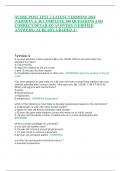
The nurse recognizes that which patient is at greatest risk for death secondary to
stroke?
-A 36-year-old Caucasian male
-A 45-year-old Asian male
-A 56-year-old African American female
-A 62-year-old Hispanic female - ANSWER--A 56-year-old African American female
The incidence of stroke is greater in men than women until age 55 at which time the
incidence of stroke is greater in women than men. Death from stroke is greater in
women and African Americans.
A nurse is caring for a client who has experienced a right-hemispheric stroke. The nurse
should expect the client to have difficulty with which of the following? (Select all that
apply)
-Impulse control
-Moving the left side
-Depth perception
-Speaking
-Situational awareness - ANSWER--Impulse control
-Moving the left side
-Depth perception
-Situational awareness
,A client who has experienced a right hemispheric stroke can exhibit impulse control
difficulty, such as the urgency to use the restroom; left sided hemiplegia; a loss in depth
perception; aphasia; and a lack of awareness of surroundings.
A nurse is assessing a client. Which of the following findings indicates that the client has
experienced a left-hemispheric stroke?
-Impulse control difficulty
-Poor judgment
-Inability to recognize familiar objects
-Loss of depth perception - ANSWER--Inability to recognize familiar objects
A client who experienced a left-hemispheric stroke will demonstrate the inability to
recognize familiar objects, known as agnosia. Difficulty with impulse control, poor
judgment, and a loss of depth perception is experienced in a client who has a right-
hemispheric stroke.
The nurse receives a report on a patient in the ICU with an SAH and clarifies that the
date of the patient's initial bleed was 4 days before. The nurse needs this information to
gauge the patient's risk of which complication of SAH?
-Hydrocephalus
-Aspiration
-Vasospasm
-Myocardial ischemia - ANSWER--Vasospasm
Patients with subarachnoid hemorrhage are at risk for vasospasm from day 4 post-
bleed through day 14 and are at peak risk for vasospasm during days 5 through 9.
, A nurse is planning care for a client who has dysphagia and a new dietary prescription.
Which of the following should the nurse include in the plan of care? (Select all that
apply)
-Have suction equipment available for use.
-Feed the client thickened liquids.
-Place food on the unaffected side of the client's mouth.
-Assign an assistive personnel to feed the client slowly.
-Teach the client to swallow with the neck flexed. - ANSWER--Have suction equipment
available for use.
-Feed the client thickened liquids.
-Place food on the unaffected side of the client's mouth.
-Teach the client to swallow with the neck flexed.
Suction equipment should be available in case of choking and aspiration. The client
should be given liquids that are thicker than water to prevent aspiration. Placing food on
the unaffected side of the client's mouth will allow them to have better control of the food
and reduce the risk of aspiration. The client should be taught to flex the neck, tucking
the chin down and under to close the epiglottis during swallowing. Due to the risk of
aspiration, assistive personnel should not be assigned to feed the client because the
client's swallowing ability should be assessed, and suctioning can be needed if choking
occurs.
A patient is admitted to a unit with a diagnosis of left middle cerebral artery acute
ischemic stroke and is not eligible for thrombolytic therapy. The nurse recognizes that
this patient is at high risk for which complication?
-Delirium
-Aspiration
Solutions
The nurse recognizes that which patient is at greatest risk for death secondary to
stroke?
-A 36-year-old Caucasian male
-A 45-year-old Asian male
-A 56-year-old African American female
-A 62-year-old Hispanic female - ANSWER--A 56-year-old African American female
The incidence of stroke is greater in men than women until age 55 at which time the
incidence of stroke is greater in women than men. Death from stroke is greater in
women and African Americans.
A nurse is caring for a client who has experienced a right-hemispheric stroke. The nurse
should expect the client to have difficulty with which of the following? (Select all that
apply)
-Impulse control
-Moving the left side
-Depth perception
-Speaking
-Situational awareness - ANSWER--Impulse control
-Moving the left side
-Depth perception
-Situational awareness
,A client who has experienced a right hemispheric stroke can exhibit impulse control
difficulty, such as the urgency to use the restroom; left sided hemiplegia; a loss in depth
perception; aphasia; and a lack of awareness of surroundings.
A nurse is assessing a client. Which of the following findings indicates that the client has
experienced a left-hemispheric stroke?
-Impulse control difficulty
-Poor judgment
-Inability to recognize familiar objects
-Loss of depth perception - ANSWER--Inability to recognize familiar objects
A client who experienced a left-hemispheric stroke will demonstrate the inability to
recognize familiar objects, known as agnosia. Difficulty with impulse control, poor
judgment, and a loss of depth perception is experienced in a client who has a right-
hemispheric stroke.
The nurse receives a report on a patient in the ICU with an SAH and clarifies that the
date of the patient's initial bleed was 4 days before. The nurse needs this information to
gauge the patient's risk of which complication of SAH?
-Hydrocephalus
-Aspiration
-Vasospasm
-Myocardial ischemia - ANSWER--Vasospasm
Patients with subarachnoid hemorrhage are at risk for vasospasm from day 4 post-
bleed through day 14 and are at peak risk for vasospasm during days 5 through 9.
, A nurse is planning care for a client who has dysphagia and a new dietary prescription.
Which of the following should the nurse include in the plan of care? (Select all that
apply)
-Have suction equipment available for use.
-Feed the client thickened liquids.
-Place food on the unaffected side of the client's mouth.
-Assign an assistive personnel to feed the client slowly.
-Teach the client to swallow with the neck flexed. - ANSWER--Have suction equipment
available for use.
-Feed the client thickened liquids.
-Place food on the unaffected side of the client's mouth.
-Teach the client to swallow with the neck flexed.
Suction equipment should be available in case of choking and aspiration. The client
should be given liquids that are thicker than water to prevent aspiration. Placing food on
the unaffected side of the client's mouth will allow them to have better control of the food
and reduce the risk of aspiration. The client should be taught to flex the neck, tucking
the chin down and under to close the epiglottis during swallowing. Due to the risk of
aspiration, assistive personnel should not be assigned to feed the client because the
client's swallowing ability should be assessed, and suctioning can be needed if choking
occurs.
A patient is admitted to a unit with a diagnosis of left middle cerebral artery acute
ischemic stroke and is not eligible for thrombolytic therapy. The nurse recognizes that
this patient is at high risk for which complication?
-Delirium
-Aspiration